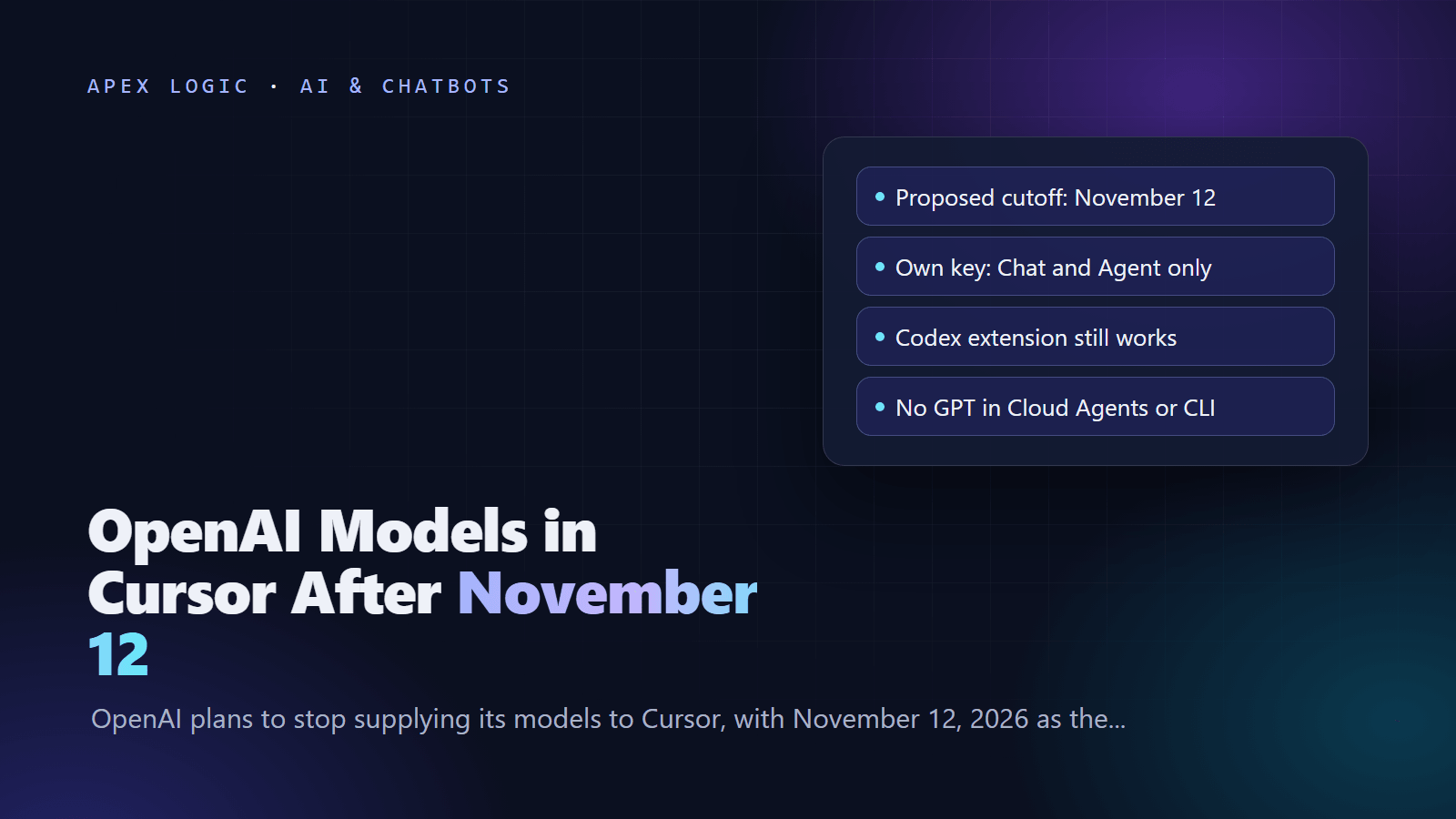
Updated 10 November 2026. OpenAI's proposed November 12 shutoff for its models in Cursor is two days away and still not confirmed as final, so this guide covers what changes and three ways to keep GPT.
OpenAI models in Cursor are scheduled to stop after November 12, 2026, the shutoff date OpenAI proposed when it said it would wind down its contract with Cursor after SpaceX acquired Cursor's parent company, Anysphere. OpenAI says Cursor may end access sooner and that it will share the official termination date once both companies confirm it. As of 10 November 2026, Cursor's models page still lists GPT-5.6 Sol, GPT-5.6 Terra and GPT-5.6 Luna.
OpenAI documents three ways to keep GPT: your own OpenAI API key for local Chat and Agent, the Codex IDE extension inside Cursor, or an AI gateway such as Azure OpenAI or Amazon Bedrock. None of them bring GPT to Auto, Cloud or Background Agents, Automations, the Cursor CLI, or the Cursor API and SDK. For those features you move to another model.
OpenAI in Cursor: quick answers
| Question | Answer, as of 10 November 2026 |
|---|---|
| Proposed shutoff | November 12, 2026, announced by OpenAI on 28 August |
| Could it come sooner? | Yes. OpenAI says Cursor may end access sooner |
| Final date confirmed? | No. OpenAI will share it once both companies confirm it |
| New OpenAI models in Cursor | None. OpenAI will not provide future models to Cursor |
| OpenAI models on Cursor's list | GPT-5.6 Sol, GPT-5.6 Terra and GPT-5.6 Luna |
| Ways to keep GPT | Your own API key, the Codex IDE extension, an AI gateway |
What happens on November 12?
On 28 August 2026, OpenAI said it had told SpaceX it intends to wind down the contract that supplies OpenAI models to Cursor, "with a proposed shutoff date of November 12, 2026." It gave the maximum notice its contract allows, said it would not supply future models to Cursor, and said it could not be confident SpaceX would use its technology within OpenAI's terms of service.
OpenAI's help article, updated in late October, says OpenAI keeps providing the models Cursor uses today until the transition ends, that Cursor may end access earlier, and that the final date will follow once both companies confirm it. So have an alternative working before November 12, not on the day. InfoWorld reported in August that analysts gave enterprises about ten weeks to prepare, and most of that time is gone.
Cursor has said little since. On 29 August a Cursor support engineer wrote in the Cursor forum that OpenAI models served about 5% of Cursor user traffic and that models from Anthropic, Google, Meta and Grok would continue through direct partnerships. On 4 November a user in that thread was still waiting for the promised update on continued access.
Which OpenAI models does the cutoff affect?
The ones Cursor supplies itself: GPT-5.6 Sol, GPT-5.6 Terra and GPT-5.6 Luna on 10 November 2026. Newer models such as GPT-6.1 Sol and GPT-6 Astra never reached Cursor's list, which fits OpenAI's statement about future models.
Which Cursor plans and features are affected?
Cursor is now sold as part of The X Subscription, and your plan decides whether you could use OpenAI models at all. Details are from Cursor's pricing and models pages as of 10 November 2026.
| Plan | Price | GPT today | After the cutoff |
|---|---|---|---|
| Free | $0 | No third-party models | No change |
| Plus | $8 a month | No: Grok and Composer only, no own API keys | No change |
| Premium, Super, Ultra | $30, $100, $200 a month | Yes, at API list price from prepaid credit | Own key, Codex extension or gateway |
| Teams and Enterprise | From $30 a seat; Enterprise custom | Yes, at API list price plus the Cursor Token Rate | Same options; the Token Rate still applies to own keys |
| Legacy Pro, Pro+, Ultra | Unchanged | Yes, from the Other Models pool | Own key, Codex extension or gateway |
OpenAI's help article also lists the Cursor features that cannot use your own key or gateway credentials, because they run on models Cursor supplies or routes:
| Cursor feature | Own key or gateway? | What to do |
|---|---|---|
| Local Chat and Agent | Yes | Add a key or gateway, or use the Codex extension |
| Tab and autocomplete | No | Nothing: Cursor says Tab uses its built-in models |
| Auto model selection | No | Pick your GPT model by hand |
| Cloud or Background Agents, Automations | No | Switch model, or run GPT tasks in Codex cloud |
| Cursor CLI | No | Switch model, or use the Codex CLI |
| Cursor API and SDK | No | Switch the model in your code |
If you built agents with Cursor's SDK, as in our Cursor Agent SDK tutorial, check every place your code names a GPT model.
How to keep GPT in Cursor: 3 ways
1. Bring your own OpenAI API key
This keeps GPT in Cursor's own Chat and Agent panels, billed to your OpenAI API account. A ChatGPT plan does not include API usage, so you need an API account with billing set up.
- Create a key on the OpenAI API keys page.
- In Cursor, open Cursor Settings, then Models.
- Find the OpenAI provider, paste the key and click Save.
- Turn on the OpenAI model you want and pick it in Chat or Agent.
- Models: Cursor describes OpenAI key support as standard, non-reasoning chat models, and OpenAI says your options depend on your API organization. Check the model picker after adding the key.
- Billing: on individual plans, including legacy Pro, Pro+ and Ultra, own-key requests skip your included usage. On Teams and Enterprise they still carry the Cursor Token Rate of $0.25 per million tokens, cached tokens included.
- Privacy: Cursor's Zero Data Retention policy does not cover own-key requests. Cursor says the key travels with each request but is not stored.
- Model names: Cursor staff explained in September that a custom model whose name contains a built-in ID such as gpt-5.6-sol gets the GPT prompt and patch-based editing tools, while other names get a generic setup. Test this again after the cutoff.
2. Use the Codex IDE extension inside Cursor
OpenAI's Codex extension runs in its own panel and does not depend on Cursor's model picker. Signed in with ChatGPT, it uses your plan's included Codex usage instead of per-token billing.
- Open the Codex IDE extension page and choose Cursor to install it.
- Open Codex from the Activity Bar, or run Codex: Open Codex Sidebar from the Command Palette.
- Choose Sign in with ChatGPT, or Use API Key for an API account.
- Open your project and start a task from the Codex panel.
It leaves Cursor's own Chat, Agent, Tab and Cloud Agents unchanged, and it offers newer models: OpenAI's Codex pricing page lists GPT-6.1 Sol and GPT-6 Luna on Plus as of 10 November 2026. Note that OpenAI says Plus, Pro and Business plans will share one allowance across ChatGPT and Codex from December.
3. Route OpenAI models through a gateway
If your company already buys OpenAI models through Azure or Amazon Bedrock, connect Cursor to that account. Cursor supports Azure OpenAI and AWS Bedrock keys, Bedrock IAM roles through its dashboard, and a custom OpenAI-compatible base URL. OpenAI says OpenRouter or Vercel AI Gateway may work, depending on the provider. Provision the model, create the credentials and deployment name, enter them in Cursor Settings, Models, then test in a local Chat or Agent session. Gateway credentials cover only local Chat and Agent, and some model-specific controls may not pass through a custom base URL.
Or switch to another model inside Cursor
For features that cannot use your key, switch models. As of 10 November 2026, Cursor's models page lists Claude Fable 5.2, Opus 5.5, Sonnet 5.5 and Haiku 5.5; Gemini 4 Argon, Gemini 3.1 Pro and Gemini 3.8 Flash; Grok 4.7, 4.6 and 4.5; Cursor's Composer 2.5; and Meta's Muse Wonder. Our Claude Fable 5.2 guide and Gemini 4 Argon guide cover two strong options.
Do not swap blindly. Rerun five recent tasks where GPT did well on two candidates, then compare diffs, test results and token cost. Our guide to AI coding assistants for teams covers that kind of trial.
Where else can you use GPT with a ChatGPT plan?
OpenAI's Sign in with ChatGPT program lets Go, Plus and Pro subscribers use their plan in partner tools. As of 10 November 2026 the list includes Amp Code, Devin, Kilo Code and Warp, plus open-source OpenCode, which our OpenCode 2.0 guide covers. Cursor is not on it, and usage there counts toward your plan's Work and Codex usage.
What does keeping GPT cost?
On individual plans, a Cursor-supplied GPT model and your own key cost about the same per token, because Cursor bills third-party models at API list price. Cursor's GPT-5.6 Sol page and OpenAI's API pricing both list $4 per million input tokens, $0.40 per million cached input tokens and $20 per million output tokens at standard speed for prompts up to 272K tokens, as of 10 November 2026. OpenAI says GPT-5.6 Sol's promotional pricing runs until 30 November 2026.
An illustrative example, with stated assumptions: one long local Agent session on GPT-5.6 Sol reads 3 million input tokens, 2.4 million of them cached, and writes 150,000 output tokens.
| Line item | Tokens | Rate per million | Cost |
|---|---|---|---|
| New input | 600,000 | $4.00 | $2.40 |
| Cached input | 2,400,000 | $0.40 | $0.96 |
| Output | 150,000 | $20.00 | $3.00 |
| OpenAI bill on your own key | 3,150,000 | $6.36 | |
| Cursor Token Rate, Teams or Enterprise only | 3,150,000 | $0.25 | $0.79 |
GPT-5.6 Sol is not exempt from the Token Rate, because its cached input price is above the $0.10 threshold. The same session on GPT-6.1 Sol through the Codex extension with an API key, at OpenAI's $2, $0.10 and $10 per million, would cost about $2.94. Measure a week of your own usage first; our LLM API cost guide shows how.
GPT not working in Cursor before November 12?
An error does not always mean the cutoff has started. In September, Cursor staff said an error about trouble reaching the model provider on GPT-5.6 Sol came from the provider's safety filter rejecting that chat, and every retry failed because the whole conversation is resent. Start a new chat, restate pasted material in your own words, and send Cursor the request ID if it still fails.
A 7-step checklist for teams
- List who uses GPT in Cursor, and in which feature.
- Export recent usage from the Cursor dashboard.
- Pick a path per workflow: own key, Codex extension, gateway or another model.
- On Teams, budget the Cursor Token Rate for own-key requests.
- If you depend on Zero Data Retention, check whether own keys fit your policy.
- Retest rules, prompts and saved agents on the replacement model.
- Check both companies' pages again on November 12.
If you are choosing models for an internal coding assistant or an AI feature in your product, our team can help you test candidates on real tasks. Browse our AI tools or contact us.
FAQ
Is OpenAI leaving Cursor on November 12, 2026?
November 12, 2026 is the shutoff date OpenAI proposed on 28 August, when it said it would wind down its contract supplying models to Cursor. As of 10 November, OpenAI's help article still calls it a proposed date and says Cursor may end access sooner. OpenAI will share the official termination date once both companies confirm it.
Can I still use GPT in Cursor after November 12?
Yes, in part. You can add your own OpenAI API key for local Chat and Agent, connect a gateway such as Azure OpenAI or Amazon Bedrock, or run OpenAI's Codex IDE extension inside Cursor. You lose GPT in the features that only use Cursor-supplied models: Auto, Cloud and Background Agents, Automations, the CLI, and the API and SDK.
Does my ChatGPT Plus subscription work in Cursor?
Not in Cursor's model picker. OpenAI says a ChatGPT subscription does not include API usage, so an own key needs a separate API account with billing. Your Plus plan does work in the Codex IDE extension, which you can install in Cursor and sign in to with ChatGPT. It then draws on your plan's included Codex usage.
Will Cursor Tab or autocomplete stop working?
Cursor's documentation says Tab completion uses Cursor's built-in models and that custom API keys only work with chat models. So Tab does not depend on the OpenAI contract, and the cutoff should not change autocomplete. What changes is the list of models you can pick for Chat, Agent and Cursor's other features.
Why can't I find GPT-6.1 Sol or GPT-6 Astra in Cursor?
OpenAI said in August that it would not provide future models to Cursor. As of 10 November 2026, Cursor's models page lists only GPT-5.6 Sol, Terra and Luna from OpenAI. To use newer OpenAI models beside your Cursor work, install the Codex IDE extension, which offers GPT-6.1 Sol on eligible ChatGPT plans or with an API key.
Is using my own OpenAI key in Cursor more expensive?
On individual plans it costs about the same per token, because Cursor already bills third-party models at API list price and own-key requests skip your included usage. On Teams and Enterprise, own-key requests add Cursor's Token Rate of $0.25 per million tokens. Long agent sessions are the real cost risk, so measure a week of usage first.
Sources
- OpenAI: Our decision on Cursor following its acquisition by SpaceX
- OpenAI Help Center: Using OpenAI models in Cursor
- Cursor Docs: Models and pricing
- Cursor Docs: GPT-5.6 Sol
- Cursor Docs: Bring your own API key
- Cursor: Pricing
- Cursor Forum: I heard OpenAI is about to cut off GPT access for Cursor
- Cursor Forum: Have they already cut Cursor from the OpenAI models?
- OpenAI: Codex IDE extension
- OpenAI: Codex pricing
- OpenAI: Sign in with ChatGPT
- OpenAI Help Center: Understanding ChatGPT and Codex usage limits
- OpenAI API: Pricing
- InfoWorld: Cursor customers will lose access to OpenAI coding models in November

Loading comments...