Updated 16 October 2026. Meta announced Muse Wonder on 12 October 2026, and this guide covers API access, prices, rate limits and a first call.
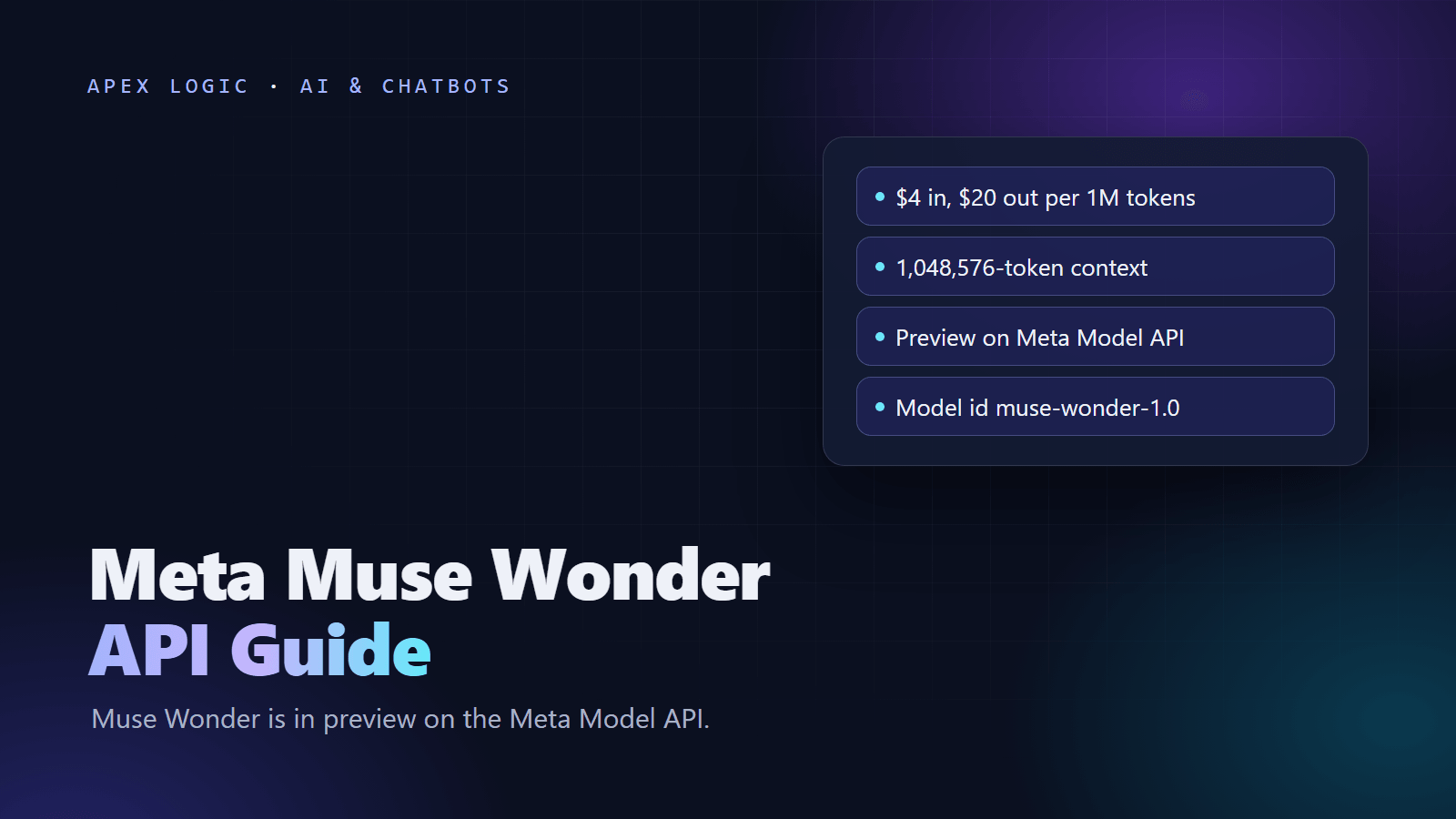
The Muse Wonder API gives developers paid access to Muse Wonder, the model Meta announced on 12 October 2026 and calls its most capable so far. The model id is muse-wonder-1.0, and it is in preview on the Meta Model API. As of 16 October 2026 it costs $4.00 per million input tokens, $0.20 per million cached input tokens and $20.00 per million output tokens, with a 1,048,576-token context window.
To start, create a key in the Model API dashboard, store it as MODEL_API_KEY and send a request to https://api.meta.ai/v1/responses. Meta's quickstart uses the OpenAI SDK with Meta's base URL, so OpenAI-style code needs few changes. If you would rather not open a Meta account, Vercel's AI Gateway offers the same model as meta/muse-wonder-1.0.
Muse Wonder at a glance
| Item | Muse Wonder |
|---|---|
| Announced | 12 October 2026 (updated 13 October), with Muse Wonder Full |
| API model id | muse-wonder-1.0 |
| Status | Preview on the Meta Model API |
| Context window | 1,048,576 tokens |
| Price per 1M tokens | $4.00 input, $0.20 cached input, $20.00 output |
| Rate limits | 3,000 requests and 4,000,000 tokens per minute, per team |
| Max output tokens | Not published by Meta |
| Where to use it | Meta Model API, Muse Code, Vercel AI Gateway |
What Muse Wonder is
Meta built Muse Wonder on Muse Spark and trained it at its Prometheus data center. It aims the model at personal and professional agent tasks, naming law, finance, health and advanced coding. Two features lead the announcement:
- Active Memory keeps relevant context across conversations.
- Active Focus keeps working toward a goal when a task gets hard, tries other approaches and checks in before important actions.
Meta's model page lists multi-file coding, long-running agents, sub-agent delegation, parallel tool calls, error recovery, computer use and active memory. Its cookbooks cover multi-agent work, computer use, a GitHub agent and search grounding.
Muse Wonder vs Muse Wonder Full
Meta announced both models together and calls them its most capable so far. The difference you can act on is access. Muse Wonder Full, model id muse-wonder-full-1.0, is not in the API. It is only in Muse Code, Meta's coding product, on the Power Usage plan at $50 a month and the Maximum Usage plan at $200 a month, as of 16 October 2026. Meta's announcement does not explain how the two differ in capability. Meta also says Muse Wonder will soon power the Muse app, first for subscribers.
Muse Wonder API pricing
Prices from Meta's model and pricing pages, as of 16 October 2026:
| Item | Price |
|---|---|
| Input | $4.00 per 1M tokens |
| Cached input | $0.20 per 1M tokens |
| Output | $20.00 per 1M tokens |
| Long-context premium | None: the same rate at any context length |
| Web search grounding | $2.50 per 1,000 search queries |
| Discounted Contributor mode | Not available for Muse Wonder |
For context, Claude Opus 5.5 also lists at $4 input and $20 output per million tokens, and GPT-6 Sol at $2 and $10. So Muse Wonder costs the same as Opus 5.5 and twice as much as GPT-6 Sol at list price. Our LLM API costs guide explains how rates like these turn into a monthly bill.
A hypothetical agent step shows why caching matters. Assume the agent reads 50,000 tokens and writes 5,000. At list price that costs $0.20 for input plus $0.10 for output, or $0.30. If 40,000 of those input tokens are cached, input drops to about $0.05 and the step costs about $0.15. Agent tasks vary a lot in length, so test with your own prompts before you set a budget.
How to get Muse Wonder API access
- Create a Meta Model API account.
- In the Model API dashboard, open API keys and choose Create API key.
- Store the key in an environment variable named
MODEL_API_KEY, for exampleexport MODEL_API_KEY="your-api-key-here"on macOS or Linux. - Install the OpenAI SDK. Meta's quickstart uses
pip install openaifor Python andnpm install openaifor TypeScript.
One catch: the OpenAI SDK does not read MODEL_API_KEY on its own. Pass the key explicitly, as in the example below, or set it as OPENAI_API_KEY. Meta's overview sends questions about accounts, API keys, billing and rate limits to its Help Center, and the pages we read do not list supported regions.
Your first Muse Wonder API call
With curl
This follows the sample on Meta's overview page, which sets reasoning effort to high:
curl -X POST "https://api.meta.ai/v1/responses"   -H "Authorization: Bearer $MODEL_API_KEY"   -H "Content-Type: application/json"   -d '{
    "model": "muse-wonder-1.0",
    "reasoning": { "effort": "high" },
    "input": "List the steps to move our support FAQ into a help center, in order."
  }'
With Python
Meta's quickstart shows this pattern with muse-spark-1.3. Here it is with muse-wonder-1.0 and the reasoning setting from the curl sample:
import os
from openai import OpenAI

client = OpenAI(
    base_url="https://api.meta.ai/v1",
    api_key=os.environ["MODEL_API_KEY"],
)

response = client.responses.create(
    model="muse-wonder-1.0",
    reasoning={"effort": "high"},
    input="List the steps to move our support FAQ into a help center, in order.",
)

print(response.model_dump_json(indent=2))
The quickstart prints the whole JSON response, and the pages we read do not document the response fields. Inspect the output once before you write code that parses it.
Through Vercel AI Gateway
Vercel added meta/muse-wonder-1.0 to its AI Gateway on launch day. You use one AI_GATEWAY_API_KEY and no Meta account. Vercel lists text, image and PDF input, tool calling and structured output. Its Python sample uses Chat Completions with streaming:
import os
from openai import OpenAI

client = OpenAI(
    api_key=os.environ["AI_GATEWAY_API_KEY"],
    base_url="https://ai-gateway.vercel.sh/v1",
)

stream = client.chat.completions.create(
    model="meta/muse-wonder-1.0",
    messages=[{"role": "user", "content": "Draft a rollout plan for a new customer portal."}],
    stream=True,
)

for chunk in stream:
    if chunk.choices:
        print(chunk.choices[0].delta.content or "", end="", flush=True)
Vercel's changelog does not list a price for the gateway, so check its model page before you budget.
Muse Wonder API limits: known and unknown
What Meta's pages state, as of 16 October 2026:
- Context window: 1,048,576 tokens.
- Rate limits: 3,000 requests per minute and 4,000,000 tokens per minute. Limits apply per team, not per API key, so extra keys do not add capacity.
- Status: preview, so behavior, limits and prices can change.
- Wonder Full: not available in the API.
What we could not confirm:
- Max output tokens. Meta does not publish a figure. Third-party listings disagree, with about 944K tokens in one and 131K in another.
- Regions. Not listed on the pages we read.
- Higher limits. Meta's pricing page does not describe tiers or how to raise limits.
- Safety report. Meta says Muse Wonder has its strongest safeguards so far against chemical, biological, radiological, nuclear and cyber misuse, while keeping defensive cyber work possible. The full safety report is not out yet.
Muse Wonder benchmarks: who says what
Meta shows its results only in charts and a model card, and its text gives no exact numbers that we could read. Treat every comparison as a claim until independent tests appear.
TechCrunch reported that the model card puts Muse Wonder and Wonder Full level with Claude Fable 5.1 and GPT-6 Astra, and puts Muse Wonder ahead of Fable, Opus and Astra on MemoryBench. TechCrunch also called it Meta's first frontier model. We have no independent scores to add. The fair test is your own task: run the same prompts on Muse Wonder, Claude Opus 5.5 and GPT-6, then compare quality, speed and cost. Our Gemini 4 Argon vs GPT-6 vs Claude comparison shows how we structure that kind of test.
Business use cases for the Muse Wonder API
Muse Wonder's price puts it in the premium tier, so use it where its agent skills and memory pay for themselves. These examples are hypothetical, each with its assumptions stated:
- Contract and lease review. Meta names law as a target domain. An assistant could flag unusual clauses for a lawyer, assuming a person signs off on every decision. See our AI contract review assistant.
- Finance analysis. An agent that works through exported reports and answers questions, assuming read-only access to the data. See our AI data analyst.
- Coding agents. Multi-file changes and GitHub work based on Meta's cookbook patterns, with every pull request reviewed by a developer.
- Long-running back-office agents. Tasks that span days, where Active Memory carries context and Active Focus checks in before important actions. Our guides on AI agents for business and how to build an AI agent cover approval steps.
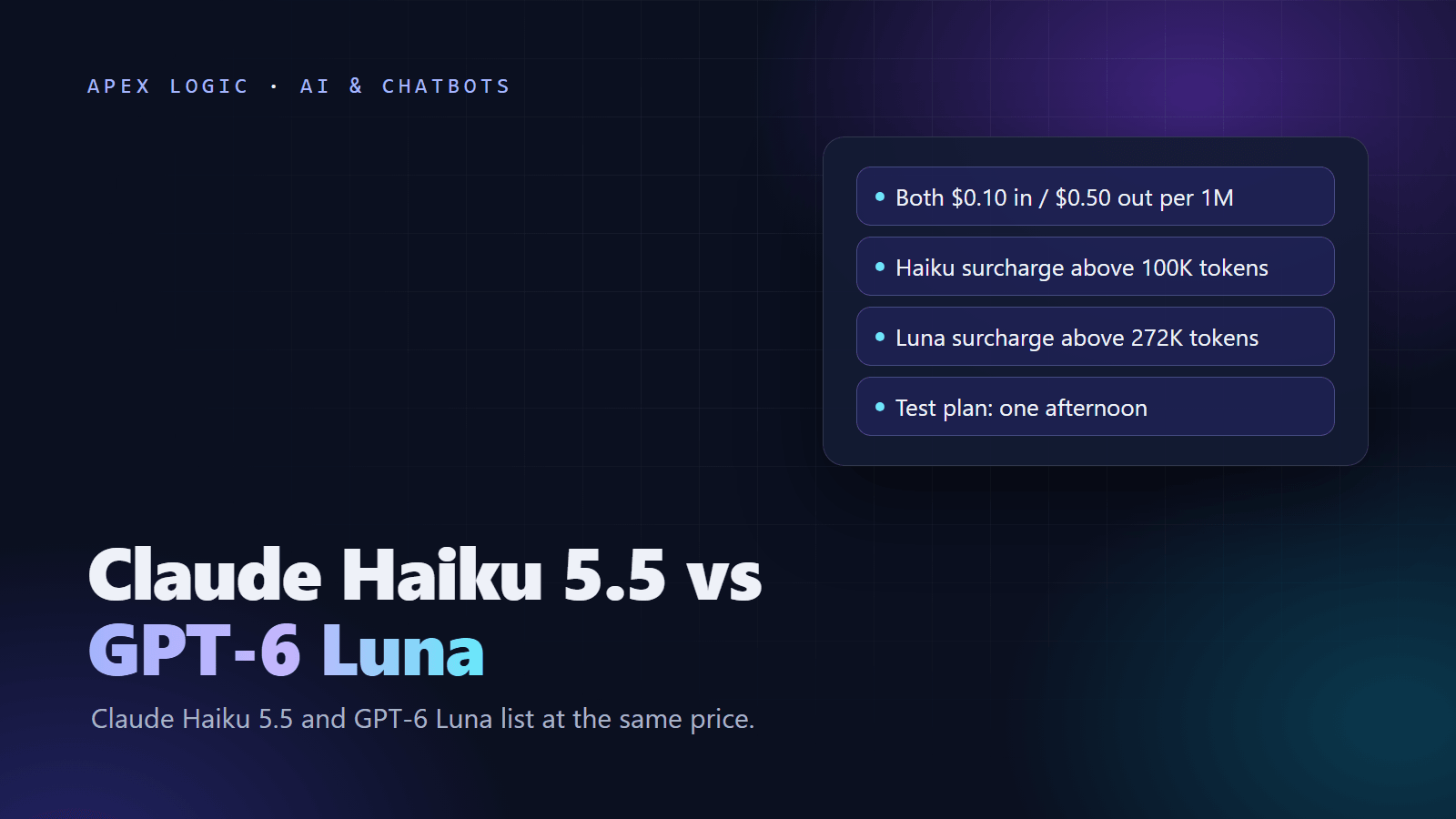
For high-volume chat, a cheaper model is usually the better fit; see Claude Haiku 5.5 vs GPT-6 Luna. If you need weights you can run yourself, Meta's open model is covered in our Muse Spark Open guide.
If you want to test Muse Wonder against Claude Opus 5.5 or GPT-6 on one of your real tasks, we can run that comparison and then build the agent, with memory and approval steps, on a fixed quote. Tell us about the task.
Muse Wonder API FAQ
How much does the Muse Wonder API cost?
As of 16 October 2026, Meta charges $4.00 per million input tokens, $0.20 per million cached input tokens and $20.00 per million output tokens for muse-wonder-1.0. There is no long-context premium, so the rate stays the same at any context length. Web search grounding costs $2.50 per 1,000 queries. That matches the list price of Claude Opus 5.5 and is twice that of GPT-6 Sol.
How do I get a Muse Wonder API key?
Create a Meta Model API account, then open API keys in the Model API dashboard and choose Create API key. Store it as MODEL_API_KEY and pass it to the OpenAI SDK with the base URL https://api.meta.ai/v1, because the SDK does not read that variable on its own. For account, billing and rate-limit questions, Meta points developers to its Help Center.
Is Muse Wonder Full available in the API?
No. As of 16 October 2026, Muse Wonder Full, model id muse-wonder-full-1.0, is only available through Muse Code subscriptions: the Power Usage plan at $50 a month or the Maximum Usage plan at $200 a month. The Meta Model API offers muse-wonder-1.0 instead. Meta's announcement calls both its most capable models so far but does not explain how they differ in capability.
What is the Muse Wonder context window?
Muse Wonder has a 1,048,576-token context window, and Meta charges the same rate whether that window is nearly empty or almost full. Meta does not publish a maximum output length. Third-party listings disagree, with figures of about 944K and about 131K tokens, so test long outputs yourself before you design around a limit.
Can I use the OpenAI SDK with Muse Wonder?
Yes. Meta's quickstart installs the official OpenAI SDK for Python or TypeScript, sets the base URL to https://api.meta.ai/v1 and calls the Responses API. Pass your MODEL_API_KEY explicitly. Vercel's AI Gateway also accepts OpenAI-style Chat Completions calls for meta/muse-wonder-1.0 at https://ai-gateway.vercel.sh/v1, with an AI Gateway key instead of a Meta account.
Is Muse Wonder open source?
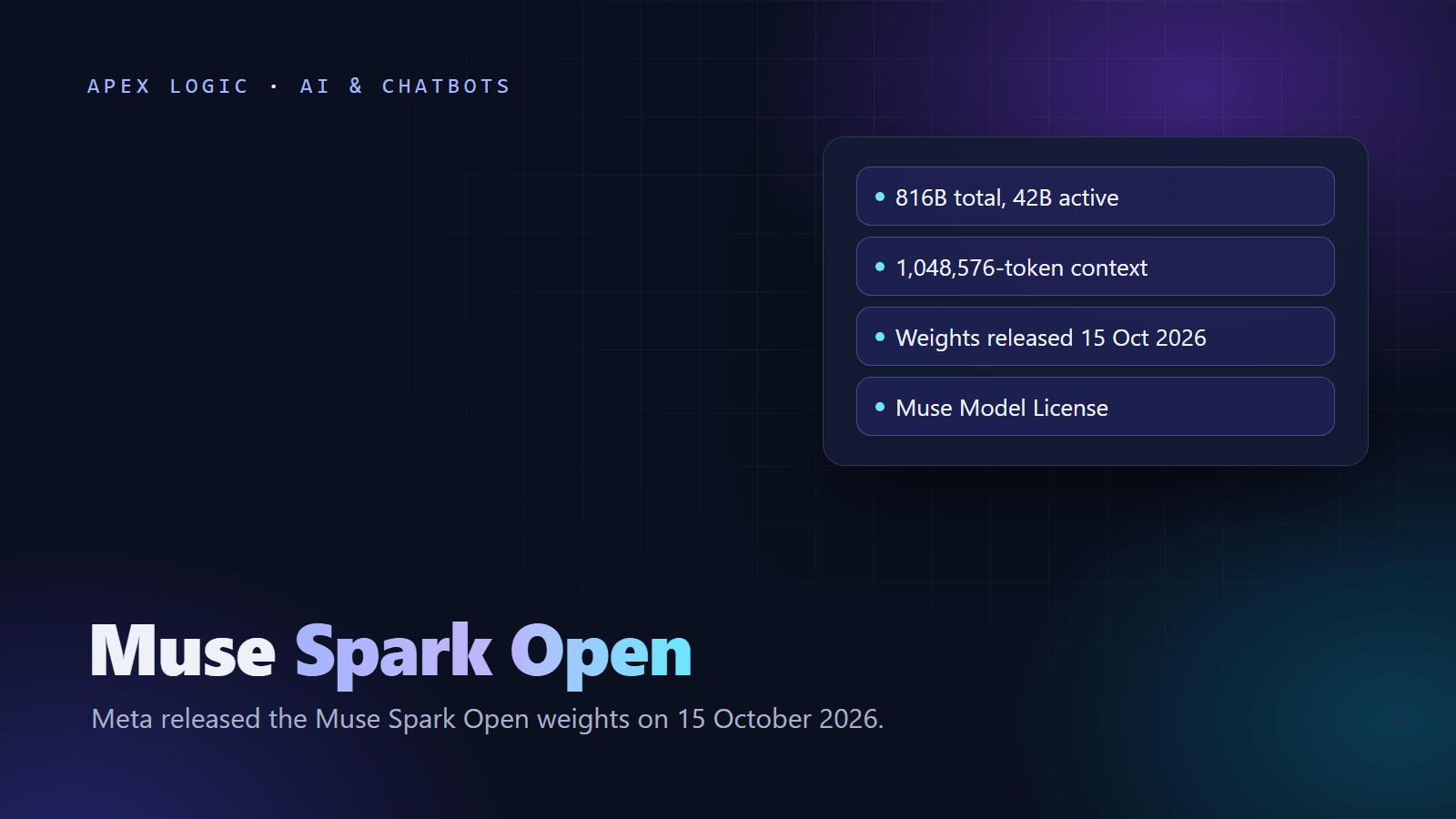
No Muse Wonder weights appear on the pages we read. Meta offers the model through the Meta Model API and Muse Code, and partners such as Vercel's AI Gateway also offer access. Meta's open-weight model is Muse Spark Open, released on 15 October 2026 under the Muse Model License, which you can download from Hugging Face and run on your own hardware or through hosted providers.
Sources
- Meta: Introducing the Muse Wonder models
- Meta AI research blog: Muse Wonder
- Meta Model API: Muse Wonder model page
- Meta Model API: overview
- Meta Model API: quickstart
- Meta Model API: pricing and rate limits
- Vercel changelog: Muse Wonder on AI Gateway
- Anthropic: Claude API pricing
- OpenAI API changelog
Loading comments...