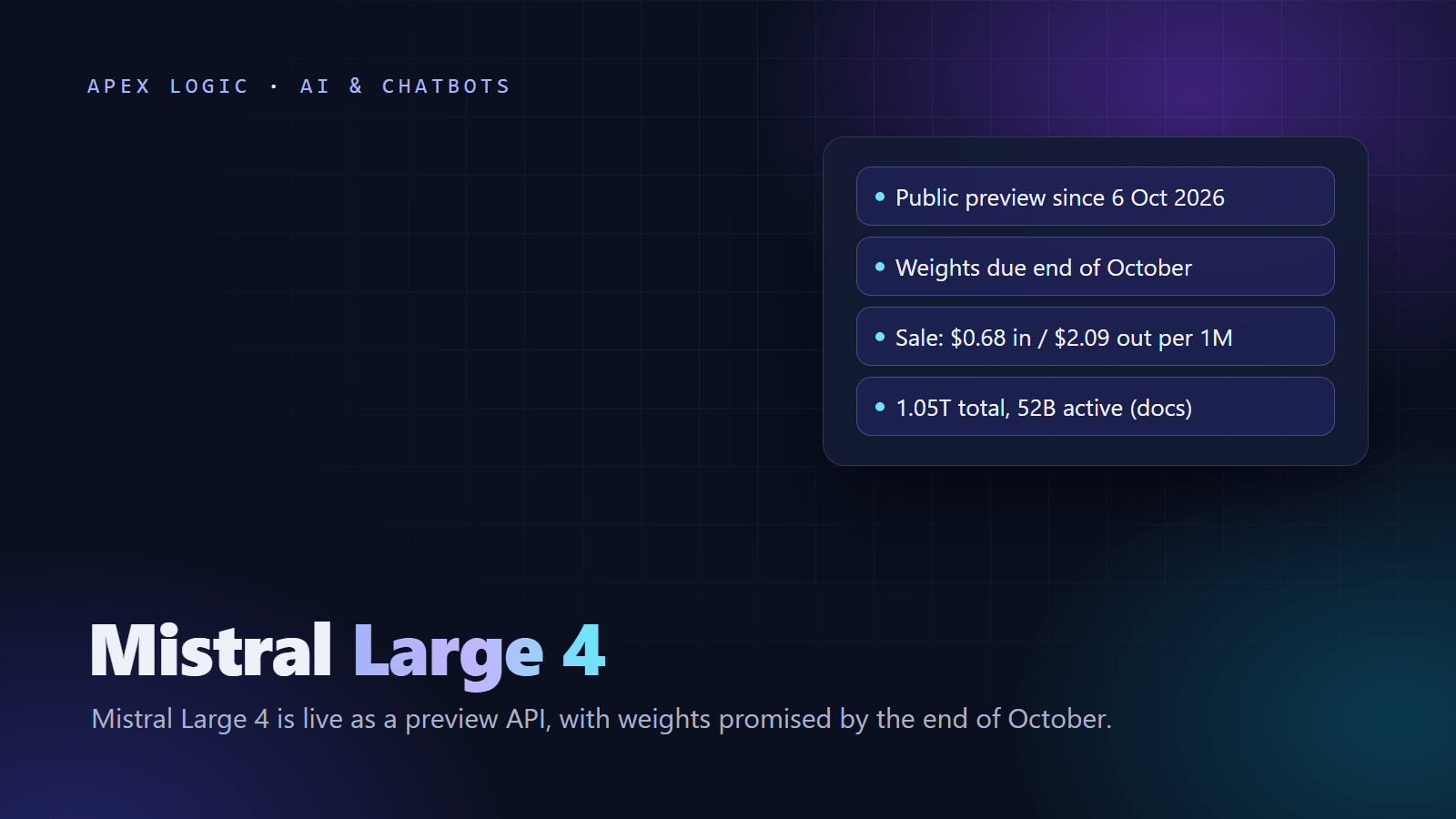
Updated 16 October 2026. Mistral Large 4 is in public preview on Mistral's API, and Mistral says the weights will follow by the end of October.
Mistral Large 4 is the newest model in Mistral's Large line, and you can call it today through Mistral's API, but you cannot download it yet. Mistral released it on 6 October 2026 as a public preview, nicknamed le Chonk (ML4 for short). It is a mixture-of-experts model with about 1 trillion parameters that reads text and images, writes text and can reason before it answers. In code, the model name is mistral-large-4.
As of 16 October 2026, Mistral's model page lists sale prices of $0.68 per 1M input tokens and $2.09 per 1M output tokens, half the regular $1.36 and $4.18, with no end date. Mistral says the weights will be released by the end of October. VentureBeat reported a date of 27 October and a custom Mistral license; Mistral has confirmed neither. Below: what is confirmed, where sources disagree, how to call the API and how to prepare to self-host.
Mistral Large 4 at a glance
These are Mistral's own figures from its Large 4 model page and launch post, checked on 16 October 2026.
| Item | Mistral Large 4 |
|---|---|
| Status | Public preview since 6 October 2026 |
| API names | mistral-large-4 and mistral-large-4-0, version 26.10 |
| Architecture | Mixture of experts: 1.05T total parameters, 52B active, plus a 1.6B vision encoder (the launch post rounds the total to 1T) |
| Context window | 1M tokens |
| Input and output | Text and images in; text out, with reasoning |
| Languages | More than 160, including every official EU language |
| Features | Structured outputs, function calling, document Q&A, prefix, chat completions, batching, agents and conversations, built-in tools |
| Where it runs | Preview API in Mistral Studio, served on a European deployment that Mistral operates end to end |
| Weights | Listed as coming soon on the model page; end of October in the launch post |
Mistral also gives vetted cybersecurity partners and state authorities preview access with reduced moderation and extra cyber capability. That access is limited to those vetted groups.
Where the sources disagree
Several outlets covered the launch, and some of their numbers differ from Mistral's. Here is each conflict with its source. We use Mistral's figure where it publishes one, but we show the others.
| Question | Mistral | Other reports |
|---|---|---|
| Active parameters | 52B (docs and launch post) | 49B (Artificial Analysis, VentureBeat) |
| Context window | 1M tokens (docs) | 512K tokens (Artificial Analysis) |
| Training GPUs | 3,800 NVIDIA Grace Blackwell (launch post) | About 4,000 (TechCrunch, VentureBeat) |
| Weights date | By the end of October | 27 October, after about three weeks of testing with developers, security teams and governments (VentureBeat) |
| License | Not published | A custom Mistral license (VentureBeat); terms not public |
| End of the launch sale | Not stated | The first two weeks after launch (Artificial Analysis) |
In practice: if a feature needs more than 512K tokens in one prompt, confirm it works on your account before you build around 1M. Budget at regular prices. And do not commit to a self-hosting date or license until Mistral publishes them.
Mistral Large 4 pricing and the launch discount
Prices per 1M tokens in US dollars, from Mistral's Large 4 model page as of 16 October 2026:
| Token type | Sale price | Regular price |
|---|---|---|
| Input | $0.68 | $1.36 |
| Cached input | $0.07 | $0.14 |
| Output | $2.09 | $4.18 |
The sale prices are exactly half the regular ones. Mistral's model page gives no end date, and the launch post shows only the regular $1.36 and $4.18. Artificial Analysis says the 50% discount covers the first two weeks after launch, which would end it around 20 October 2026. Mistral has not confirmed that, so treat the sale as a bonus, not a budget.
One trap: as of 16 October 2026, the FAQ on Mistral's general pricing page still lists "Mistral Large" at $0.50 input and $1.50 output per 1M tokens. That entry is the older Mistral Large, not Large 4.
What a month of use costs
A hypothetical example at prices as of 16 October 2026: a support assistant handles 1,000 requests a day for 30 days, each with 3,000 input tokens and 500 output tokens. That is 90M input and 15M output tokens a month.
- Regular prices: 90 x $1.36 = $122.40 plus 15 x $4.18 = $62.70, so $185.10 a month.
- Sale prices: 90 x $0.68 = $61.20 plus 15 x $2.09 = $31.35, so $92.55 a month.
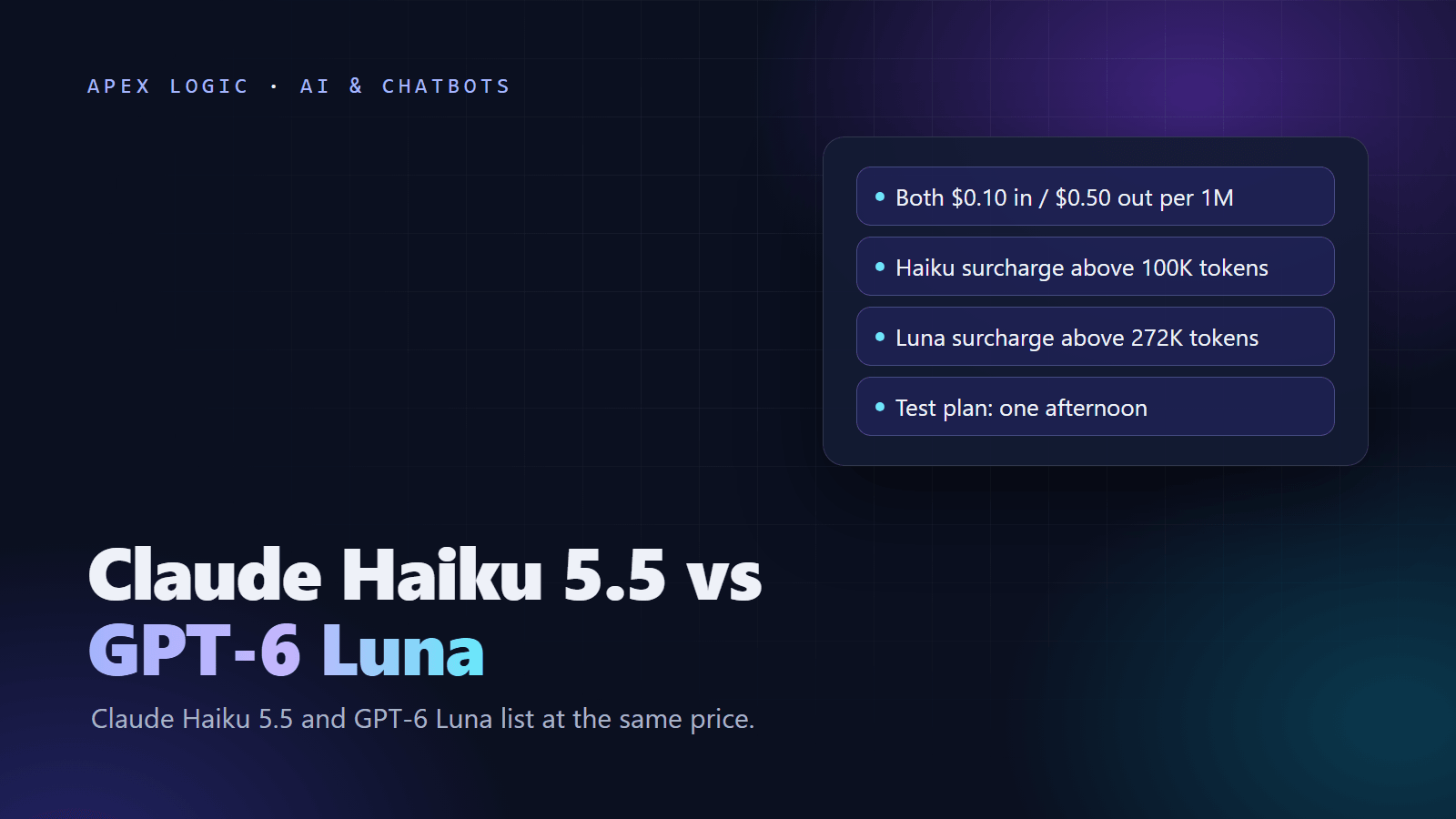
- A low-cost model: at the $0.10 input and $0.50 output list price of Claude Haiku 5.5 or GPT-6 Luna, 90 x $0.10 = $9.00 plus 15 x $0.50 = $7.50, so $16.50.
Cached input costs about a tenth of the normal input rate, so caching a long system prompt cuts the input side further. Our LLM API costs guide covers more ways to trim the bill.
Benchmarks: Mistral's numbers and one independent index
Mistral published these results. They are Mistral-reported, and Mistral says more benchmarks will come with the weights.
| Test (Mistral-reported) | Mistral Large 4 |
|---|---|
| DeepSWE 1.1 | 61.7% |
| SWE-Atlas-QnA | 59.4% |
| Terminal-Bench 4.0 | 28.3% |
| AutomationBench | 59.9% |
| Blind human coding evaluation | 3.74 out of 5, second of five models, behind Claude Opus 5 at 4.22 |
Artificial Analysis gave Large 4 a score of 38 on its Intelligence Index, level with GPT-6 Luna at maximum effort (38) and close to DeepSeek V4.1 Flash at maximum effort (39). Luna lists at a fraction of Large 4's price, so test both on your own tasks before you pay more. Our Claude Haiku 5.5 vs GPT-6 Luna comparison covers that price tier. Mistral also says it is still refining and red-teaming the model, so expect its behavior to change during the preview.
How to call Mistral Large 4 today
- Create an account in Mistral Studio at console.mistral.ai.
- Create an API key under API keys and store it in the
MISTRAL_API_KEYenvironment variable. - Send a chat request with the model name
mistral-large-4.
The quickest test is a direct call to the chat completions endpoint:
curl https://api.mistral.ai/v1/chat/completions \
  -H "Content-Type: application/json" \
  -H "Authorization: Bearer $MISTRAL_API_KEY" \
  -d '{
    "model": "mistral-large-4",
    "messages": [
      {"role": "user", "content": "Write a two-sentence reply to a customer whose package is late."}
    ]
  }'
In Python, use Mistral's official SDK. Its current quickstart imports the client from mistralai.client, so check the import line if you copy older examples.
# pip install mistralai
import os
from mistralai.client import Mistral

client = Mistral(api_key=os.environ["MISTRAL_API_KEY"])

response = client.chat.complete(
    model="mistral-large-4",
    messages=[
        {"role": "system", "content": "You are a polite support assistant. Reply in the customer's language."},
        {"role": "user", "content": "Bonjour, puis-je retourner un article après 30 jours ?"},
    ],
)

print(response.choices[0].message.content)
While it is a preview, keep a set of real prompts with known good answers so you can re-check them after updates, and log which of the two API names each request used. Mistral says the preview runs on a European deployment it operates independently of other digital service providers; still review Mistral's data processing terms against your own GDPR duties.
How to prepare to self-host when the weights land
Mistral says Large 4 will be able to run on private cloud or on-premise, and that it will share architecture details with the weights. As of 16 October 2026, three things you need for planning are not public: hardware requirements, license terms and an exact release date. For another large open-weight model, see our Muse Spark Open guide.
A rough memory floor
A mixture-of-experts model uses only part of its parameters for each token, but the server still has to hold all of them. Simple arithmetic on the 1.05T total in Mistral's docs gives the size of the weights alone: about 2.1 TB at 16-bit precision (2 bytes per parameter), about 1.05 TB at 8-bit and about 525 GB at 4-bit.
This is our arithmetic, not a Mistral figure. Mistral has not said which precision it will publish, and a real deployment needs more memory for the KV cache (each conversation's working memory), activations and the serving software. Plan for a multi-GPU server or a hosted provider, not a desktop machine, and wait for Mistral's own requirements before you buy or rent.
A checklist for the next few weeks
- Decide if you need self-hosting at all. Typical reasons are data that cannot leave your servers, fixed monthly costs, or full control over the model version. If Mistral's European API deployment meets your data rules, the API may be enough. Our guide to open-weight LLMs vs API models covers the trade-offs.
- Read the license first. Once it is out, check commercial use, usage limits, attribution and redistribution with your lawyer.
- Model the cost both ways. Log your token use during the preview, then compare a month of API spend with servers, power, monitoring and staff time.
- Build portable code now. Put every model call behind one function and keep the endpoint, model name and key in configuration, so a move to your own server is a configuration change plus a test run.
- Re-run your test set. A compressed (quantized) build may not answer exactly like the API, so compare before you switch traffic.
- Plan the data protection review. Write down where prompts, logs and retrieved documents live, who can see them and how long you keep them.
Which business tools Mistral Large 4 suits
Based on its published features, these are the tools we would test it on first. In each case, compare it with a cheaper model on your own data before you commit.
- Multilingual customer support. Mistral says it is fluent in more than 160 languages, including every official EU language. That fits an AI customer support chatbot for European customers.
- Answers from company documents. Document Q&A and a long context window suit an AI knowledge base assistant. For large document sets, retrieving only the relevant passages is usually cheaper and easier to audit than one giant prompt; see our production RAG architecture guide.
- Invoice and form extraction. Image input plus structured outputs fit invoice and document data extraction, with validation rules and a human check. Artificial Analysis says the API accepts up to 100 images per request.
- Workflow agents. Function calling and the agents and conversations endpoints suit multi-step automations, and Mistral reports 59.9% on AutomationBench. Our guide on how to build an AI agent covers the design.
It fits less well today for simple, high-volume tasks where a $0.10 / $0.50 model passes your tests, and for production systems that cannot accept model changes while Large 4 is still a preview.
If you want a European-made model in a customer-facing tool, we can build on Mistral's API now and plan a private or EU-hosted deployment for when the weights and license are published. Tell us what you are building.
Mistral Large 4 FAQ
When will Mistral Large 4 weights be released?
Mistral's launch post says the weights will be released by the end of October 2026, and its model page lists them as coming soon. VentureBeat reported a planned date of 27 October, after about three weeks of testing with developers, security teams and governments, but Mistral has not confirmed that date. As of 16 October 2026 there is no official download, and the launch post does not say where the weights will be hosted.
How much does Mistral Large 4 cost?
As of 16 October 2026, Mistral's model page lists sale prices of $0.68 per 1M input tokens, $0.07 per 1M cached input tokens and $2.09 per 1M output tokens. The regular prices are $1.36, $0.14 and $4.18. Mistral gives no end date for the sale. Artificial Analysis says the discount covers the first two weeks after the 6 October launch, so plan your budget at the regular prices.
What is the Mistral Large 4 context window?
Mistral's documentation lists a context window of 1M tokens, while Artificial Analysis reported 512K tokens. Treat 1M as the official figure, but test your longest real inputs on your own account before you build a feature that needs more than 512K tokens. For most business tools, sending only the relevant passages keeps prompts far shorter than either limit, which also keeps costs down.
How many parameters does Mistral Large 4 have?
Mistral's documentation lists 1.05 trillion total parameters, 52 billion of them active for each token, plus a separate 1.6 billion parameter vision encoder. The launch post rounds this to 1 trillion total and 52 billion active. Artificial Analysis and VentureBeat reported 49 billion active parameters instead. Mistral says it will share more architecture details when it releases the weights.
What license will Mistral Large 4 use?
Mistral has not published the license yet. VentureBeat reported that the weights will come under a custom Mistral license, but the terms are not public, so do not assume every commercial use will be allowed. When the weights arrive, read the license for commercial use, limits, attribution and redistribution, ideally with your lawyer, before you plan a self-hosted product.
What hardware do I need to run Mistral Large 4?
Mistral has not published hardware requirements. It says the model will be able to run on private cloud or on-premise. Our own arithmetic on the 1.05 trillion total parameters puts the weights alone at about 2.1 TB at 16-bit precision and about 525 GB at 4-bit, before working memory. Expect a multi-GPU server or a hosted provider, and wait for Mistral's figures before you buy.
Loading comments...