Updated 16 October 2026. Anthropic released Claude Haiku 5.5 on 7 October at the same list price as OpenAI's GPT-6 Luna; all prices below were checked on 16 October 2026.
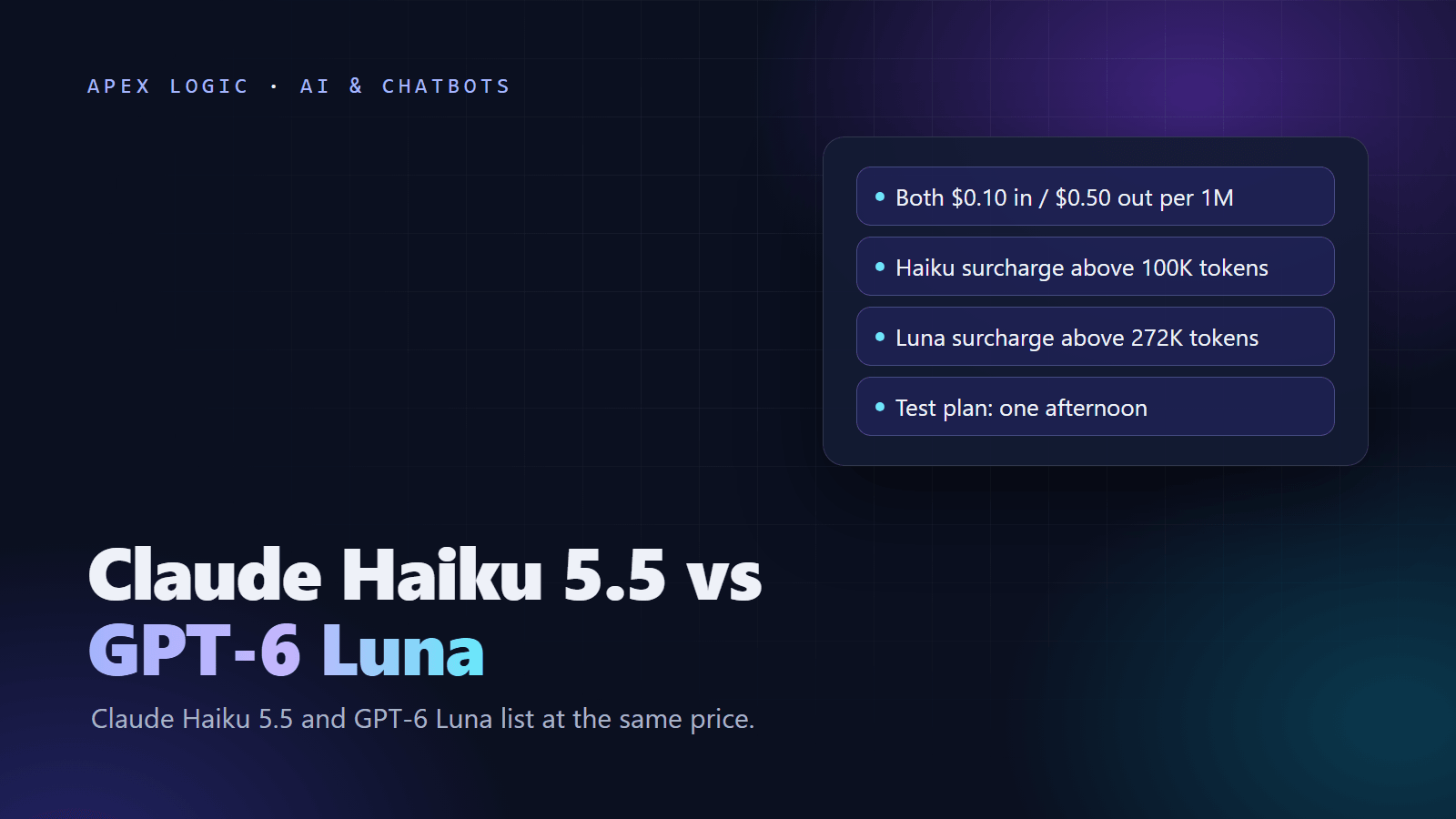
For most customer support chatbots, Claude Haiku 5.5 and GPT-6 Luna cost the same, so choose on answer quality, platform and data rules, not price. As of 16 October 2026, both list at $0.10 per 1M input tokens and $0.50 per 1M output tokens, and both charge $0.01 per 1M cached input tokens. A bot that sends a few thousand tokens per message pays the same list-price bill on either model, for the same token counts.
The bills split on long prompts. Once a prompt passes 100,000 tokens, Haiku 5.5 charges $0.50 input and $2.50 output for the whole request, while Luna keeps standard rates up to 272K input tokens. Anthropic's published benchmark comparison is vendor-run and neither company publishes speed figures, so test both on your own conversations. A plan you can run in one afternoon is below.
Claude Haiku 5.5 vs GPT-6 Luna at a glance
Prices are per 1M tokens in US dollars, as of 16 October 2026, from Anthropic's pricing page and OpenAI's GPT-6 Luna page.
| Item | Claude Haiku 5.5 | GPT-6 Luna |
|---|---|---|
| Released | 7 October 2026 | 22 September 2026 |
| API model id | claude-haiku-5-5 | gpt-6-luna |
| Input / output | $0.10 / $0.50 for prompts up to 100K tokens | $0.10 / $0.50 up to 272K input tokens |
| Cached input | $0.01 per cache hit | $0.01 |
| Cache writes | $0.125 (5-minute) or $0.20 (1-hour) | $0.125 |
| Long prompts | Over 100K tokens: $0.50 / $2.50, whole request | Over 272K input tokens: 2x input and cache rates, 1.5x output ($0.20 / $0.75), whole request |
| Batch | $0.05 / $0.25 (over 100K: $0.25 / $1.25) | 50% off; Flex also 50% off |
| Other price options | US-only inference: 1.1x | Regional processing: +10%; Fast mode: 2x |
| Context window | 1M tokens | 1,050,000 tokens (max input 922,000) |
| Max output | 128K tokens | 128,000 tokens |
| Input types | Text and images | Text and images |
| Reasoning | Adaptive thinking, default effort medium | Effort from none to max, default medium |
| Knowledge cutoff | June 2026 | 18 May 2026 |
| Where to use it | Claude API, Amazon Bedrock, Google Cloud, Microsoft Foundry, Claude Platform on AWS | OpenAI API: Chat Completions, Responses and Batch |
| Data location | US-only inference option on the Claude API | EU data residency available |
| Limits to know | Anthropic suggests Sonnet 5.5 or Opus 5.5 for complex agentic coding | Not on the Live or Realtime APIs; no fine-tuning |
What the table does not show: the same text can count as a different number of tokens on each model, and Anthropic says Haiku 5.5's updated tokenizer uses slightly more tokens per task than before. Retries add tokens too. Anthropic also notes that Bedrock and Google Cloud set their own regional pricing, so check there if you buy through them.
Long prompts: where the bills split
As of 16 October 2026, both providers charge more for very long prompts, and the higher rate applies to the whole request, not just the tokens over the line.
- Haiku 5.5: once a prompt is over 100,000 tokens, input goes from $0.10 to $0.50, output from $0.50 to $2.50 and cache hits from $0.01 to $0.05. Anthropic counts every input token toward that line, including cache reads and writes, so caching a long document does not keep you under it.
- GPT-6 Luna: standard rates hold up to 272K input tokens. Above that, input and cache rates double and output rises 1.5x, to $0.20 input and $0.75 output.
Example: a bot pastes a whole 150,000-token product manual into every message, 10,000 times a month, with 300-token replies. That is 1,500M input and 3M output tokens. On Haiku 5.5: 1,500 x $0.50 = $750.00 plus 3 x $2.50 = $7.50, so $757.50 a month. On Luna: 1,500 x $0.10 = $150.00 plus 3 x $0.50 = $1.50, so $151.50.
The better fix is retrieval, not a model switch: send only the passages that answer the question. A prompt of a few thousand tokens costs the same on both models and is easier to check. Our production RAG architecture guide shows how.
Monthly cost examples for a support chatbot
These are hypothetical examples at list prices as of 16 October 2026. They assume both models use the same number of tokens, which real tokenizers will not, so swap in numbers from your own test.
Assumptions for scenarios A to C: 10,000 conversations a month with 4 customer messages each, so 40,000 model calls. Each call sends 4,000 input tokens: a 2,000-token system prompt (instructions, tone and policies) plus 2,000 tokens of retrieved help articles, chat history and the new message. Each reply is 250 output tokens. That makes 160M input and 10M output tokens a month.
| Scenario | Arithmetic | Claude Haiku 5.5 | GPT-6 Luna |
|---|---|---|---|
| A. Standard rates, no caching | 160 x $0.10 + 10 x $0.50 | $21.00 | $21.00 |
| B. System prompt cached | See below | $14.72 | $14.72 |
| C. Scenario A with US-only inference (Haiku) or regional processing (Luna) | $21.00 x 1.1 | $23.10 | $23.10 |
| D. 40,000 ticket summaries on Batch | 60 x $0.05 + 8 x $0.25 | $5.00 | $5.00 |
Scenario B. We assume the system prompt is read from cache on 90% of calls and written on the other 10%, at Haiku's 5-minute write rate. Cache reads: 36,000 x 2,000 = 72M tokens x $0.01 = $0.72. Cache writes: 4,000 x 2,000 = 8M tokens x $0.125 = $1.00. Uncached input: 80M tokens x $0.10 = $8.00. Output: $5.00. Total: $14.72, about 30% less than A. Your real hit rate depends on traffic and on how each provider's cache works.
Scenario D. 40,000 tickets with 1,500 input and 200 output tokens each make 60M input and 8M output tokens: $10.00 at standard rates, $5.00 on Batch. That suits work that can wait, such as overnight summaries.
Luna's Fast mode doubles the rate, so scenario A would cost $42.00 there. At these volumes the model bill is small next to building and running the bot; our guide to how much an AI chatbot costs covers the full budget, and the LLM API costs guide has more ways to cut token spend.
Quality: what the benchmarks do and do not tell you
These scores are vendor-reported: Anthropic published them on its Haiku 5.5 launch page and chose which tests to show. None of them tests customer support conversations.
| Benchmark (Anthropic-reported) | Claude Haiku 5.5 | GPT-6 Luna |
|---|---|---|
| GDPval-AA v2.1 | 1,620 | 1,437 |
| AA-Briefcase v1.1 | 1,578 | 1,336 |
| OSWorld 2.1 (offline subset) | 72.4% | 48.9% |
| Terminal-Bench 4.0 | 39.2% | 16.4% |
| FrontierCode 1.1 | 46.4% | 42.4% |
- Haiku leads every row shown. The FrontierCode gap is 4 points; the OSWorld and Terminal-Bench gaps are over 20. Anthropic's table has no Luna score for Humanity's Last Exam.
- Settings matter. VentureBeat noted that Haiku's Terminal-Bench score was measured at maximum effort and is about 20% at medium effort. A support bot will often run below maximum, so expect different results.
Speed and limits
- No published speed numbers. Neither company publishes tokens-per-second figures. Anthropic lists Haiku 5.5 as its fastest current model and says latency depends on prompt length, output length and thinking effort. OpenAI calls Luna its most efficient model for focused, high-volume tasks. Neither claim compares the two, so time both.
- Rate limits. OpenAI's default limits for Luna are 5,000 requests and 2M tokens per minute on Build, 10,000 and 10M on Launch, and 30,000 and 180M on Grow. Check your Anthropic account's limits before launch.
- Tools on Luna. On Chat Completions, Luna supports function calling only with reasoning effort set to none. The Responses API offers tools including web search, file search, code interpreter, computer use and MCP.
Which one should you pick?
If your tests show no clear quality gap, pick on fit:
- Your cloud. Haiku 5.5 runs on Amazon Bedrock, Google Cloud and Microsoft Foundry as well as Anthropic's own API.
- EU data residency on OpenAI. Luna supports it. For Haiku, check the regions your cloud platform offers.
- Prompts over 100K tokens. Luna is cheaper, but retrieval that keeps prompts short is cheaper still.
- Voice. Luna is not on OpenAI's Live or Realtime APIs, so voice agents there need another model.
- OpenAI's Decisions API. Luna is the only model behind it; see our Decisions API tutorial.
- Harder tasks. If neither passes, step up a tier; our Gemini 4 vs GPT-6 vs Claude comparison covers the larger models.
Test both on your own data in one afternoon
- Collect 50 to 100 real questions (about an hour). Pull them from chat logs or tickets and remove personal details. Include hard ones: refunds, angry customers, questions your help content does not cover, and other languages you serve.
- Write down what a good answer must contain (30 minutes). Note the key facts, the correct policy and when the bot should hand over to a person.
- Use one prompt for both (30 minutes). Same system prompt, same help content, same questions, and keep every prompt well under 100K tokens.
- Run the script below (15 to 30 minutes). It saves each answer with token counts and response time.
- Grade blind (about 90 minutes). Hide the model column, shuffle the rows, and have someone from support score each answer from 1 to 5 for accuracy, tone and policy. Count made-up facts and missed handovers as failures.
- Decide (30 minutes). Work out cost per conversation from the real token counts. If quality ties, take the cheaper or better-fitting platform. If one fails more hard cases, that outweighs a few cents.
Put your questions in questions.csv with one column named question, and your system prompt and help content in support_prompt.txt:
# pip install anthropic openai
# Needs ANTHROPIC_API_KEY and OPENAI_API_KEY in your environment.
import csv
import time

import anthropic
from openai import OpenAI

claude = anthropic.Anthropic()
openai_client = OpenAI()

with open("support_prompt.txt", encoding="utf-8") as f:
    SYSTEM = f.read()


def ask_haiku(question):
    msg = claude.messages.create(
        model="claude-haiku-5-5",
        max_tokens=4000,
        system=SYSTEM,
        messages=[{"role": "user", "content": question}],
    )
    text = "".join(b.text for b in msg.content if b.type == "text")
    return text, msg.usage.input_tokens, msg.usage.output_tokens


def ask_luna(question):
    resp = openai_client.responses.create(
        model="gpt-6-luna",
        instructions=SYSTEM,
        input=question,
    )
    return resp.output_text, resp.usage.input_tokens, resp.usage.output_tokens


with open("questions.csv", encoding="utf-8") as f:
    questions = [row["question"] for row in csv.DictReader(f)]

with open("results.csv", "w", newline="", encoding="utf-8") as out:
    writer = csv.writer(out)
    writer.writerow(["question", "model", "answer", "input_tokens", "output_tokens", "seconds"])
    for q in questions:
        for name, ask in [("claude-haiku-5-5", ask_haiku), ("gpt-6-luna", ask_luna)]:
            start = time.perf_counter()
            answer, tokens_in, tokens_out = ask(q)
            seconds = round(time.perf_counter() - start, 2)
            writer.writerow([q, name, answer, tokens_in, tokens_out, seconds])
Both calls run at the default medium effort. If speed matters, add a second run at a lower effort and compare. Our AI customer support guide covers what good support answers look like.
If you would like help running this test, or building the bot around the winner, tell us about your support volume. Our AI customer support chatbot page shows how we approach it.
Claude Haiku 5.5 vs GPT-6 Luna FAQ
Is Claude Haiku 5.5 cheaper than GPT-6 Luna?
Not for normal prompts. As of 16 October 2026, both list at $0.10 per 1M input tokens and $0.50 per 1M output tokens, with $0.01 for cached input, and both take 50% off for batch processing. Luna is cheaper once a prompt passes 100,000 tokens, because Haiku 5.5 then charges $0.50 and $2.50 for the whole request.
How much does Claude Haiku 5.5 cost?
As of 16 October 2026, for prompts up to 100,000 tokens, Claude Haiku 5.5 costs $0.10 per 1M input tokens and $0.50 per 1M output tokens. Cache writes cost $0.125 for 5 minutes or $0.20 for 1 hour, and cache hits cost $0.01. Above 100,000 tokens, the whole request pays $0.50 input and $2.50 output. The Batch API halves the input and output rates, and US-only inference adds a 1.1x multiplier.
What is the Claude Haiku 5.5 model ID?
On the Claude API the model ID is claude-haiku-5-5. Amazon Bedrock uses anthropic.claude-haiku-5-5, while Google Cloud, Microsoft Foundry and Claude Platform on AWS use claude-haiku-5-5. Anthropic released the model on 7 October 2026 and says it will not retire it before 7 October 2027 on the platforms it operates.
What is the GPT-6 Luna context window?
As of 16 October 2026, GPT-6 Luna has a context window of 1,050,000 tokens, with a maximum of 922,000 input tokens and 128,000 output tokens. Its knowledge cutoff is 18 May 2026. Prompts with more than 272K input tokens pay twice the input and cache rates and 1.5 times the output rate for the whole request, so very long prompts cost more even though they fit.
Which is better for a customer support chatbot?
The head-to-head scores Anthropic published are vendor-reported, and none of them tests support conversations. Haiku 5.5 leads every row in that table, but the rows cover areas such as coding and computer use. Prices are the same for normal prompts, so run both on 50 to 100 of your real questions, grade the answers blind, and pick the model that handles your hard cases better.
Is GPT-6 Luna the model in free ChatGPT?
Yes. Since 7 to 8 October 2026, ChatGPT Free and Go users get GPT-6 Luna, while paid plans get GPT-6 Sol. In the API, the model ID is gpt-6-luna, released on 22 September 2026, and it works with the Chat Completions, Responses and Batch endpoints. It is not available on the Live or Realtime APIs, and OpenAI does not offer fine-tuning for it.
Loading comments...