Updated 14 October 2026. Gemini 4 Argon became generally available in the Gemini API on 13 October 2026. Prices change on 1 December 2026; this article shows both.
No single model is best for every business task. In Google-reported benchmarks, Gemini 4 Argon leads on enterprise knowledge work, automation and very long documents. Claude Opus 5.5 leads on terminal-based coding, and GPT-6 Astra leads on one hard software engineering test and on computer use. Google ran the table, and most rival scores in it are the providers' own published numbers.
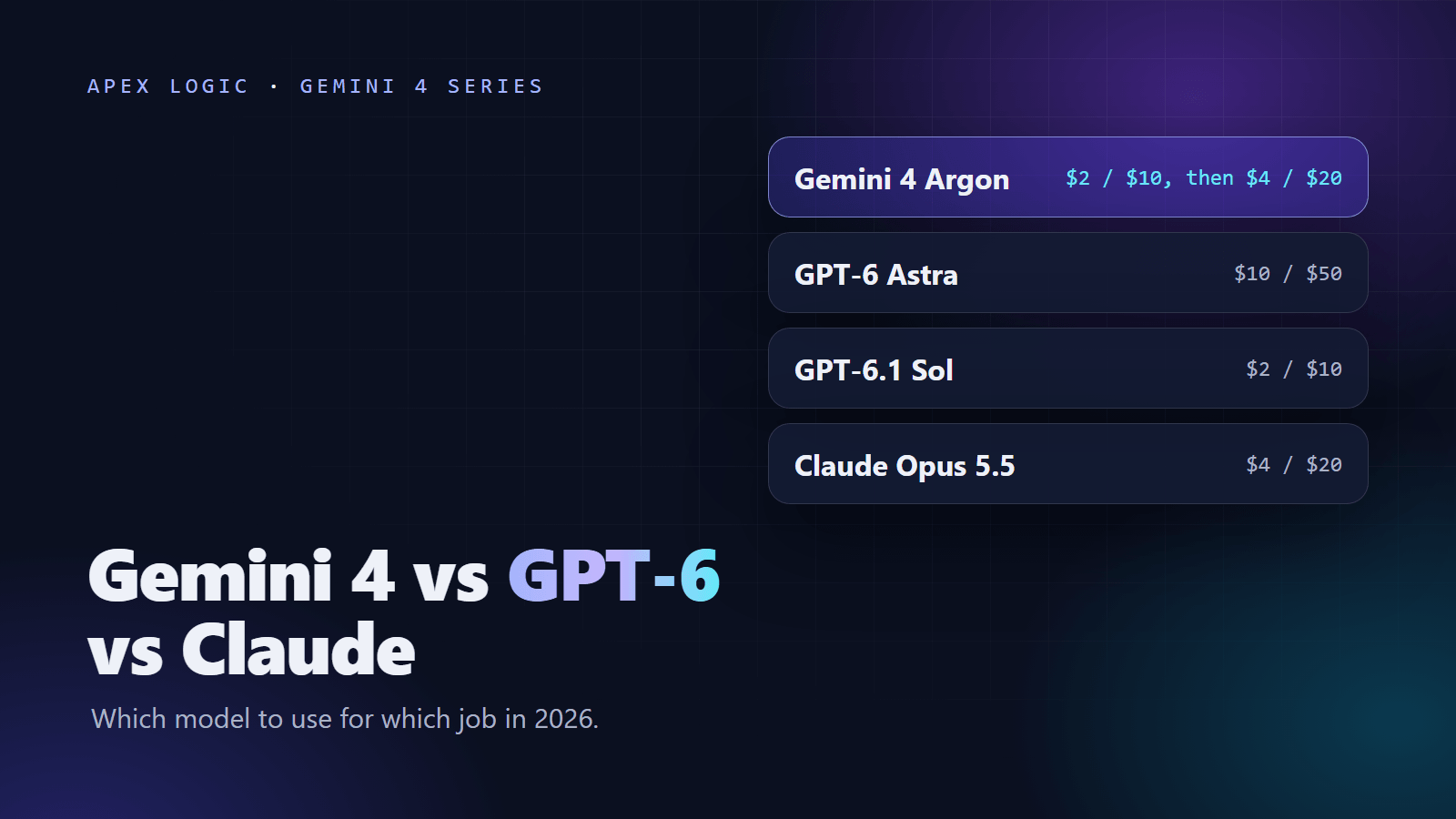
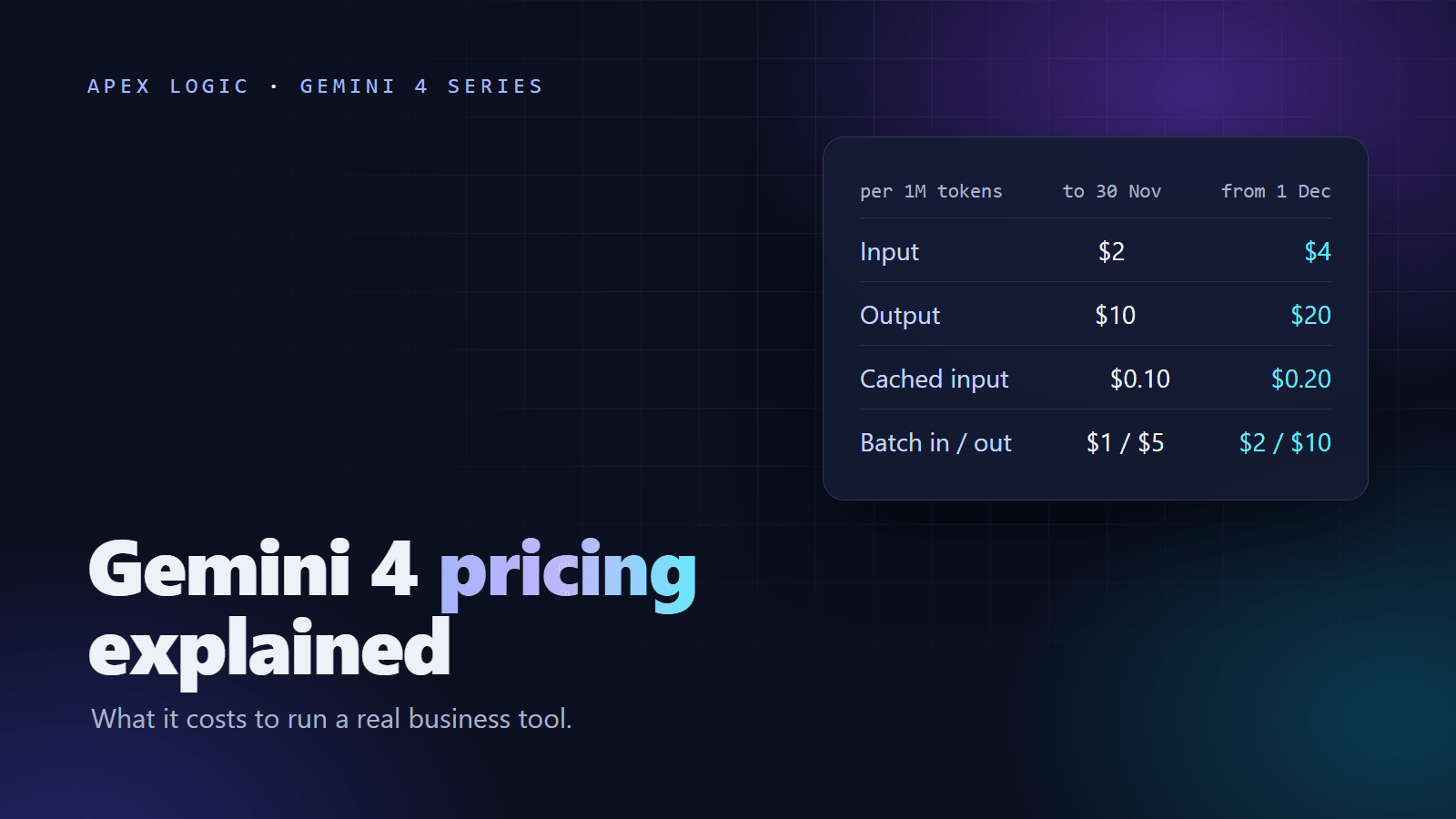
Price narrows the choice. As of 14 October 2026, Argon costs $2 per 1M input tokens and $10 per 1M output tokens through 30 November 2026, then $4 and $20 from 1 December 2026, the same as Claude Opus 5.5. GPT-6.1 Sol matches Argon's launch price, while GPT-6 Astra and Claude Fable 5.1 cost $10 and $50. The practical answer: choose a model per task, test it on your own data and keep it easy to swap.
Quick verdict by use case
Use this as a shortlist, not a final answer. "Top score" means the highest Google-reported score among the models Google compared. For tool ideas, see 12 AI tools you can build with Gemini 4.
| Use case | Shortlist first | Why |
|---|---|---|
| Finance, legal and other document-heavy knowledge work | Gemini 4 Argon | Top score on Vals Index, Vals Finance Agent v2 and the Harvey Legal Agent Benchmark |
| Business automation | Gemini 4 Argon | Top AutomationBench score: 51.3, against 42.5 or lower |
| Very long documents (256K to 1M tokens) | Gemini 4 Argon | Top GraphWalks score, and no long-prompt surcharge |
| Coding agents that work in a terminal | Claude Opus 5.5 | Top Terminal-bench 4.0 score: 66.4, against 58.2 or lower |
| Hard software engineering | Test GPT-6 Astra, Argon and Opus 5.5 | Astra tops FrontierSWE v2, Argon tops DeepSWE v1.1 |
| Operating apps through the screen (computer use) | GPT-6 Astra, then Argon | Astra tops OSWorld-2.0; Argon's computer use is in Preview |
| Video understanding | Gemini 4 Argon, with care | Top LVBench score, but frame sampling differed between models |
| High-volume routine steps | GPT-6.1 Sol, or Argon on Batch or Flex | Among the lowest token prices here, if quality holds in your tests |
The five models compared
- Gemini 4 Argon (
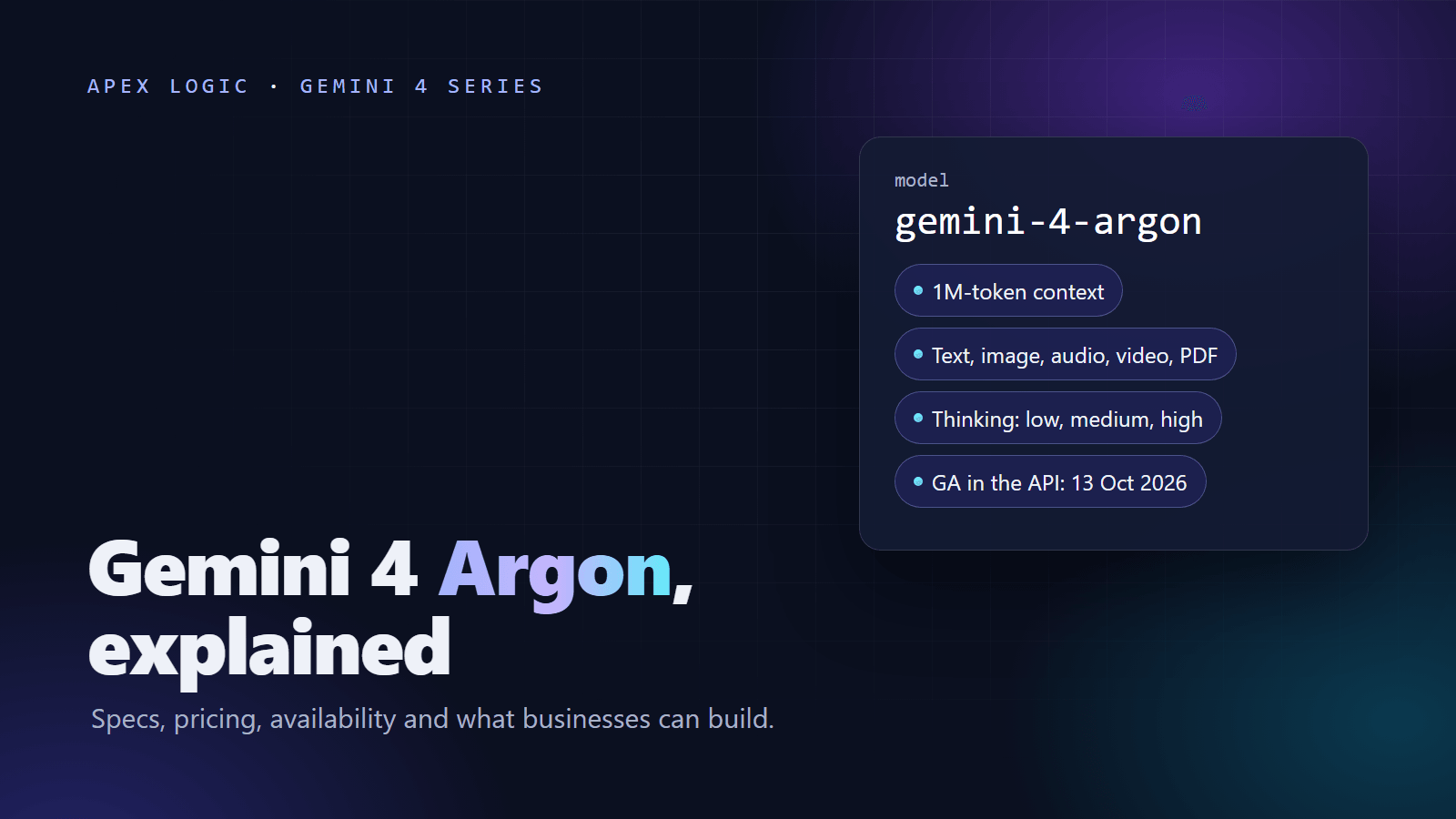
gemini-4-argon): announced on 30 September 2026 and generally available in the Gemini API paid tier and Google AI Studio since 13 October 2026. It is the first Gemini 4 model, uses a codename instead of Pro or Flash, and is the only Gemini 4 model id in the API. - GPT-6 Astra (
gpt-6-astra): the higher-priced OpenAI model in this comparison. - GPT-6.1 Sol (
gpt-6.1-sol): the lower-priced OpenAI model, at one fifth of Astra's per-token price. - Claude Fable 5.1 (
claude-fable-5-1): the higher-priced Anthropic model, with the same input and output prices as Astra. - Claude Opus 5.5 (
claude-opus-5-5): the Anthropic model priced the same as Argon from 1 December 2026.
Reuters reported a Google spokesperson saying Argon is larger than the old Pro line and that Gemini 3.5 Pro will not be released. Our Gemini 4 Argon guide covers the launch in full.
Specs and prices side by side
Prices are per 1M tokens in US dollars, as of 14 October 2026. Argon gets two rows because its price doubles on 1 December 2026.
| Model | Input / output | Cached input | Context window | Max output per request |
|---|---|---|---|---|
| Gemini 4 Argon, through 30 Nov 2026 | $2 / $10 | $0.10 | 1,048,576 | 65,536 by default |
| Gemini 4 Argon, from 1 Dec 2026 | $4 / $20 | $0.20 | 1,048,576 | 65,536 by default |
| GPT-6 Astra | $10 / $50 | $1 | 1,050,000 | 128K |
| GPT-6.1 Sol | $2 / $10 | $0.10 | 1,050,000 | 128K |
| Claude Fable 5.1 | $10 / $50 | $0.25 | 1M | 128K |
| Claude Opus 5.5 | $4 / $20 | $0.20 | 1M | 128K |
What the table does not show:
- Long prompts: Argon has no long-prompt surcharge tier, and Anthropic bills the full 1M context at standard rates. OpenAI charges 2x for input and 1.5x for output on prompts over 272K tokens.
- Discounts: Argon's Batch and Flex tiers cost half the standard rate. OpenAI's Batch and Flex are 50% off, and Anthropic's Batch is 50% off.
- Caching: Argon caching is implicit only: automatic for prompts of at least 4,096 tokens, with no storage fee.
- Output: Argon's context is shared by input, thinking and output, and thinking is billed as output. Past the default 65,536 tokens (32,768 for non-streaming REST), Argon can keep writing up to 1M tokens minus the input through a continuation token.
For every Argon price tier, including Priority, see our Gemini 4 Argon pricing breakdown.
Google's benchmark table, with caveats
Google published these scores in the Gemini 4 Argon model card. Read them with four caveats:
- Google ran and reported the table. Most rival scores were taken from the providers' own published numbers, so test setups may differ.
- LVBench frame sampling differed between models.
- No comparison with older cards. Google's model card says these results cannot be compared with earlier Gemini model cards.
- Gaps. GPT-6.1 Sol is not in the table, and OSWorld-2.0 has no Claude scores.
| Benchmark (%) | Gemini 4 Argon | GPT-6 Astra | Claude Fable 5.1 | Claude Opus 5.5 |
|---|---|---|---|---|
| Vals Index | 68.9 | 63.1 | 65.8 | 67.0 |
| AutomationBench | 51.3 | 41.4 | 31.4 | 42.5 |
| Vals Finance Agent v2 | 65.4 | 53.5 | 58.9 | 58.6 |
| Harvey Legal Agent Benchmark | 19.6 | 5.4 | 6.7 | 3.8 |
| DeepSWE v1.1 | 77.9 | 74.1 | 67.4 | 74.2 |
| FrontierSWE v2 | 55.0 | 65.5 | 56.3 | 62.3 |
| Terminal-bench 4.0 | 57.4 | 58.2 | 57.9 | 66.4 |
| GraphWalks BFS F1, 256K to 1M tokens | 84.2 | 71.8 | 65.0 | 66.8 |
| LVBench (frame sampling differed) | 91.7 | 87.5 | 79.7 | 83.7 |
| OSWorld-2.0 | 69.2 | 72.6 | Not reported | Not reported |
Bold marks the top score in each row. These are 10 of the 19 rows in Google's table. Across all 19, Argon leads 13, ties 1 and trails on 5. In the 10 shown here, it leads 7 and trails 3.
Where each model looks strongest
Based on the Google-reported scores above. Treat this as a guide to what to test first, not a ranking of your own results.
Gemini 4 Argon
Argon is strongest on knowledge work and automation. It tops Vals Index (68.9), Vals Finance Agent v2 (65.4, 6.5 points clear) and AutomationBench (51.3, 8.8 points clear), and it leads the long-context GraphWalks test by 12.4 points. Its weak spots are FrontierSWE v2 and Terminal-bench 4.0, where it scores lowest of the four.
GPT-6 Astra
Astra tops FrontierSWE v2 (65.5) and OSWorld-2.0 (72.6), the computer use test, and comes second on Terminal-bench 4.0, GraphWalks and LVBench. At $10 / $50 per 1M tokens, it costs five times Argon's launch price and two and a half times Argon's price from 1 December 2026, and more again on prompts over 272K tokens.
Claude Opus 5.5
Opus 5.5 holds the biggest lead of any rival in these rows: 66.4 on Terminal-bench 4.0, 8.2 points ahead of the next model. It is also second on four rows: Vals Index, AutomationBench, DeepSWE v1.1 and FrontierSWE v2. From 1 December 2026 it costs exactly what Argon costs ($4 / $20, with $0.20 cached input); until then, Argon costs half as much.
Claude Fable 5.1
Fable 5.1 does not top any of the 10 rows shown. It comes second on Vals Finance Agent v2 (58.9) and the Harvey Legal Agent Benchmark (6.7), and it edges out Argon on FrontierSWE v2 and Terminal-bench 4.0. It is priced like Astra. Google chose which benchmarks to publish, so if Fable already performs well in your app, test carefully before you switch.
GPT-6.1 Sol
Sol is not in Google's table, so there are no Google-reported scores to weigh. Its case is price: $2 / $10 per 1M tokens with $0.10 cached input, the same as Argon until 30 November 2026 and half of Argon's price from 1 December. That makes it a candidate for routine, high-volume steps, if it passes your own tests.
How to choose: practical guidance
Pick a model per task
Most business apps are chains of steps: read an email, classify it, look up the customer, draft a reply. Each step can use a different model, and paying top prices for every step wastes money. Our explainer on AI agents for business shows how these chains fit together.
Test on your own data
- Collect real examples from your business, including the messy ones.
- Write down what a correct answer looks like for each.
- Run every shortlisted model on the same examples and score the results.
- Record cost per task and response time, not just quality. We could not confirm Argon's latency or per-tier rate limits as of 14 October 2026, so measure both.
Keep the model swappable
Rankings and prices move, and Argon's own price doubles on 1 December 2026. Put every model call behind one function, keep model ids and prompts in configuration, and log inputs and outputs so you can replay them against a new model. A routing table is enough to start:
MODEL_FOR_TASK = {
    "triage_email": "gpt-6.1-sol",
    "review_contract": "gemini-4-argon",
    "fix_failing_test": "claude-opus-5-5",
}

def model_for(task):
    return MODEL_FOR_TASK.get(task, "gemini-4-argon")
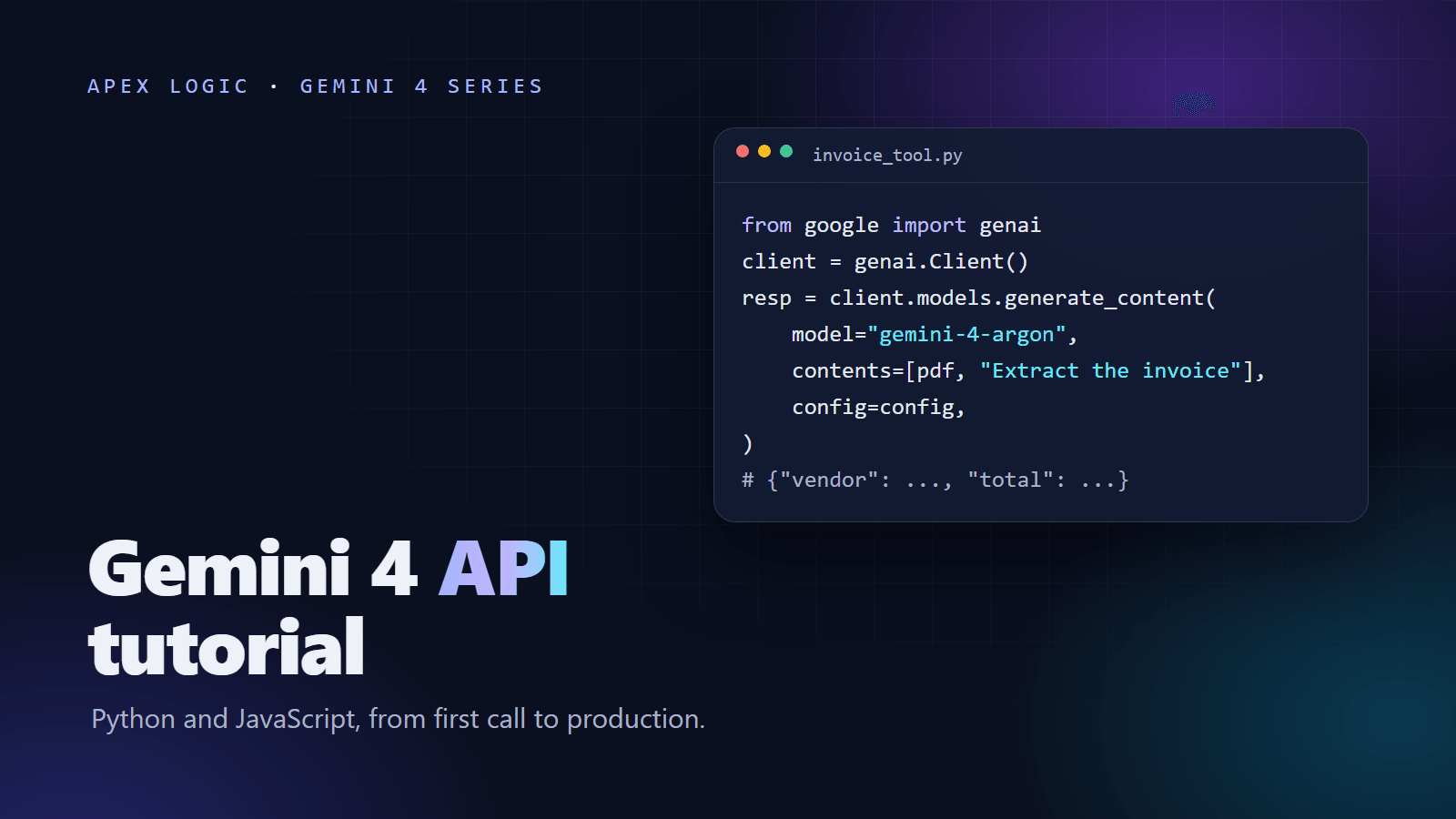
The ids are the official model ids; the routing choices are only an example for your test results to replace. Our Gemini 4 Argon API tutorial shows the Gemini side of the call.
Route routine steps to cheaper models
Tagging, sorting, short replies and simple extraction rarely need the most capable model. Send them to a lower-priced model, or to Argon's Batch or Flex tiers when they can wait. Try Argon's low thinking level on simple steps too: thinking is billed as output, so a lighter setting can cut cost if quality holds. Keep the top models for steps where your tests show a real gap. Our LLM API costs guide has more ways to trim the bill.
Before you choose Argon
- It reads text, images, video, audio and PDF, but outputs text only and cannot generate images or audio. Its Gemini API version does not support the Live API, so live voice apps need separate speech components.
- It is not on the Gemini API free tier.
- Its knowledge cutoff is March 2026. Use Google Search grounding or URL context for anything newer.
- Google lists hallucinations, occasional slowness or timeouts, and dated knowledge in some areas as known limitations.
- On hard tasks, a step can return empty text plus a continuation token. Use the latest SDK or a continuation loop, and set HTTP timeouts to at least 20 minutes.
Not sure which model fits your workflow? We can build the tool and help you test models on your own data first. Tell us about the task, browse the AI tools we build, or read what a Gemini 4 tool costs to build.
Gemini 4 vs GPT-6 vs Claude FAQ
Is Gemini 4 better than GPT-6?
Not on every task. In Google-reported benchmarks, Gemini 4 Argon beats GPT-6 Astra on 7 of the 10 rows shown here, including the knowledge work, automation and long-context tests. Astra wins on FrontierSWE v2, Terminal-bench 4.0 and OSWorld-2.0. Most rival scores were the providers' own published numbers. On price, Argon costs $2 / $10 per 1M tokens until 30 November 2026 and $4 / $20 from 1 December, against $10 / $50 for Astra.
Is Gemini 4 Argon better than Claude Opus 5.5?
In Google-reported results, where most rival scores are the providers' own published numbers, Argon scores higher than Opus 5.5 on 7 of the 9 rows that include both, such as Vals Index, AutomationBench and the finance and legal agent tests. Opus 5.5 wins on Terminal-bench 4.0, by 9 points, and on FrontierSWE v2. From 1 December 2026 both cost $4 / $20 per 1M tokens; until then, Argon costs half.
Is Gemini 4 better than ChatGPT?
ChatGPT is OpenAI's app, so for building business tools the useful comparison is between models: Gemini 4 Argon against GPT-6 Astra and GPT-6.1 Sol in the API. As an app, Argon is available in the Gemini app and AI Mode in Search for Google AI Pro and Ultra subscribers, with more usage on Ultra. For business tools, compare the models on your own tasks, starting from the tables above.
What is the best AI model for business in 2026?
There is no single best model. Going by Google-reported scores, Gemini 4 Argon is the first model to test for document-heavy knowledge work, automation and very long inputs. Claude Opus 5.5 is the first to test for coding agents that work in a terminal, and GPT-6 Astra for computer use. For routine, high-volume steps, a lower-priced model such as GPT-6.1 Sol may be enough, if it passes your tests.
Which of these models is cheapest?
At standard rates, as of 14 October 2026, GPT-6.1 Sol and Gemini 4 Argon tie at $2 per 1M input tokens and $10 per 1M output tokens until 30 November 2026. From 1 December 2026, Argon rises to $4 / $20, matching Claude Opus 5.5. GPT-6 Astra and Claude Fable 5.1 cost $10 / $50. Prompts over 272K tokens cost more on OpenAI, while Google and Anthropic charge standard rates across the full context.
Sources
- Google DeepMind: Gemini 4 Argon model card
- Gemini API pricing
- Gemini API: Gemini 4 Argon model page
- Gemini API: models
- Gemini API: output limits, thinking and continuation
- Gemini API changelog
- Google: Gemini 4 Argon announcement
- Google: Gemini 4 Argon in the Gemini app and Search
- Google Cloud: get started with Gemini 4
- OpenAI API pricing
- Anthropic: Claude pricing
Loading comments...