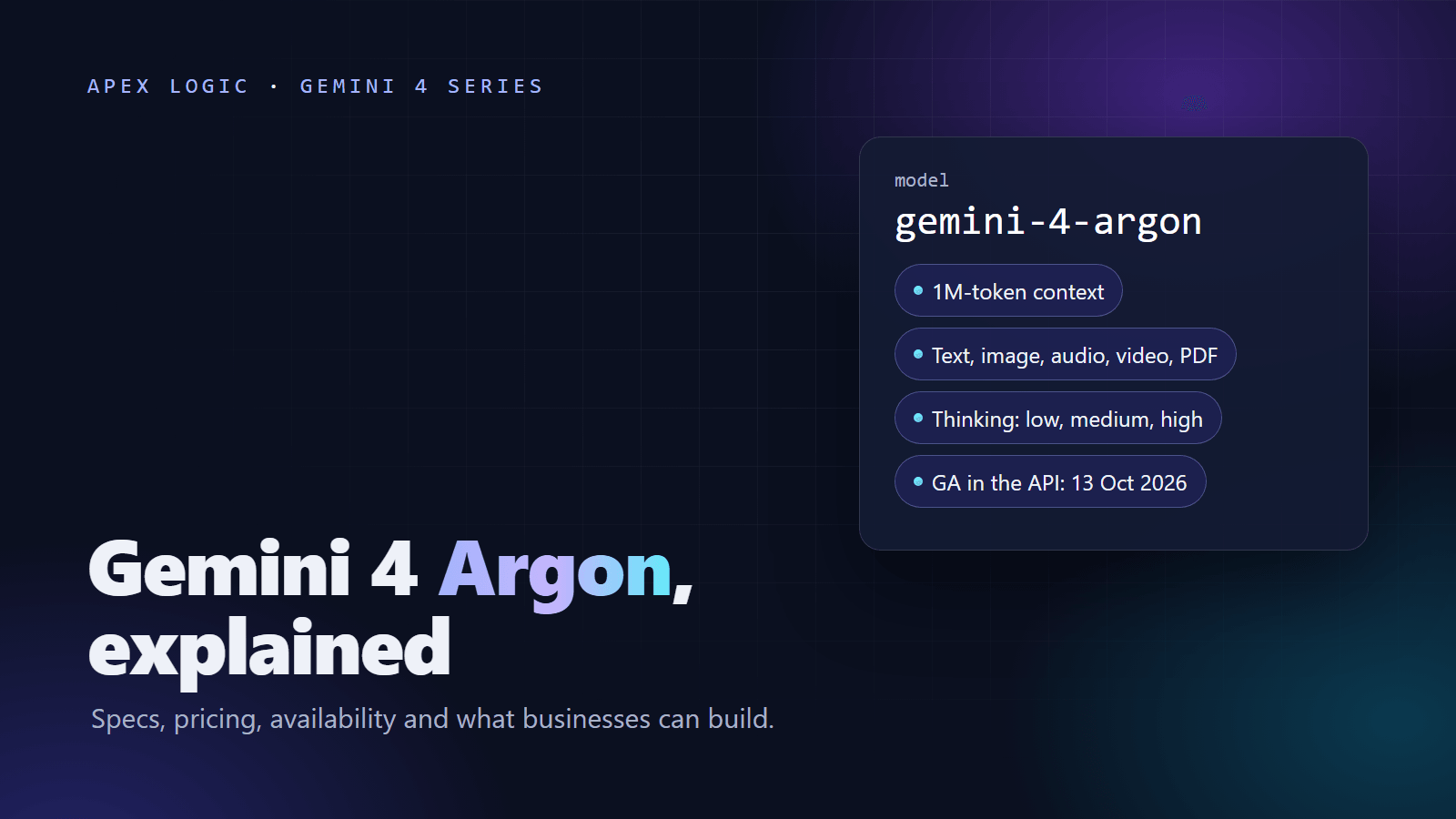
Updated 14 October 2026. Gemini 4 Argon became generally available in the Gemini API on 13 October 2026. Prices change on 1 December 2026; this article shows both.
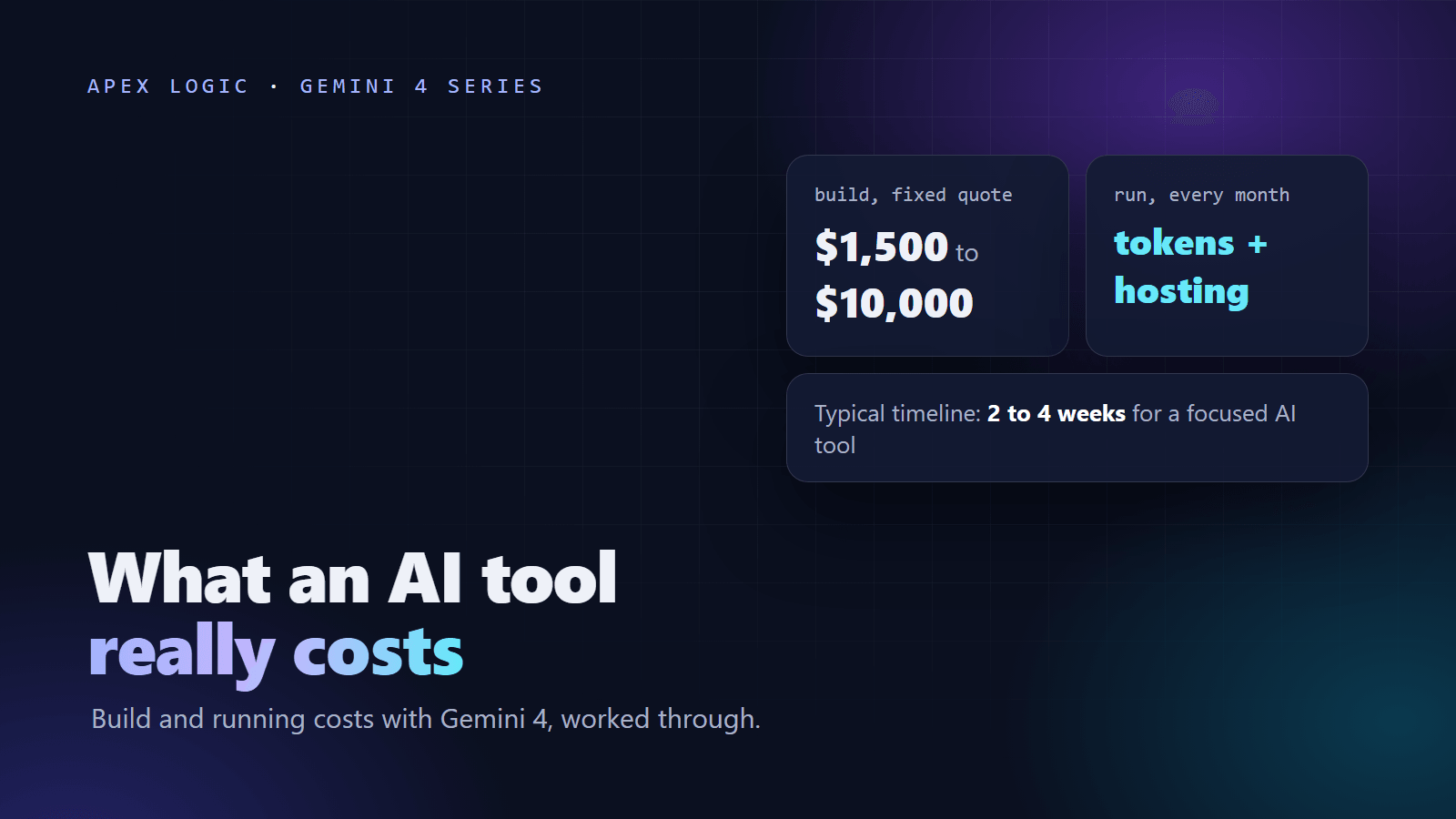
Building a custom AI tool with Gemini 4 costs $1,500 to $10,000 for an AI chatbot or LLM integration at Apex Logic's published rates, or $500 to $1,500 for a single automation workflow. A chatbot or single AI feature typically takes 2 to 4 weeks. Where your project lands depends on integrations, data cleanup, document types, review screens, security needs and languages.
Running costs come on top. As of 14 October 2026, Gemini 4 Argon costs $2 per 1M input tokens and $10 per 1M output tokens through 30 November 2026, then $4 and $20 from 1 December 2026. In the three hypothetical examples below, monthly model costs range from $40 to $520, before hosting, monitoring and maintenance.
Two buckets: build and run
- Build cost: a one-off price to scope, build, test and launch the tool.
- Running cost: model tokens, hosting, monitoring and maintenance, every month.
Budgets go wrong when the second bucket is forgotten, or when token costs are planned on a price that is about to change. Argon's per-token prices double on 1 December 2026, so plan on the later prices. Our Gemini 4 Argon guide covers what the model can and cannot do.
Build cost: published price ranges
| What you need | Apex Logic price range |
|---|---|
| Single automation workflow | $500 to $1,500 |
| Custom AI chatbot or LLM integration | $1,500 to $10,000 |
| Custom web app or SaaS MVP | $3,000 to $25,000 |
A chatbot or single AI feature typically takes 2 to 4 weeks. If the tool needs a full app around it, with user accounts, dashboards and billing, it moves into the web app range; our guide to custom software costs explains that side. Every project is a fixed quote, you own 100% of the code, and an optional 24-month support plan is available. Token costs are separate from the build price.
What moves a project up or down the range
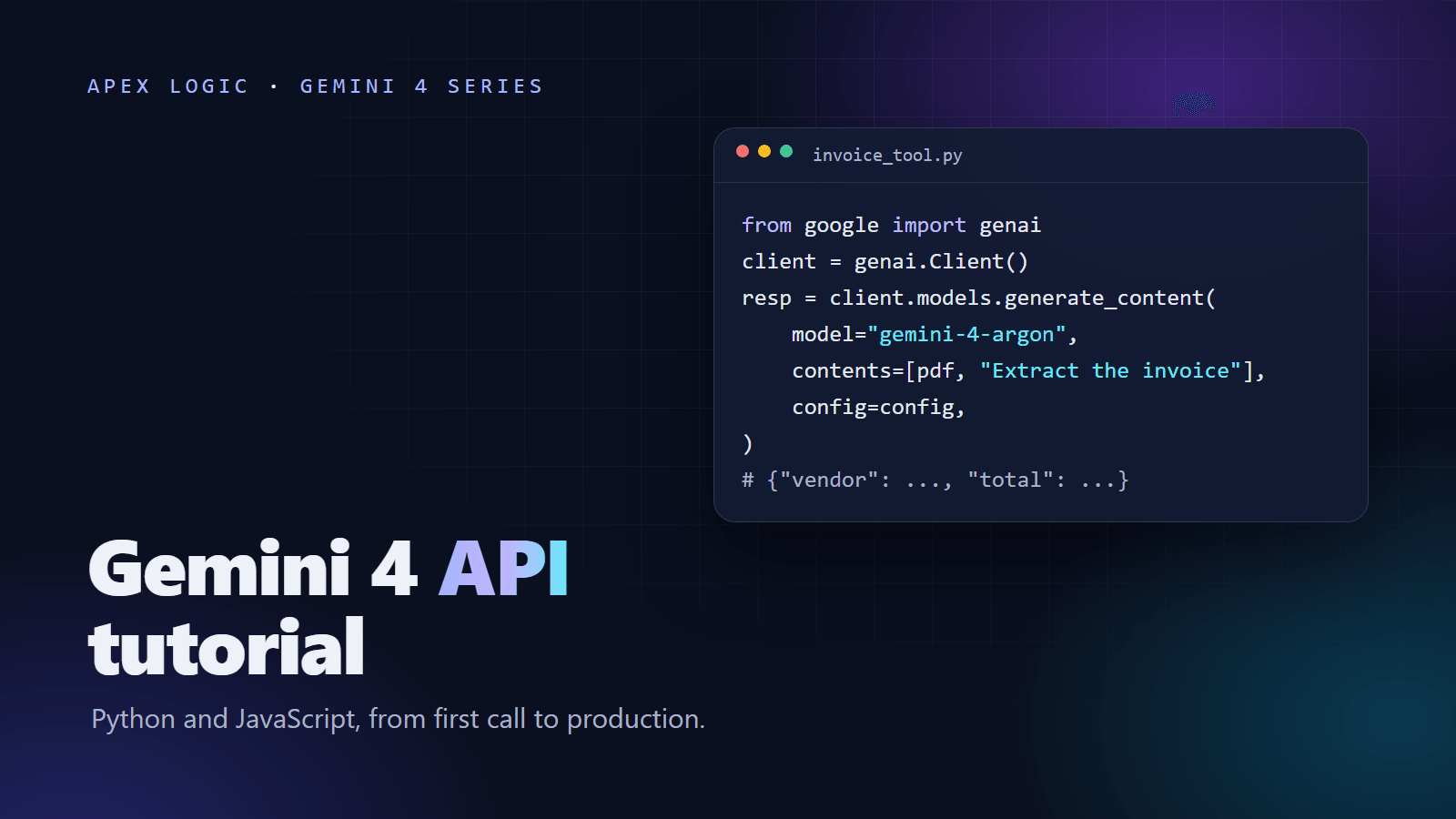
Calling Gemini 4 Argon takes a few lines of code. The price is driven by the work around that call.
Integrations
Every system the tool reads from or writes to adds work: your CRM, help desk, accounting software, calendar or database. A chatbot that only answers from your help center sits near the bottom of the range. One that also checks orders, issues refunds and updates the CRM sits much higher. Systems without a usable API take the most effort.
Data cleanup
An AI tool is only as good as the material it works from. Outdated help articles, duplicate documents and inconsistent spreadsheets need fixing before launch, and that work has to be scoped like any other part of the build.
Number of document types
An extractor for one invoice layout is a small job. Ten document types, each with its own fields and rules, means ten schemas, ten sets of test files and many more edge cases. Argon reads PDFs and images directly, but each document type still needs its own schema and checks.
Human review screens
Many tools need a screen where staff check, correct and approve outputs before anything is sent, posted or paid. A simple approve or reject list is quick to build. A side-by-side view of the source document and the extracted fields, with editing and an audit trail, takes longer.
Security and compliance
Logins, user roles, audit logs, data retention rules and personal data handling all add time, and regulated work needs more testing and documentation. If you need to choose a region, Argon is generally available on Google Cloud's Gemini Enterprise Agent Platform in the us and eu multi-regions as well as the global endpoint.
Languages
Each extra language needs its own test examples and a review by a fluent speaker. Prompts, interface text and handoff messages all need translating and checking.
Running costs: Gemini 4 Argon token prices
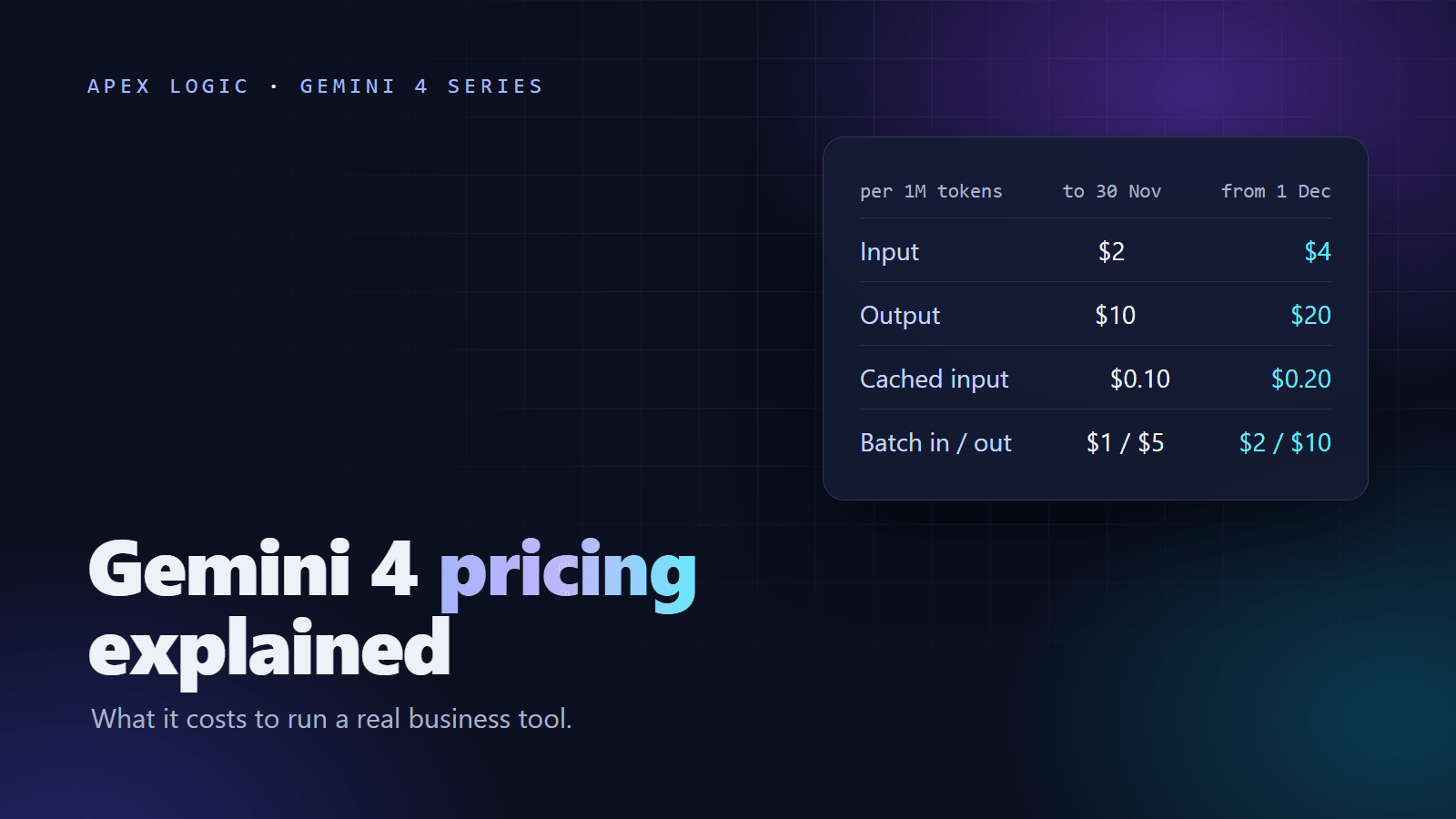
Gemini API prices in US dollars per 1M tokens, as of 14 October 2026. Argon is not available on the free tier.
| Price type | Through 30 Nov 2026 | From 1 Dec 2026 |
|---|---|---|
| Input | $2.00 | $4.00 |
| Output (includes thinking) | $10.00 | $20.00 |
| Cached input (implicit only) | $0.10 | $0.20 |
| Batch input / output | $1.00 / $5.00 | $2.00 / $10.00 |
| Flex input / output | $1.00 / $5.00 | $2.00 / $10.00 |
| Priority input / output | $3.60 / $18.00 | $7.20 / $36.00 |
- Thinking is billed as output. Argon's thinking tokens count toward
max_output_tokensand are charged at the output rate. Thinking levels are low, medium (the default) and high. - No long-prompt surcharge and no cache storage fee. Implicit caching applies automatically to prompts of at least 4,096 tokens (6,144 on Google Cloud).
- Google Search grounding includes 5,000 free requests a month, shared across Gemini 3 and newer models, then costs $14 per 1,000.
Our Gemini 4 Argon pricing guide explains each tier in detail.
Three worked monthly examples
These are hypothetical examples with stated assumptions, not client projects. Token counts vary a lot between tools, so measure your own in a pilot before you set a budget. For more tool ideas, see 12 AI tools you can build with Gemini 4.
Example 1: Support chatbot
Assumptions: 2,000 conversations a month, five model calls per conversation, 8,000 input tokens per call (instructions, help articles and chat history) and 1,000 output tokens per call (reply plus thinking). That is 10,000 calls, 80M input tokens and 10M output tokens a month.
| Line | Through 30 Nov 2026 | From 1 Dec 2026 |
|---|---|---|
| Input: 80M tokens | $160 | $320 |
| Output: 10M tokens | $100 | $200 |
| Monthly total | $260 | $520 |
| If half the input is billed at the cached rate | $184 | $368 |
Each call is above the 4,096-token threshold, so implicit caching can apply, but how much of your input gets cached depends on your prompts. Check the real share before you count on the lower figure.
Example 2: Invoice extraction on the Batch API
Assumptions: 5,000 invoices a month processed overnight with the Batch API, 3,000 input tokens per invoice (the PDF plus instructions) and 1,000 output tokens per invoice (the extracted fields plus thinking). That is 15M input tokens and 5M output tokens a month.
| Line | Through 30 Nov 2026 | From 1 Dec 2026 |
|---|---|---|
| Input: 15M tokens at Batch rates | $15 | $30 |
| Output: 5M tokens at Batch rates | $25 | $50 |
| Monthly total | $40 | $80 |
| Same volume at standard rates | $80 | $160 |
Batch suits work that can wait, such as invoices that arrive during the day and post overnight.
Example 3: Lead research with Google Search grounding
Assumptions: 3,000 new leads a month, two grounded requests per lead, and 12,000 input tokens plus 2,000 output tokens per lead across all calls. That is 6,000 grounded requests, 36M input tokens and 6M output tokens. The first 5,000 grounded requests are free, so 1,000 are billed.
| Line | Through 30 Nov 2026 | From 1 Dec 2026 |
|---|---|---|
| Input: 36M tokens | $72 | $144 |
| Output: 6M tokens | $60 | $120 |
| Grounding: 1,000 billed requests | $14 | $14 |
| Monthly total | $146 | $278 |
We have assumed the grounding price stays at $14 per 1,000 after 1 December; check it again then. The free allowance is shared across Gemini 3 and newer models.
Hosting, monitoring and maintenance
- Hosting: the app, database, file storage and background jobs. The cost depends on your stack and traffic, so ask for an estimate alongside the quote.
- Monitoring: logs of every model call, error alerts, daily token spend and a sample of outputs checked by a person. Google lists hallucinations and occasional slowness or timeouts as known limitations, so this is not optional.
- Maintenance: updating prompts as your products and policies change, re-testing when providers change models or prices, and keeping SDKs current. The latest Google SDKs continue Argon's long outputs automatically.
- Review time: someone on your team checks flagged outputs. Budget for it, especially in the first months.
How fixed quotes work
A fixed quote turns the build bucket into one known number. You agree a written scope that lists the integrations, document types, review screens and languages, and the price only changes if the scope does. The risk of underestimating the work sits with the builder, not with you. Our comparison of fixed price and time and materials explains when each model fits.
A good quote for an AI tool also states what it does not include, such as tokens and hosting, and estimates both, so you see the full monthly picture before you sign.
Ways to keep costs down
- Start with one workflow. Prove the value on a single task before a bigger build.
- Use Batch or Flex for work that can wait. Both cost half the standard rate.
- Send routine steps to a cheaper model. Keep Argon for long documents and hard cases.
- Test the low thinking level. Thinking is billed as output, so check whether low is good enough for simple steps.
- Keep prompts lean. Send only the documents and history each step needs.
- Keep repeated context identical. Implicit caching bills cached input at one twentieth of the standard input rate.
- Use the free grounding allowance before you pay for search.
- Skip Priority unless you need it. It costs 1.8 times the standard rate.
- Keep the model swappable, so you can move steps if prices or quality change.
Our LLM API costs guide covers these levers across providers.
Build vs buy: custom tool or off-the-shelf SaaS?
Buy when the problem is common, your workflow fits the product as it is, volume is low and you need something running this week. Our list of AI tools for small business is a good place to start.
Build when the tool has to work with your own systems and data, when per-seat fees grow with your team, when you need control over which model runs and where data goes, or when you want to own the code. You can also start with a SaaS tool to learn what you need, then build once you hit its limits. For chatbots in particular, see how much an AI chatbot costs.
Want a number for your own tool? Send us the task and the systems involved, and we can come back with a fixed quote and a running cost estimate for both Argon price periods.
AI tool cost FAQ
How much does it cost to build an AI app with Gemini 4?
At Apex Logic's published rates, a custom AI chatbot or LLM integration costs $1,500 to $10,000 to build, a single automation workflow $500 to $1,500, and a custom web app or SaaS MVP $3,000 to $25,000. Running costs are extra: as of 14 October 2026, Argon tokens cost $2 per 1M input and $10 per 1M output through 30 November 2026, then $4 and $20 from 1 December, plus hosting and maintenance.
How long does it take to build an AI tool with Gemini 4?
A chatbot or single AI feature typically takes 2 to 4 weeks. The time goes into connecting your systems, preparing the content the tool works from, testing it on real examples and building review or handoff screens. Projects with many integrations, several languages or strict compliance needs take longer, so agree the timeline in writing before work starts.
What does a Gemini 4 chatbot cost to run each month?
It depends on volume and prompt size. In our hypothetical example of 2,000 conversations a month with five calls each, Argon tokens cost $260 a month through 30 November 2026 and $520 from 1 December, or less when implicit caching applies. Hosting, monitoring and maintenance come on top. Measure your real token counts in a pilot before you set a budget.
How does the 1 December 2026 price change affect my budget?
It doubles the token side. From 1 December 2026, Argon input rises from $2 to $4 per 1M tokens and output from $10 to $20, and the cached, Batch, Flex and Priority prices double too. Build costs, hosting and staff time are not affected. Plan on the later prices from the start, and keep the model swappable so you can move routine steps to a cheaper model.
Is it cheaper to buy an AI tool than to build one?
For common problems at low volume, often yes: an off-the-shelf tool costs less up front and can be running the same week. Building pays off when the tool must fit your own systems and data, when per-seat fees grow with your team, or when you want to own the code and choose the model. You can start with a SaaS tool and build once you reach its limits.
What does a fixed quote for an AI tool include?
A fixed quote prices an agreed, written scope: the integrations, document types, review screens, languages and testing the tool needs. The price only changes if the scope changes. At Apex Logic you own 100% of the code, and an optional 24-month support plan is available. Model tokens and hosting are running costs, separate from the build price.
Loading comments...