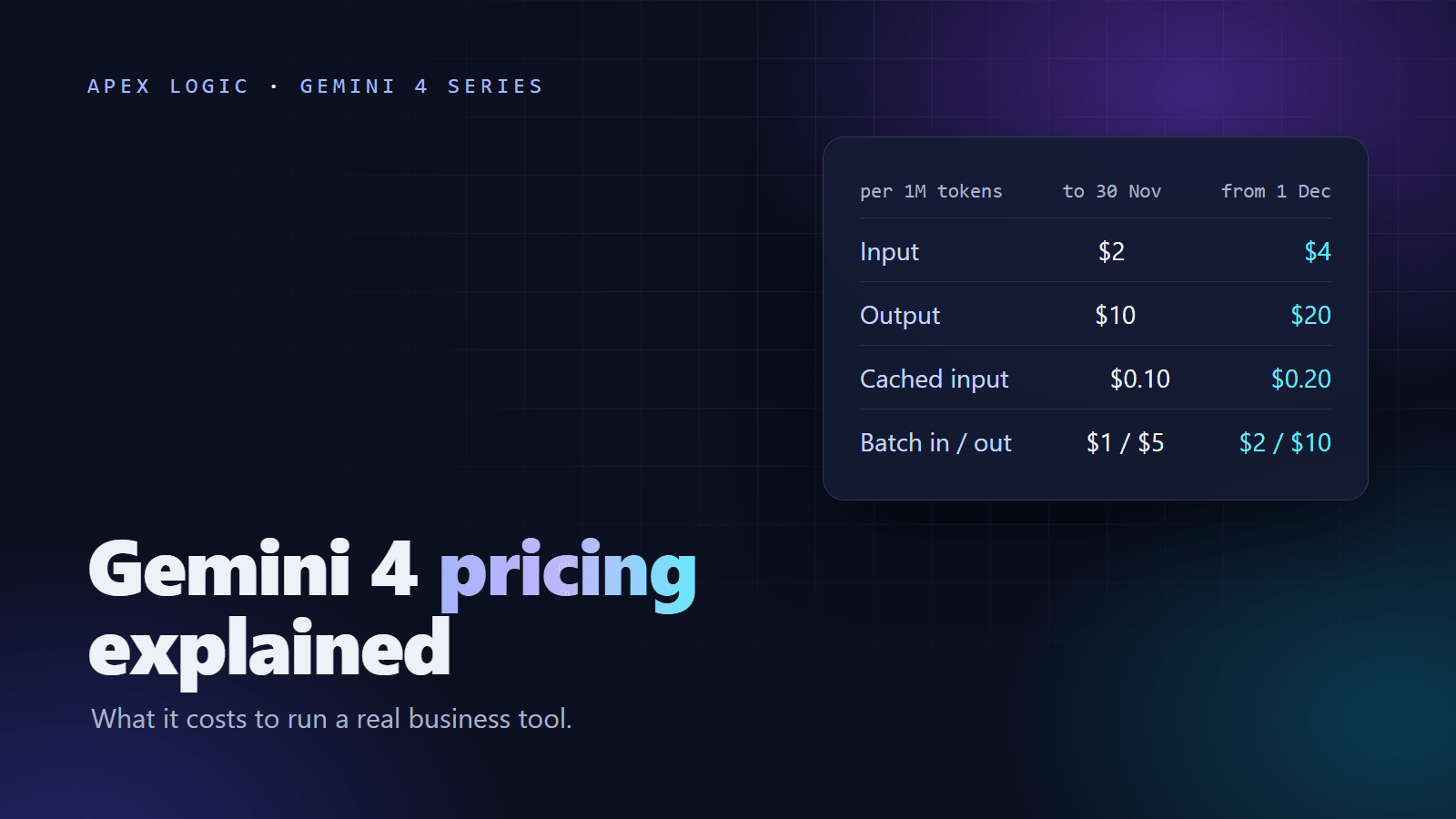
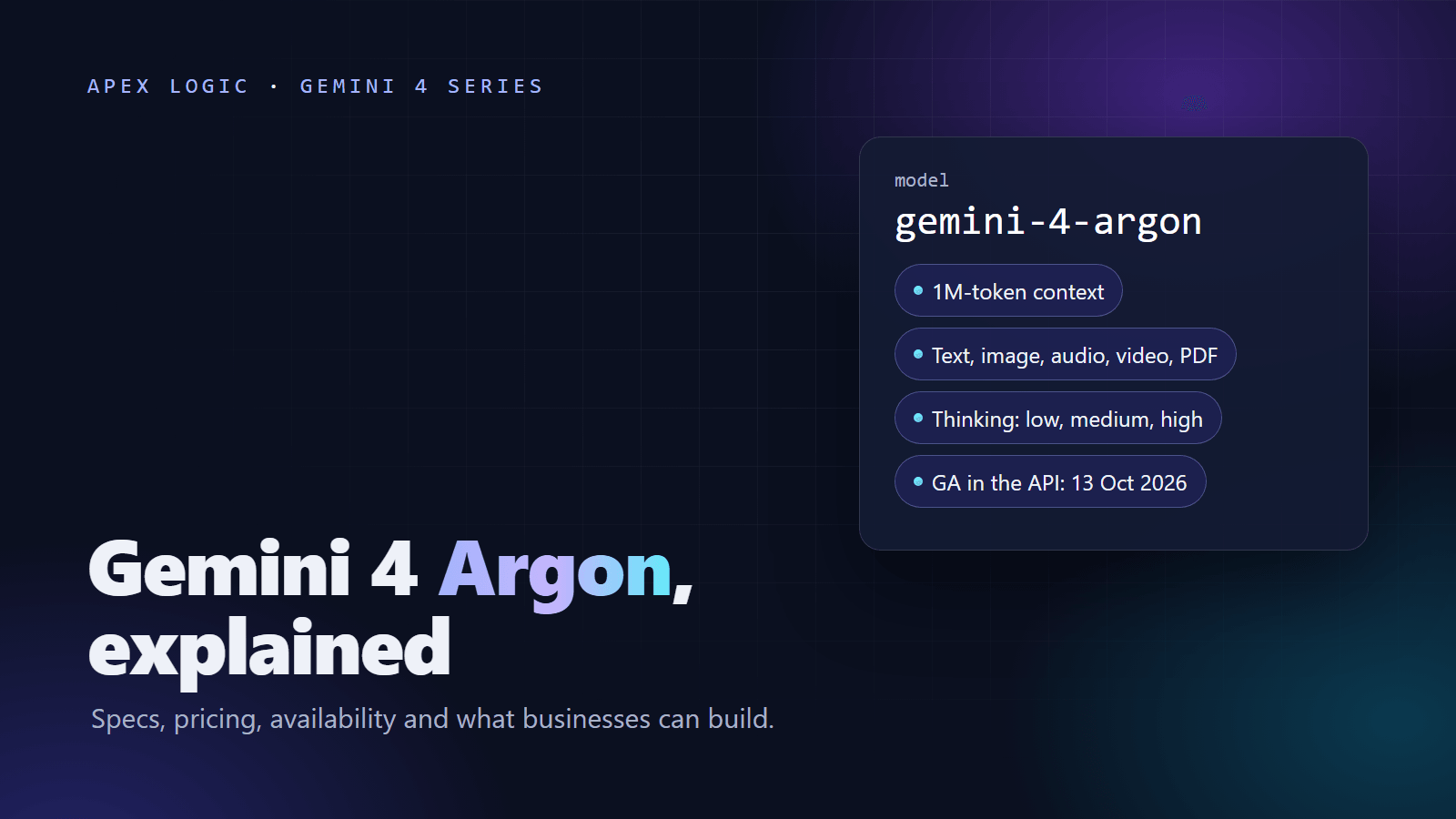
Updated 14 October 2026. Gemini 4 Argon became generally available in the Gemini API on 13 October 2026. Prices change on 1 December 2026; this article shows both.
Gemini 4 Argon costs $2 per million input tokens and $10 per million output tokens through 30 November 2026, then $4 and $20 from 1 December 2026. These are Gemini API list prices as of 14 October 2026. Thinking tokens bill as output, Batch and Flex cost half the standard rate, cached input is $0.10 per million (then $0.20), and there is no free tier.
In our three hypothetical business examples below, the monthly model bill comes to $27.60 to $220 at the rates through 30 November, and $55.20 to $440 from 1 December. For everything else about the model, see our Gemini 4 Argon guide.
Gemini 4 Argon price table
Gemini API prices in US dollars per 1 million tokens, as of 14 October 2026:
| Rate | Through 30 Nov 2026 | From 1 Dec 2026 |
|---|---|---|
| Input | $2.00 | $4.00 |
| Output (includes thinking) | $10.00 | $20.00 |
| Cached input (implicit only) | $0.10 | $0.20 |
| Batch input / output | $1.00 / $5.00 | $2.00 / $10.00 |
| Flex input / output | $1.00 / $5.00 | $2.00 / $10.00 |
| Priority input / output | $3.60 / $18.00 | $7.20 / $36.00 |
Every token rate doubles on 1 December 2026. In both periods, Batch and Flex are half the standard rate, Priority is 1.8 times it, and cached input is 5% of normal input. Google lists no long-prompt surcharge tier and no cache storage fee, so a 900,000-token prompt costs the same per token as a 9,000-token one.
No free tier. Argon is not available on the Gemini API free tier, so even test calls need a paid-tier project.
Google Cloud. Argon is also generally available on Gemini Enterprise Agent Platform, the new name for Vertex AI, but as of 14 October 2026 we have not found a Google Cloud price page for it. Check Cloud pricing before you budget a Cloud deployment.
What changes on 1 December 2026
Every token rate doubles, as the table shows. A tool that runs for a year spends only its first few weeks at the current rates, so base any budget or quote on the 1 December rates. Log tokens per task on your real workload now, and the December bill will hold no surprises.
Why thinking tokens matter
Argon's thinking tokens are billed as output: $10 per million through 30 November and $20 from 1 December, as of 14 October 2026. They also count toward max_output_tokens.
Suppose each reply has 300 visible tokens and 1,200 thinking tokens. You pay for 1,500 output tokens, five times the visible text. Over 10,000 requests a month:
| 10,000 requests | Through 30 Nov | From 1 Dec |
|---|---|---|
| Visible output only (3M tokens) | $30 | $60 |
| Visible plus thinking (15M tokens) | $150 | $300 |
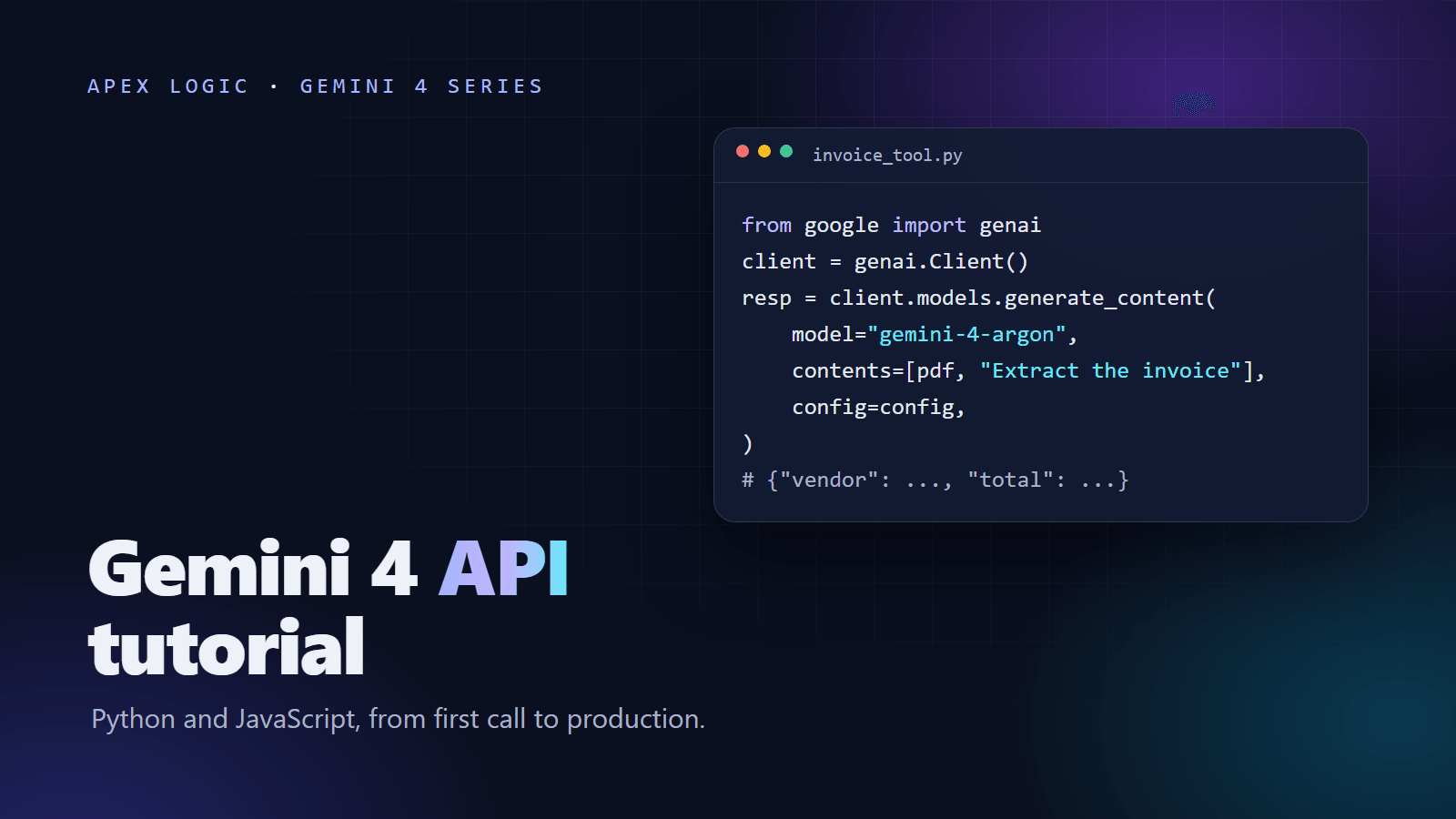
Your main control is the thinking level: low, medium (the default) or high. Keep the lowest level that passes your tests; our Gemini 4 API tutorial shows how to set it.
Implicit caching and its threshold
Argon supports implicit caching only, with no storage fee. It applies automatically to prompts of at least 4,096 tokens, or 6,144 on Google Cloud. As of 14 October 2026, cached input costs $0.10 per million tokens through 30 November and $0.20 from 1 December.
A prompt below the threshold gets no caching, so a 3,000-token prompt always pays full price. Caching also only helps content that repeats, so keep fixed instructions and reference text identical and at the start of the prompt. Our LLM API costs guide explains how prompt caching works.
Google Search grounding charges
As of 14 October 2026, the first 5,000 grounded requests a month are free, shared across Gemini 3 and newer models, and each 1,000 after that costs $14. The 1 December 2026 change covers the token rates, so check the grounding rate again after that date.
Example: 20,000 grounded requests in a month means 15,000 billable requests, or 15 x $14 = $210 for grounding alone.
Three worked monthly cost examples
These are hypothetical examples, not quotes or measurements. They use Gemini API rates as of 14 October 2026 for both periods, and the output token counts include thinking.
1. Website support chatbot
Assumptions: 2,000 chats a month with 5 customer messages each, so 10,000 model calls. Each call sends 6,000 input tokens (4,500 tokens of fixed instructions and help-center content plus 1,500 tokens of conversation) and returns 1,000 output tokens at the low thinking level. Standard processing, because customers are waiting.
| Line | Tokens a month | Through 30 Nov | From 1 Dec |
|---|---|---|---|
| Input | 60M | $120.00 | $240.00 |
| Output | 10M | $100.00 | $200.00 |
| Total | 70M | $220.00 | $440.00 |
Best case with caching: if the 4,500 fixed tokens were served from cache on every call, 45M input tokens would bill at the cached rate ($4.50, then $9.00) and 15M at the normal rate ($30.00, then $60.00). With output unchanged, the total falls to $134.50 through 30 November and $269.00 from 1 December. Measure your real cache hits after launch. See our AI customer support chatbot.
2. Invoice extraction
Assumptions: 3,000 invoices a month. Each request sends 4,000 input tokens (the document plus extraction instructions; measure this with your own files) and returns 1,500 output tokens, a short JSON record plus thinking at the low level. The job runs overnight on the Batch API, since nobody waits for the result.
| Line | Tokens a month | Batch, through 30 Nov | Batch, from 1 Dec |
|---|---|---|---|
| Input | 12M | $12.00 | $24.00 |
| Output | 4.5M | $22.50 | $45.00 |
| Total | 16.5M | $34.50 | $69.00 |
That is 1.15 cents per invoice through 30 November and 2.3 cents from 1 December. At standard rates the same work would cost $69.00, then $138.00. See our AI invoice data extraction page.
3. Meeting summaries
Assumptions: 600 meetings a month. Each request sends 13,000 input tokens (a 12,000-token text transcript from your meeting tool plus 1,000 tokens of instructions) and returns 2,000 output tokens covering the summary, decisions, action items and thinking at the medium level. Standard processing, so summaries arrive soon after each meeting.
| Line | Tokens a month | Through 30 Nov | From 1 Dec |
|---|---|---|---|
| Input | 7.8M | $15.60 | $31.20 |
| Output | 1.2M | $12.00 | $24.00 |
| Total | 9M | $27.60 | $55.20 |
That is 4.6 cents per meeting, then 9.2 cents. Caching helps little here, because only the 1,000-token instruction block repeats. If summaries can wait, Batch would halve the bill. See our AI meeting notes summarizer.
Model costs at this scale are often smaller than the cost of building and maintaining the tool. Our guides to the cost to build an AI tool on Gemini 4 and how much an AI chatbot costs cover that side.
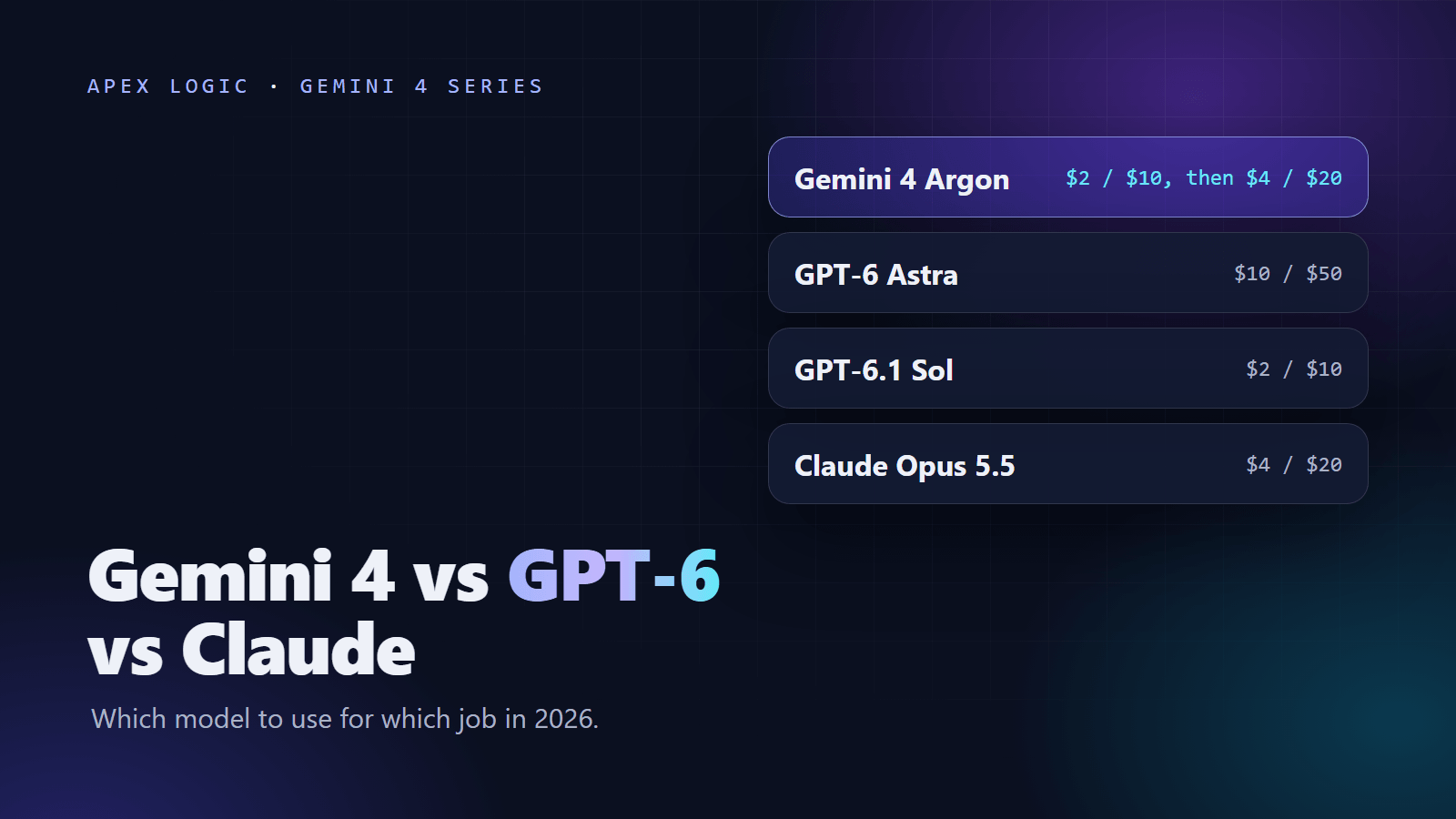
Gemini 4 vs GPT-6 and Claude: price comparison
List prices per 1 million tokens from each provider's official pricing page, as of 14 October 2026. Argon's rates double on 1 December 2026; we have no information on changes to the others.
| Model (id) | Input / output | Cached input | Context / max output | Long prompts |
|---|---|---|---|---|
Gemini 4 Argon to 30 Nov (gemini-4-argon) | $2 / $10 | $0.10 | 1,048,576 / 65,536 per request | No surcharge |
| Gemini 4 Argon from 1 Dec | $4 / $20 | $0.20 | Same | No surcharge |
GPT-6.1 Sol (gpt-6.1-sol) | $2 / $10 | $0.10 | 1,050,000 / 128K | 2x input, 1.5x output over 272K |
GPT-6 Astra (gpt-6-astra) | $10 / $50 | $1.00 | 1,050,000 / 128K | 2x input, 1.5x output over 272K |
Claude Opus 5.5 (claude-opus-5-5) | $4 / $20 | $0.20 | 1M / 128K | Standard rates across 1M |
Claude Fable 5.1 (claude-fable-5-1) | $10 / $50 | $0.25 | 1M / 128K | Standard rates across 1M |
Argon's 65,536 is its default output per request; long decode can continue up to 1M tokens minus input. What the table means:
- Through 30 November, Argon's list rates match GPT-6.1 Sol and are one fifth of GPT-6 Astra and Claude Fable 5.1.
- From 1 December, Argon matches Claude Opus 5.5 and costs twice as much as GPT-6.1 Sol per token.
- Long prompts: OpenAI charges 2x input and 1.5x output on prompts over 272K tokens. Google has no long-prompt tier for Argon, and Anthropic bills the full 1M context at standard rates.
- Discounts: Batch is 50% off at all three providers, and Flex is 50% off at OpenAI and Google.
The surcharge in practice, for one request with a 400,000-token prompt and 4,000 output tokens (standard rates, no caching):
| Model | Input cost | Output cost | Total |
|---|---|---|---|
| Gemini 4 Argon, to 30 Nov | $0.80 | $0.04 | $0.84 |
| Gemini 4 Argon, from 1 Dec | $1.60 | $0.08 | $1.68 |
| GPT-6.1 Sol (surcharged) | $1.60 | $0.06 | $1.66 |
| GPT-6 Astra (surcharged) | $8.00 | $0.30 | $8.30 |
| Claude Opus 5.5 | $1.60 | $0.08 | $1.68 |
| Claude Fable 5.1 | $4.00 | $0.20 | $4.20 |
Price per token is only half the picture. Models can use different numbers of tokens, including thinking, for the same job, and Google's benchmark table does not include GPT-6.1 Sol. Compare cost per finished task on your own examples, and see our Gemini 4 vs GPT-6 vs Claude comparison for quality and fit.
Practical ways to cut your Gemini 4 bill
- Route routine steps to a cheaper model. Classification, routing and short replies often do not need Argon, so test a lower-priced model on those steps. Google's Flash line continues on Gemini 3.x (Gemini 3.8 Flash), so it is one candidate; check current prices on each provider's pricing page.
- Use Batch or Flex where you can. Both cost half the standard rate, and Batch suits work that can wait, such as overnight runs.
- Avoid Priority unless you need it. It costs 1.8 times standard.
- Design for implicit caching. Put fixed instructions and reference text first and keep them identical between calls.
- Send less. Pass only the documents and chat history a task needs, not a whole manual just because the 1M window allows it.
- Lower the thinking level wherever quality holds, because thinking bills as output.
- Ask for shorter answers. Output costs five times as much as input, so trimming the answer format saves more than trimming the prompt by the same number of tokens.
- Ground only when needed. Search grounding beyond the free monthly allowance is billed per request.
If you want a second opinion on a model budget, or a tool built with costs designed in from the start, get in touch. We build custom AI tools on fixed quotes, and we will tell you plainly when a cheaper model does the job.
Gemini 4 pricing FAQ
How much does Gemini 4 Argon cost per million tokens?
As of 14 October 2026, Gemini 4 Argon costs $2 per million input tokens and $10 per million output tokens in the Gemini API through 30 November 2026. From 1 December 2026 the rates are $4 and $20. Cached input is $0.10, then $0.20. Batch and Flex cost half the standard rate, and Priority costs 1.8 times it.
Is there a free tier for Gemini 4?
No. Gemini 4 Argon is not available on the Gemini API free tier, so you need a paid-tier project and an API key from Google AI Studio. Google AI Pro and Ultra subscribers can use Argon in the Gemini app and AI Mode in Search, but that consumer subscription is separate from the API you would use to build tools.
What changes in Gemini 4 pricing on 1 December 2026?
On 1 December 2026 every token rate doubles. Input goes from $2 to $4 per million tokens, output from $10 to $20, cached input from $0.10 to $0.20, Batch and Flex from $1 and $5 to $2 and $10, and Priority from $3.60 and $18 to $7.20 and $36. These are list prices as of 14 October 2026, so budget long-running tools on the December rates.
Are Gemini 4 thinking tokens billed?
Yes. Thinking tokens are billed as output, at $10 per million through 30 November 2026 and $20 from 1 December 2026, as of 14 October 2026. They also count toward max_output_tokens. Because a reply can contain more thinking than visible text, the thinking level you choose can affect your bill more than the length of your prompt does.
Is Gemini 4 cheaper than GPT-6 and Claude?
It depends on the date and the model. As of 14 October 2026, Argon's $2 and $10 rates through 30 November match GPT-6.1 Sol and are a fifth of GPT-6 Astra and Claude Fable 5.1. From 1 December 2026, Argon's $4 and $20 match Claude Opus 5.5 and are double GPT-6.1 Sol. OpenAI also charges more on prompts over 272K tokens; Google does not.
Does Gemini 4 charge for Google Search grounding?
Yes, beyond a free allowance. As of 14 October 2026, the first 5,000 grounded requests a month are free, shared across Gemini 3 and newer models, and each further 1,000 costs $14. The 1 December 2026 change covers token rates, so check the grounding rate again after that date, and enable grounding only for questions that need fresh information.
Loading comments...