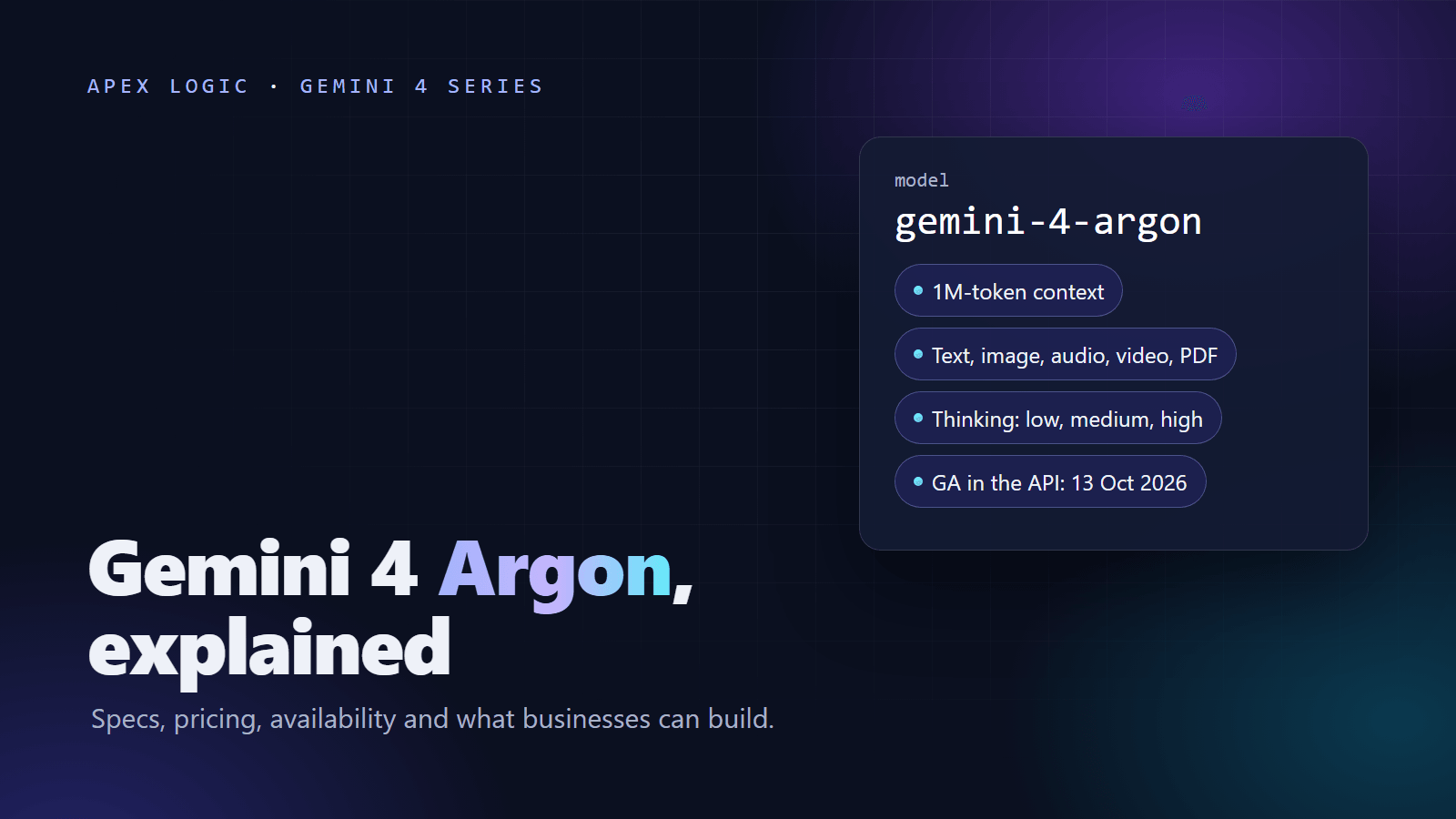
Updated 14 October 2026. Gemini 4 Argon became generally available in the Gemini API on 13 October 2026. Prices change on 1 December 2026; this article shows both.
Yes, Gemini 4 is out. Gemini 4 Argon is the first model in Google's Gemini 4 family. Google announced it on 30 September 2026 and made it generally available in the Gemini API (paid tier) and Google AI Studio on 13 October 2026. The same day, it reached the Gemini app and AI Mode in Search for Google AI Pro and Ultra subscribers. In code, the model id is gemini-4-argon.
Argon reads text, images, video, audio and PDFs, writes text, and has a 1,048,576-token context window. As of 14 October 2026, it costs $2 per million input tokens and $10 per million output tokens in the Gemini API, and those rates double on 1 December 2026. This guide covers the timeline, the naming, the specs, supported features, pricing, benchmarks, safety and access. It is the hub of our Gemini 4 series, with links to deeper articles on the API, pricing, model comparisons and build costs.
Gemini 4 Argon at a glance
| Item | Gemini 4 Argon |
|---|---|
| Model id | gemini-4-argon (stable, no preview alias) |
| Announced | 30 September 2026 |
| Generally available | 13 October 2026 (Gemini API paid tier and Google AI Studio) |
| Context window | 1,048,576 tokens, shared by input, thinking and output |
| Output per request | 65,536 tokens by default (32,768 for non-streaming REST) |
| Long decode | Up to 1M tokens minus input, via a continuation token |
| Thinking levels | low, medium (default), high |
| Input | Text, image, video, audio, PDF |
| Output | Text only |
| Knowledge cutoff | March 2026 |
| Architecture | Sparse mixture-of-experts transformer, natively multimodal |
| API price through 30 Nov 2026 | $2 input, $10 output per 1M tokens |
| API price from 1 Dec 2026 | $4 input, $20 output per 1M tokens |
Prices are Gemini API list prices as of 14 October 2026.
Is Gemini 4 out? Release date and timeline
Yes. The rollout happened in stages:
| Date | What happened |
|---|---|
| 30 September 2026 | Koray Kavukcuoglu, SVP at Google DeepMind, announced Gemini 4 Argon. First access went to trusted cyber defenders in the Fairwind Program. |
| 13 October 2026 | Generally available in the Gemini API (paid tier) and Google AI Studio. |
| 13 October 2026 | Live in the Gemini app and AI Mode in Search for Google AI Pro and Ultra subscribers. Ultra subscribers get more usage. |
| 13 October 2026 | Generally available on Google Cloud's Gemini Enterprise Agent Platform, the new name for Vertex AI, in the global endpoint and the us and eu multi-regions. |
| 14 October 2026 | Google Cloud announced availability in Gemini for business and through Google Cloud. |
So the Gemini 4 release date depends on who you are. Fairwind partners had it first. Developers, Google AI Pro and Ultra subscribers and Google Cloud customers got it on 13 October, and Gemini for business followed on 14 October.
What is the Fairwind Program?
Fairwind is Google DeepMind's early-access program for cyber defenders: governments, national cyber authorities, critical-infrastructure operators and core tech platforms. Google lists "over 650 partners". Use is limited to defense, and members get Argon without the cyber guardrails that apply to everyone else. For most businesses it is background: general access began on 13 October.
Why Argon and not Pro or Flash?
Argon is the first model of the Gemini 4 family, and Google gave it a codename instead of the usual Pro or Flash label. In the Gemini API, gemini-4-argon is the only Gemini 4 model id. It is stable, with no preview alias, so you can pin it in production.
- No Gemini 4 Pro or Gemini 4 Flash id. As of 14 October 2026, Argon is the only Gemini 4 model in the API.
- Flash stays on 3.x. Google's Flash line continues on the Gemini 3.x numbering. Gemini 3.8 Flash went GA on 2 September 2026.
- No Gemini 3.5 Pro. Reuters reported that a Google spokesperson said Argon is larger than the old Pro line and that Gemini 3.5 Pro will not be released.
Gemini 4 Argon specs
Context window and output limits
The context window is 1,048,576 tokens, and that one budget is shared by your input, the model's thinking and its output. For example, a 900,000-token prompt leaves at most 148,576 tokens for thinking and output combined.
- Default output: 65,536 tokens per request when you stream or use the SDKs, and 32,768 for non-streaming REST calls.
- Long decode: output can continue up to 1M tokens minus your input, using a
continuation_token. The latest SDKs continue automatically. - Empty steps are normal: on hard tasks, an output step can be all thinking. You get empty text plus a continuation token, not an error.
Thinking levels
You control how much Argon reasons with thinking_level: low, medium (the default) or high. It replaces the thinking_budget setting from Gemini 3.x.
Two details matter for cost and reliability. Thinking tokens count toward max_output_tokens, and they are billed as output. A high level with a tight output limit can spend the whole budget on thinking before any visible answer appears.
Modalities, knowledge cutoff and architecture
- Input: text, images, video, audio and PDF.
- Output: text only. Argon does not generate images or audio.
- Knowledge cutoff: March 2026. For anything newer, ground answers with Google Search or URL context.
- Architecture: a sparse mixture-of-experts transformer, natively multimodal, according to the Gemini 4 Argon model card.
Gemini 4 features: what is supported and what is not
Supported in the Gemini API:
- Function calling and structured outputs
- Code execution
- File search and URL context
- Google Search and Google Maps grounding
- Batch API, Flex and Priority processing
- Implicit caching, applied automatically to prompts of at least 4,096 tokens (6,144 on Google Cloud)
- Thinking, with three levels
- Computer use, in Preview
Not supported:
- Explicit caching
- The Live API
- Image generation
- Audio generation
Teams moving from Gemini 3.x should also know that temperature, top_p, top_k and candidate_count are ignored, and that HTTP timeouts should be at least 20 minutes.
Gemini 4 pricing summary
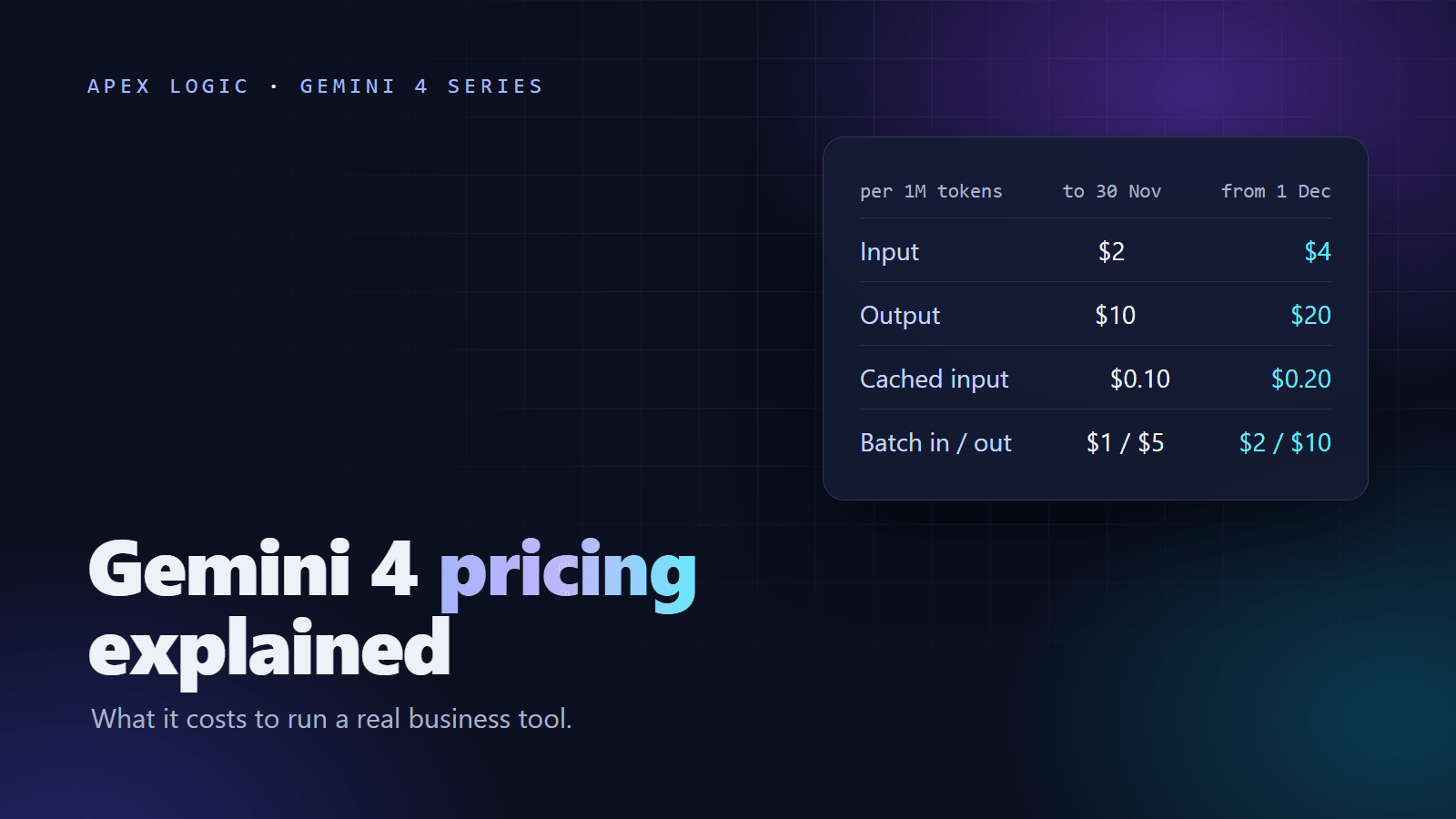
Gemini API prices in US dollars per 1 million tokens, as of 14 October 2026. Every token rate in this table doubles on 1 December 2026.
| Per 1M tokens | Through 30 Nov 2026 | From 1 Dec 2026 |
|---|---|---|
| Input | $2.00 | $4.00 |
| Output (includes thinking) | $10.00 | $20.00 |
| Cached input (implicit only) | $0.10 | $0.20 |
| Batch input / output | $1.00 / $5.00 | $2.00 / $10.00 |
| Flex input / output | $1.00 / $5.00 | $2.00 / $10.00 |
| Priority input / output | $3.60 / $18.00 | $7.20 / $36.00 |
- No long-prompt surcharge tier and no cache storage fee.
- Google Search grounding: 5,000 free requests a month, shared across Gemini 3 and newer models, then $14 per 1,000 requests.
- No free tier: Argon is not available on the Gemini API free tier.
- We have not found a Google Cloud price page for Argon yet, so these are Gemini API prices only.
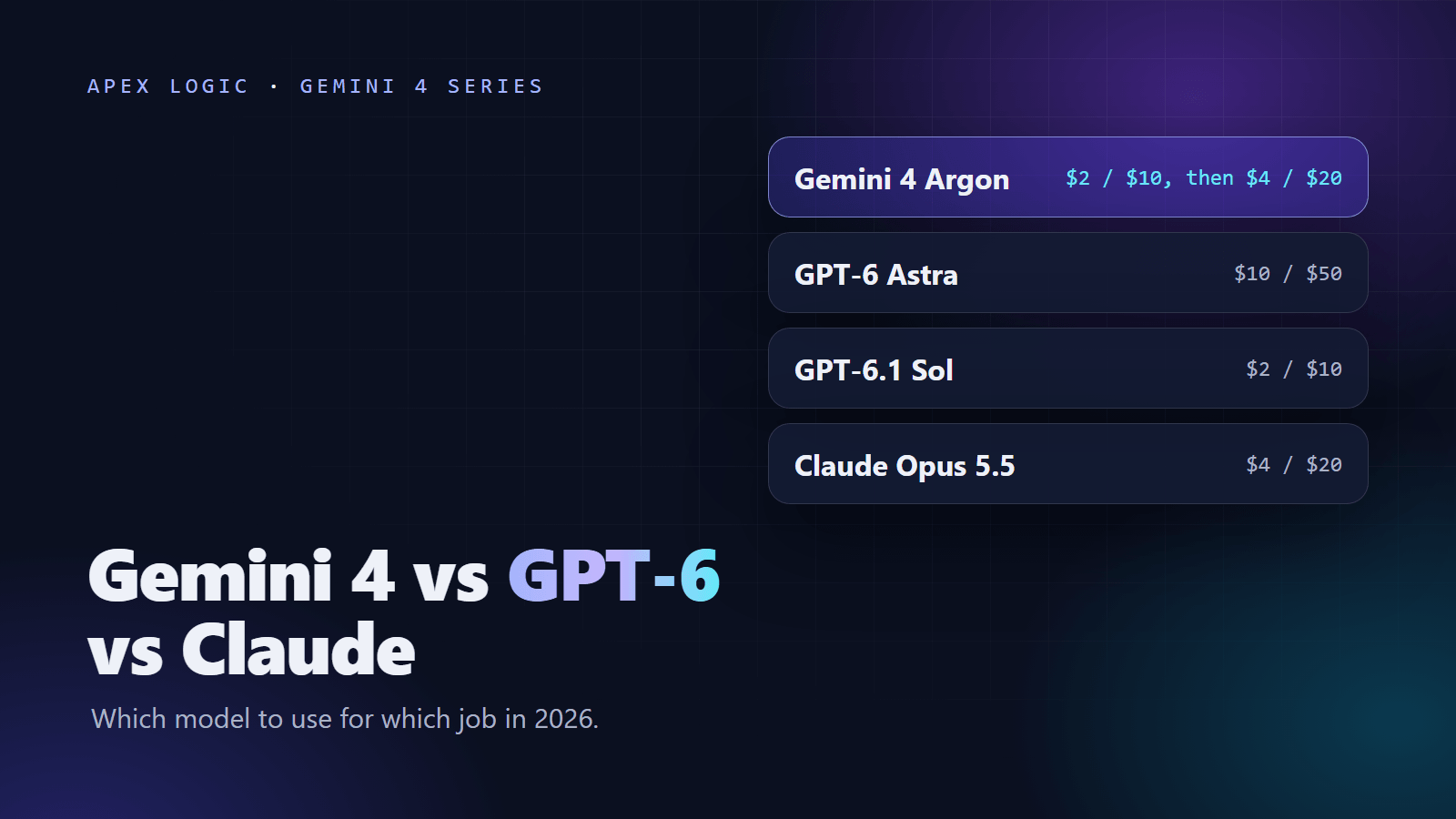
For worked monthly costs and a price comparison with GPT-6 and Claude, read our Gemini 4 pricing breakdown.
Gemini 4 benchmarks: what Google reported
Google's model card compares Argon with GPT-6 Astra, Claude Fable 5.1 and Claude Opus 5.5. All figures below are Google-reported, and the rival scores were mostly taken from the providers' own published numbers.
| Benchmark (%) | Gemini 4 Argon | GPT-6 Astra | Claude Fable 5.1 | Claude Opus 5.5 |
|---|---|---|---|---|
| Vals Index | 68.9 | 63.1 | 65.8 | 67.0 |
| AutomationBench | 51.3 | 41.4 | 31.4 | 42.5 |
| Vals Finance Agent v2 | 65.4 | 53.5 | 58.9 | 58.6 |
| Harvey Legal Agent Benchmark | 19.6 | 5.4 | 6.7 | 3.8 |
| DeepSWE v1.1 | 77.9 | 74.1 | 67.4 | 74.2 |
| FrontierSWE v2 | 55.0 | 65.5 | 56.3 | 62.3 |
| Terminal-bench 4.0 | 57.4 | 58.2 | 57.9 | 66.4 |
| GraphWalks BFS F1 256k-1M | 84.2 | 71.8 | 65.0 | 66.8 |
| LVBench | 91.7 | 87.5 | 79.7 | 83.7 |
| OSWorld-2.0 | 69.2 | 72.6 | Not reported | Not reported |
Bold marks the top score in each row. What the numbers say:
- Where Argon leads: business agent tasks (AutomationBench, Vals Finance Agent v2 and the Harvey Legal Agent Benchmark), long-context reasoning (GraphWalks at 256k to 1M tokens) and long video (LVBench).
- Where it trails: FrontierSWE v2 and Terminal-bench 4.0, where all three rivals score higher, and OSWorld-2.0, where GPT-6 Astra is ahead.
- Overall: across all 19 rows in Google's table, Argon leads 13, ties 1 and trails on 5. The 10 rows above include 3 of those 5.
Read them with caveats. Because rival scores are mostly the providers' own numbers, test setups can differ. LVBench frame sampling differed between models. OSWorld-2.0 has no reported Claude scores. And the model card says these results cannot be compared with earlier Gemini model cards, so do not line them up against Gemini 3.x numbers.
A lead in a table is not a solved problem: the top score on the Harvey Legal Agent Benchmark is 19.6. Use benchmarks to build a shortlist, then test on your own tasks. Our Gemini 4 vs GPT-6 vs Claude comparison weighs price and fit side by side.
Safety notes and known limitations
Google says Argon was built for long-horizon software engineering, enterprise knowledge work such as legal and finance, and cybersecurity defense. A few points matter in practice:
- Cyber guardrails: for general use, mitigations block offensive tasks such as exploitation. Only Fairwind members, working on defense, get Argon without them.
- Hallucinations: listed as a known limitation in the model card. Check facts, figures and citations before anything reaches a customer.
- Slowness and timeouts: also listed. Set HTTP timeouts to at least 20 minutes and plan for retries.
- Dated knowledge: some areas are out of date. Use Search grounding or URL context where freshness matters.
- Empty answers on hard tasks: an output step can be all thinking, returning empty text and a continuation token. Code that treats empty text as a failure will misbehave.
What we do not know yet
As of 14 October 2026, we have found no official figures for Argon's parameter count, latency, per-tier rate limits or Gemini app usage caps. We have also not found a country list for the consumer rollout, a Google Cloud price page or any word on other Gemini 4 models. We will update this guide as official details appear.
How to get access to Gemini 4 Argon
Developers: Gemini API and Google AI Studio
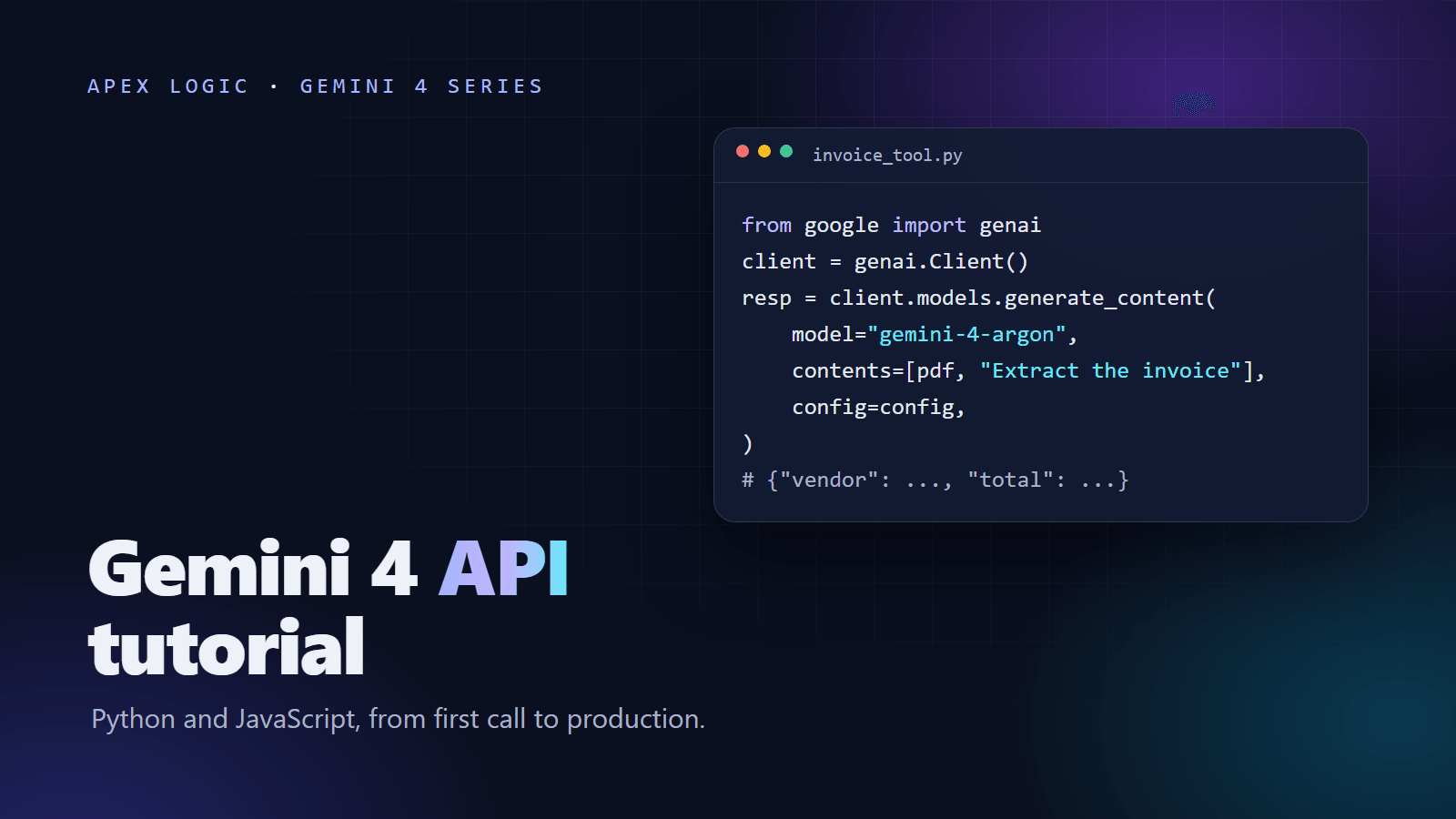
Create an API key in Google AI Studio on a paid-tier project and call gemini-4-argon. Google's official samples use google-genai 2.30.1 or later for Python and @google/genai 2.29.1 or later for JavaScript. Our Gemini 4 API tutorial walks through the first request, structured output, long responses and the full migration checklist from Gemini 3.x.
Everyday users: Gemini app and AI Mode
Argon is in the Gemini app and in AI Mode in Search for Google AI Pro and Ultra subscribers. Ultra subscribers get more usage.
Businesses: Google Cloud and Gemini for business
On Google Cloud, Argon is generally available on Gemini Enterprise Agent Platform, the new name for Vertex AI, in the global endpoint and the us and eu multi-regions. It is also available in Gemini for business. One difference to note: implicit caching starts at 6,144 tokens on Google Cloud, not 4,096.
What businesses can build with Gemini 4
Among the benchmark rows above, Argon's widest leads are in legal work, long-context reasoning, automation and finance. Add PDF, image, audio and video input, and it suits tools like these:
- Customer support chatbots that answer from your own help content using file search. See our AI customer support chatbot.
- Invoice and document extraction that turns PDFs and scans into clean JSON with structured outputs. See AI invoice data extraction.
- Contract review assistants that read long agreements in one pass and flag clauses for a lawyer, who makes every decision. See our AI contract review assistant.
- Finance and data analysis agents that use code execution to work through exported data and reports.
- Meeting summaries from recordings or transcripts, with decisions and action items.
Browse the full set on our AI tools page. For more ideas, read AI tools you can build with Gemini 4, and for budgets and timelines, see what it costs to build an AI tool on Gemini 4.
We build custom AI tools like these on fixed quotes, and you own 100% of the code. A chatbot or a single AI feature typically takes 2 to 4 weeks. If you have a process in mind, tell us about it and we will say honestly whether Argon or a cheaper model is the better fit.
Gemini 4 Argon FAQ
Is Gemini 4 out?
Yes. Gemini 4 Argon became generally available in the Gemini API (paid tier) and Google AI Studio on 13 October 2026. The same day it reached the Gemini app and AI Mode in Search for Google AI Pro and Ultra subscribers, and Google Cloud's Gemini Enterprise Agent Platform. Google announced the model on 30 September 2026, when only Fairwind Program partners had access.
What is Gemini 4?
Gemini 4 is the latest generation of Google's Gemini models. Its first model, Gemini 4 Argon, is a sparse mixture-of-experts transformer that reads text, images, video, audio and PDFs and writes text. As of 14 October 2026 it is the only Gemini 4 model in the Gemini API. Google built it for long-horizon software engineering, enterprise knowledge work such as legal and finance, and cybersecurity defense.
Is there a Gemini 4 Pro or Gemini 4 Flash?
No. Google gave the first Gemini 4 model a codename, Argon, instead of a Pro or Flash label, and gemini-4-argon is the only Gemini 4 model id in the Gemini API. Flash continues on the 3.x line, with Gemini 3.8 Flash generally available since 2 September 2026. Reuters reported that a Google spokesperson said Argon is larger than the old Pro line and that Gemini 3.5 Pro will not be released.
How big is the Gemini 4 context window?
Gemini 4 Argon has a 1,048,576-token context window, shared by input, thinking and output. A single request returns up to 65,536 output tokens by default when you stream or use the SDKs, or 32,768 with non-streaming REST calls. With long decode, output can run up to 1M tokens minus your input through a continuation token, and the latest SDKs continue automatically.
What is the Gemini 4 knowledge cutoff?
The model card gives a knowledge cutoff of March 2026 and lists dated knowledge in some areas as a known limitation. For anything that changed after that, such as prices, regulations or product details, give the model fresh sources. Argon supports Google Search grounding, Maps grounding, URL context and file search, so it can work from current information instead of memory.
How much does Gemini 4 cost?
As of 14 October 2026, Gemini 4 Argon costs $2 per million input tokens and $10 per million output tokens in the Gemini API through 30 November 2026. From 1 December 2026 those rates double to $4 and $20. Thinking tokens are billed as output, Batch and Flex run at half the standard rate, and there is no free tier.
Sources
- Google: Gemini 4 Argon announcement (30 September 2026)
- Google: Gemini 4 Argon in the Gemini app and AI Mode
- Google DeepMind: Fairwind Program
- Google DeepMind: Gemini 4 Argon model card
- Gemini API changelog
- Gemini API: models
- Gemini API: Gemini 4 Argon model page
- Gemini API: generating content with the latest model
- Gemini API pricing
- Google Cloud: Gemini 4 Argon on Gemini Enterprise Agent Platform
- Google Cloud: get started with Gemini 4
- Google Cloud blog: Gemini 4 Argon available on Google Cloud
Loading comments...