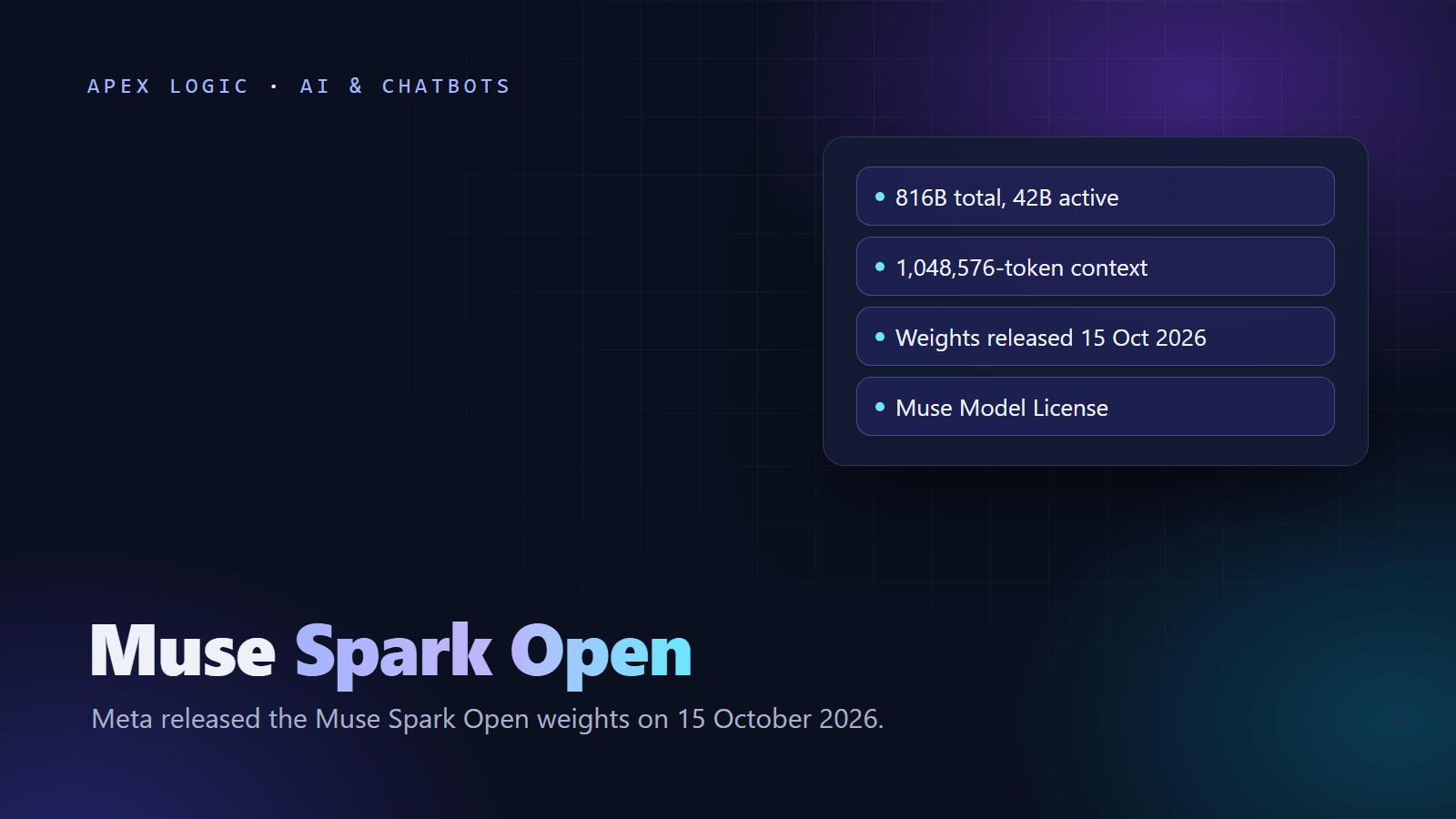
Updated 16 October 2026. Meta released the Muse Spark Open weights on 15 October 2026, and this guide covers the license, hardware, hosted APIs and how to run it.
Muse Spark Open is the open-weight version of Meta's Muse Spark model, released on 15 October 2026. It is a sparse mixture-of-experts model with 816B total parameters and 42B active per token. It reads text, images, audio and video, writes text, and has a 1,048,576-token context window. Meta calls it the most capable US open-weight model so far.
You can download it from Hugging Face after a gated form and run it with vLLM, SGLang, TensorRT-LLM, Hugging Face Transformers, MLX, llama.cpp or Unsloth. It is big: Meta puts the 4-bit weights at about 530 GB and the full-precision weights at about 1.6 TB, before memory for the cache and runtime. Meta does not serve it on its own Model API, so most businesses will start on a hosted provider such as Together AI, Fireworks AI or Baseten, and self-host only when data rules or steady volume justify the hardware.
Muse Spark Open at a glance
| Item | Muse Spark Open |
|---|---|
| Maker | Meta Superintelligence Labs |
| Released | 15 October 2026 |
| Hugging Face repo | meta-models/Muse-Spark-Open-816B-A42B |
| Architecture | Sparse mixture-of-experts: 816B total, 42B active per token, 256 experts with 8 active per token |
| Perception encoder | 1.8B parameters, for images, video and audio |
| Input and output | Text, image, audio and video in; text out |
| Context window | 1,048,576 tokens |
| Training data | More than 100 languages |
| Reasoning effort | low, medium, high or xhigh (default xhigh) |
| License | Muse Model License plus Meta's Acceptable Use Policy |
| Price from Meta | None: self-host it or use a hosted provider |
The PyTorch blog says Muse Spark Open shares its base model with Muse Spark 1.3, plus extra safety post-training that makes it harder to misuse without Meta's system guardrails. Some news coverage says version 1.2 instead; we follow the PyTorch blog, an official source.
Meta built it for coding and agent work: tool calling, subagents, web browsing and computer use across desktop, mobile and browser.
The Muse Model License: what it allows
Muse Spark Open is not under Apache or MIT. It ships under the Muse Model License plus Meta's Acceptable Use Policy. Read both before you build. The points that matter most for a business:
- Attribution. Products and services built with it must prominently display "Built with Muse Spark Open" in their user interface.
- The $20 million rule. If the licensee and its affiliates pass $20 million in gross revenue in any 12 consecutive months, the licensee must notify Meta and sign a separate written agreement before offering the model as a service.
- Possible exemptions. VentureBeat reported that internal deployment, research and use inside a product that is not itself a model service are exempt from that rule. Check this against the license text with your lawyer.
- Gated download. The Hugging Face form asks for your full legal name, date of birth and full organization name with all corporate identifiers. You cannot edit it after you submit, and the model is not intended for anyone under 18.
If a permissive license matters more than size, Meta's smaller Muse Glimmer is open-weight under Apache 2.0 and aimed at local and edge use.
Hardware: how much memory Muse Spark Open needs
Only 42B parameters are active per token, but all 816B have to sit in memory. That is why even the compressed builds need hundreds of gigabytes. Meta publishes these options:
| Build | Weights size | Where Meta says it runs |
|---|---|---|
| BF16 (full precision) | About 1.6 to 1.65 TB | 8 GPUs, for example 8x B300; budget about 2 TB of VRAM |
| NVFP4 (experts in 4-bit) | About 530 to 537 GB | One 4-GPU NVIDIA Blackwell node, four Blackwell Ultra GPUs or eight H200s |
| NVFP4 with Apple MLX | Same as above | Two M5 Ultra Mac Studios with 512 GB each, or four with 256 GB each, linked by Thunderbolt 5 with RDMA |
| Unsloth GGUF (down to about 2-bit) | See the conflict below | Combined RAM and VRAM, with llama.cpp |
Weights are not the whole bill. Meta's docs say you need memory beyond the weights for the KV cache, activations and runtime overhead, and the cache grows with the length of your prompts. Meta says the model is verified on NVIDIA, AMD, Intel and Apple silicon.
Meta's memory figures do not agree
Meta's figures range from about 530 GB to 700 GB for the NVFP4 build, and from about 1.6 TB to 2 TB for BF16:
- Meta's docs give checkpoint sizes of about 537 GB (NVFP4) and 1.65 TB (BF16). Meta's developer post rounds them to 530 GB and 1.6 TB.
- The Hugging Face model card says the model needs at least 700 GB of VRAM for NVFP4 and 2 TB for BF16.
- For the smallest GGUF build, Meta's developer post says it fits in about 300 GB of combined RAM and VRAM, while the quantization table in the same post says it runs on a 256 GB setup with llama.cpp.
Our reading is that the card's higher figures include room for the cache and runtime, but Meta does not say so. Plan capacity with the higher numbers and test before you buy hardware.
Running it on Macs
The Mac route in the table uses Apple MLX and unified memory. On 15 October, VentureBeat reported that the 512 GB Mac Studio ships in late October with no price yet, and that Apple lists a 256 GB M5 Ultra at $10,799. At that reported price, four 256 GB machines cost about $43,200 before cables and setup, a serious purchase for a model you can also rent by the token.
Hosted Muse Spark Open APIs and prices
Meta does not serve Muse Spark Open on its own Model API, and it lists no per-token price. At launch, Meta named seven hosted providers:
| Provider | What Meta says is offered |
|---|---|
| Baseten | Serverless and dedicated inference on the NVFP4 build, with the 1M-token context |
| Fireworks AI | Serverless pay-per-token API, dedicated deployments and serverless LoRA fine-tuning |
| Groq | Limited preview on GroqCloud, aimed at fast multi-step agent loops |
| Modal | A per-token shared endpoint or a dedicated endpoint |
| Nebius Token Factory | Available at launch |
| OpenRouter | Access through its model gateway |
| Together AI | Serverless and dedicated endpoints, with a 99.9% SLA |
The weights are also in Amazon SageMaker AI, Google Cloud Model Garden and Microsoft Foundry Models, which suits teams that already run on those clouds.
Prices, as of 16 October 2026. The only per-token price we have is third-party. VentureBeat reported Together AI's serverless price as $1.25 per million input tokens, $0.15 per million cached input tokens and $4.25 per million output tokens. We could not verify prices on Fireworks AI, Baseten, Nebius, Groq or OpenRouter, so check each provider's pricing page before you commit. One third-party report says Groq caps the context at 131,072 tokens; we could not confirm that either.
How to run Muse Spark Open, step by step
This path assumes you have suitable hardware or a rented GPU node. The commands come from Meta's model card and Meta's developer post.
Step 1: Get access on Hugging Face
Open the model page, accept the license and fill in the gated form. Use your full legal details without acronyms or special characters, because you cannot edit the form later. Once you are approved, log in to Hugging Face on the machine that will download the weights, with an access token from the approved account.
Step 2: Pick the build that fits your hardware
- 8 large GPUs with about 2 TB of VRAM: the BF16 checkpoint.
- A 4-GPU Blackwell node or eight H200s: the NVFP4 checkpoint,
meta-models/Muse-Spark-Open-816B-A42B-NVFP4. - Two or four M5 Ultra Mac Studios: the NVFP4 build with MLX. Meta links a cookbook for this setup rather than a single command.
- A big-memory workstation: a GGUF build with llama.cpp or Unsloth.
Step 3: Start a server
The basic vLLM command from the model card:
pip install vllm
vllm serve "meta-models/Muse-Spark-Open-816B-A42B"
For the NVFP4 build on a 4-GPU Blackwell node, Meta's developer post adds tensor and expert parallelism and the full context length. A shortened version of its flags:
vllm serve meta-models/Muse-Spark-Open-816B-A42B-NVFP4 --tensor-parallel-size 4 --enable-expert-parallel --max-model-len 1048576Meta's full command also sets a speculative decoding config, and the post gives tuned versions for SGLang and TensorRT-LLM. Copy those for production. The SGLang basics from the model card:
pip install sglang
python3 -m sglang.launch_server --model-path "meta-models/Muse-Spark-Open-816B-A42B" --host 0.0.0.0 --port 30000
For GGUF builds, Meta's post shows these llama.cpp and Unsloth commands:
llama serve -hf ggml-org/Muse-Spark-Open-816B-A42B-GGUF:Q4_K_S
unsloth run --model unsloth/Muse-Spark-Open-816B-A42B-GGUF:UD-Q2_K_XL
Check each file's size on Hugging Face before you download it. The model card also links quantized builds for Ollama, LM Studio and other compatible apps.
Step 4: Send a test request
vLLM and SGLang expose an OpenAI-compatible API, on port 8000 for the vLLM command above and port 30000 for SGLang. A test call with Meta's recommended sampling settings:
curl http://localhost:8000/v1/chat/completions   -H "Content-Type: application/json"   -d '{
    "model": "meta-models/Muse-Spark-Open-816B-A42B",
    "messages": [{"role": "user", "content": "List three risks in this supplier contract clause: ..."}],
    "temperature": 1.0,
    "top_p": 1.0,
    "reasoning_effort": "medium"
  }'
Use the same model name you passed to the server. Meta recommends temperature 1.0 and top_p 1.0 with top_k turned off. Reasoning effort can be low, medium, high or xhigh, set with the reasoning_effort request parameter or through chat_template_kwargs. The default is xhigh, and Meta's benchmark scores were measured at xhigh, so test lower levels on your own tasks before you rely on them.
Step 5: Add guardrails
Meta lists these limitations on the model card:
- It can give inaccurate or biased answers.
- It can make multi-step reasoning errors, mainly in new situations.
- It has not been evaluated on every language in its training data.
- Quantized builds can differ slightly from full precision in edge cases.
- Very short or low-resolution video may fail. Use clips at least 448 px on the short side.
For agents, Meta advises guardrails such as human confirmation before irreversible actions.
Fine-tuning options
Meta lists TorchTitan (SFT, LoRA and RL), NVIDIA NeMo AutoModel and Hugging Face TRL for training you run yourself. Managed options include serverless LoRA on Fireworks AI, with sequences up to 262,144 tokens, and SFT or GRPO on Together AI. For most business data, start with retrieval and fine-tune only when that falls short; our RAG vs fine-tuning guide explains the trade-off.
Muse Spark Open benchmarks: what Meta reported
Meta's model card lists these scores, all at xhigh effort:
| Benchmark | Meta-reported score |
|---|---|
| Artificial Analysis Intelligence Index | 39 |
| MCP-Atlas | 89.2 |
| OSWorld Verified | 80.4 |
| Terminal-Bench 2.1 | 76.4 |
| GPQA Diamond | 89.0 |
| DeepSWE 1.1 | 60 |
VentureBeat reported that in Meta's own comparison with GLM 5.3, Kimi K3 and Qwen3.8, Muse Spark Open leads on JobBench and MCP-Atlas and trails on Terminal-Bench 2.1, DeepSWE 1.1 and GDPVal-AA v2. VentureBeat also listed other open models on the Intelligence Index: MiMo-V2.6-Pro at 46, GLM-5.3 at 45, Kimi K3 at 44 and Qwen3.8 at 40. So "most capable US open-weight model" is a narrower claim than "best open model". Treat these as vendor and press figures. Meta's full evaluation report was not out on 16 October 2026; Meta says it is coming soon.
Self-hosting or an API model: which makes sense?
Open weights give you control, not free compute. This is how we would frame the choice for a business:
| Choose | When |
|---|---|
| Self-host Muse Spark Open | Data cannot leave your servers or go to a US API; volume is high and steady; you need to fine-tune deeply or pin one version for years |
| A hosted Muse Spark Open endpoint | You want open weights without running GPUs; volume is uneven; you want the option to self-host later |
| A closed API model | You want the least operations work, or a stronger model for your task; volume is small |
A hypothetical example shows the gap. Assume a support assistant handles 2,000 conversations a day, each with 3,000 input and 500 output tokens: 6 million input and 1 million output tokens a day. At the Together AI prices VentureBeat reported, that is about $11.75 a day, or roughly $350 a month, before cached-input discounts. Long reasoning can raise the output count, so measure real usage. Self-hosting instead means a 4-GPU Blackwell node or several Mac Studios, plus people to run them. On cost alone it pays off only at much higher volume; data rules are the more common reason.
For a deeper comparison, read open-weight LLMs vs API models and our LLM API costs guide.
What you can build with Muse Spark Open
Meta built the model for coding and agents, and it reads images, audio and video. Hypothetical examples, each with its assumptions stated:
- A private knowledge assistant. Staff get answers from internal documents that never leave your servers, assuming a retrieval layer like the one in our production RAG architecture guide. See our AI knowledge base assistant.
- Contract and document review. First-pass review of agreements you cannot send to an outside API, with a lawyer making every decision. See our AI contract review assistant.
- Internal coding agents. Agents that use tools and subagents inside your own environment, with human approval before anything irreversible. Our guide on how to build an AI agent covers the pattern.
- Media intake. Turning site photos, call recordings or short video clips into structured notes, assuming the clips meet Meta's 448 px guidance.
Whatever you build, plan for the "Built with Muse Spark Open" label in the interface. If you would rather use Meta's hosted frontier model, see our Muse Wonder API guide.
We build private AI tools like these on fixed quotes, and you own 100% of the code. If you are weighing self-hosting against a hosted endpoint or an API model, tell us about the workload and we will model the costs both ways before you buy anything.
Muse Spark Open FAQ
Is Muse Spark Open free for commercial use?
The weights are free to download, but use is governed by the Muse Model License and Meta's Acceptable Use Policy, not Apache or MIT. Products must display "Built with Muse Spark Open". If you and your affiliates pass $20 million in gross revenue in any 12 consecutive months, you must notify Meta and sign a separate agreement before offering the model as a service. VentureBeat reported that internal use is exempt from that rule; have a lawyer confirm it.
How much VRAM does Muse Spark Open need?
Meta's figures range from about 530 GB to 700 GB for the 4-bit NVFP4 build, and from about 1.6 TB to 2 TB for full BF16. Meta's docs give checkpoint sizes of about 537 GB and 1.65 TB, while the Hugging Face card says at least 700 GB and 2 TB of VRAM. You also need memory for the KV cache and runtime. The smallest GGUF build needs about 256 GB to 300 GB of combined RAM and VRAM.
Is there a Muse Spark Open API?
Not from Meta, which does not serve it on its Model API. At launch Meta listed Baseten, Fireworks AI, Groq (limited preview), Modal, Nebius Token Factory, OpenRouter and Together AI as hosted providers, and the weights are in Amazon SageMaker AI, Google Cloud Model Garden and Microsoft Foundry Models. VentureBeat reported Together AI's price as $1.25 input and $4.25 output per million tokens, as of 16 October 2026.
Does Muse Spark Open work with llama.cpp or Ollama?
It works with llama.cpp if you have the memory. Meta's developer post shows a llama.cpp command for a Q4_K_S GGUF build from ggml-org and an Unsloth command. Meta says Unsloth's smallest build, at about 2-bit, needs about 256 GB to 300 GB of combined RAM and VRAM. The model card links quantized builds for Ollama, LM Studio and other apps, but the Meta pages we read show no Ollama command.
How is Muse Spark Open different from Muse Spark?
Muse Spark is Meta's hosted model family on the Meta Model API, with ids such as muse-spark-1.3. Muse Spark Open is the open-weight version that you download and run yourself or through a provider. The PyTorch blog says it shares its base model with Muse Spark 1.3 and adds safety post-training for use without Meta's system guardrails. Some news coverage says version 1.2 instead, so the exact lineage is not settled.
Loading comments...