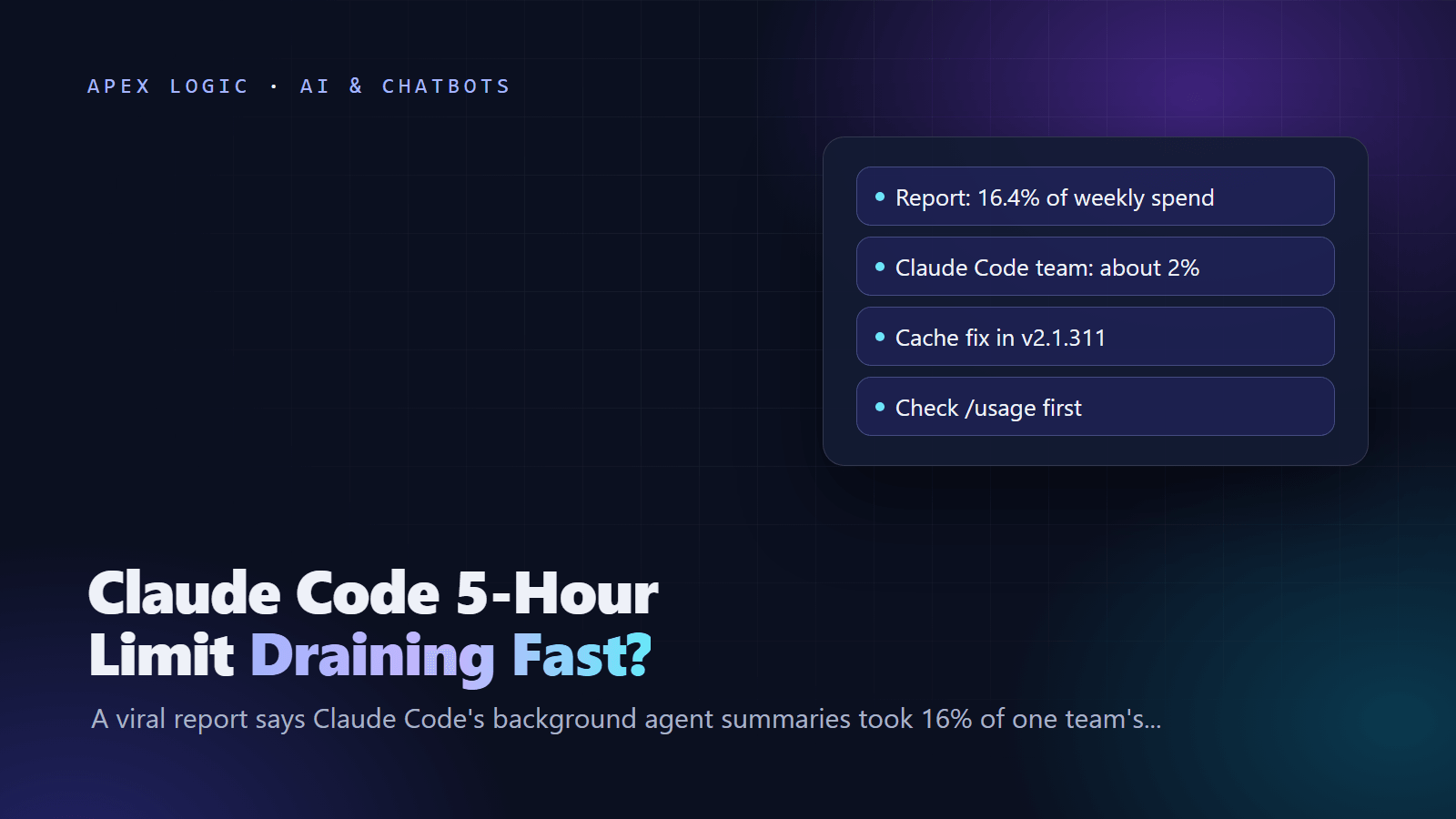
Updated 29 October 2026. A report that Claude Code's background agent summaries eat a large share of usage reached the top of Hacker News on 29 October, and a Claude Code engineer replied with Anthropic's own numbers and a fix in version 2.1.311.
If your Claude Code 5-hour limit drains faster than your work explains, background agents are one likely cause. Claude Code sends each actively working background agent's transcript to a model about every 30 seconds to write a short status label of 3 to 5 words. A developer's report, published on 28 October 2026, measured these "agent_summary" calls at 16.4% of one team's weekly spend. A Claude Code engineer answered on Hacker News that, across users who send telemetry, they are about 2% of cost at API list prices, or about 6% in the terminal, that a fix for the most expensive case shipped in 2.1.311, and that a much cheaper mode is in the works.
To cut usage now, run claude update to get 2.1.311 or later, open /usage to see what is using your limit, put subagents on a smaller model with CLAUDE_CODE_SUBAGENT_MODEL, and turn fork mode off with CLAUDE_CODE_FORK_SUBAGENT=0 if you do not need subagents running in the background. As of 29 October 2026, Anthropic documents no setting that switches the summaries off.
Claude Code agent summaries at a glance
| Question | Answer |
|---|---|
| What it is | A request per active background agent, about every 30 seconds, that writes the short label next to that agent |
| What it is not | Your custom status line script, which Anthropic says runs locally and uses no API tokens |
| Reported share | 16.4% of one team's weekly spend in the Flamerix report; about 18% of weighted tokens in a 27-subagent session in a GitHub issue |
| Anthropic's figure | About 2% of cost and just under 4% of requests across telemetry users last week; about 6% of cost in the terminal |
| Fixed so far | Summaries that missed the prompt cache, fixed in 2.1.311 and later, according to the engineer |
| Off switch | None documented as of 29 October 2026 |
| First steps | Update, check /usage, use a smaller subagent model, turn fork mode off if you can |
What are Claude Code agent summaries?
In interactive sessions, subagents that Claude starts from your main conversation run in the background by default, according to Anthropic's subagents docs. The changelog shows when that started: 2.1.232, released on 13 August 2026, made subagents in interactive sessions run in the background by default, and 2.1.302, on 16 October, made the desktop app and VS Code always run the main conversation's subagents in the background, as the terminal does.
Each background agent shows a short live label, such as what it is reading or fixing. The Flamerix report says Claude Code builds that label by sending the agent's transcript to the agent's own model with a request for a few words, and that the answer only updates the label; it never reaches your conversation. The report dates the behavior to 2.1.232. The Claude Code engineer who replied confirmed the basic mechanism, and added that only background agents that are actively working get these calls, not idle ones.
This is not the status line you set up with a script. Anthropic's status line docs say that one runs locally and does not consume API tokens. In the TypeScript Agent SDK, a similar feature is an option called agentProgressSummaries, which is off by default, according to the SDK reference.
How much of your usage do agent summaries use?
The measurements vary widely, because they depend on how many agents run at once, for how long, how large each transcript is and which model each agent uses:
| Source | Setup | Share reported |
|---|---|---|
| Flamerix report (28 October 2026) | One team's week, mostly background agents | 16.4% of estimated spend and 19.7% of requests, 96% of it on Opus |
| GitHub issue 86879 (15 August 2026) | One 4-hour session with 27 subagents | 22.7% of requests and about 18% of weighted tokens |
| A tester on Hacker News | Their own sessions | About 8% at most |
| Claude Code engineer | Users who send telemetry, last week | About 2% of cost and under 4% of requests; about 6% of cost in the terminal |
The pattern is clear even if the totals differ: many long-running background agents on Opus cost the most, and a summary that misses the prompt cache costs far more than one that hits it. The report's figures are Claude Code's own per-request estimates, not invoices, and the engineer suggested the 16.4% reflects a team that runs mostly background agents rather than a typical session.
What has Anthropic said and fixed?
- The response: in a Hacker News comment on 29 October, a Claude Code engineer gave the 2% and 6% figures, agreed that this is a lot to spend on a status label and offered to look into the reporter's session.
- Version 2.1.311 (26 October 2026): the engineer said a fix for summaries that miss the prompt cache, the most expensive case, shipped in 2.1.311 and later. The same release made
/usageshow large prompt-cache misses. - A cheaper mode is coming: the engineer said Anthropic is working on a mode that sends short notes to a smaller model instead of the full transcript. The report says a "short" mode already exists in 2.1.310 but is off by default and controlled by Anthropic.
- Earlier fixes: version 2.1.128, from 4 May 2026, fixed subagent progress summaries missing the prompt cache and stopped them firing repeatedly while a subagent sat idle.
- No off switch yet: GitHub issue 86879, opened on 15 August, asks for a supported way to disable the summaries. It was still open with no staff reply when we checked on 29 October 2026.
What is the Claude Code 5-hour limit?
Pro and Max plans have a five-hour limit and a weekly limit, and both are shared between Claude chat and Claude Code, according to Anthropic's help center. Max plans also have a separate weekly limit for Fable models. Since version 2.1.312, released on 27 October 2026, Claude Code calls the five-hour window the "5-hour limit" instead of the "session limit", and VS Code shows the clock time when it resets.
As of 29 October 2026, Pro costs $20 a month, or $17 a month billed annually, and Max starts at $100 a month for 5x or 20x Pro's usage per session. When you hit a limit, you can wait for the reset, turn on usage credits billed at API rates or upgrade. Switching models does not restore access after a 5-hour or weekly limit, because those limits cover all models. Since 2.1.304 (19 October), Pro and Max also warn you when resuming an old conversation would use a noticeable share of the 5-hour limit.
How to see what is using your Claude Code limit
- Run
/usage. On Pro, Max, Team and Enterprise plans it shows how recent usage splits across skills, subagents, plugins and MCP servers, plus recommendations for anything behind 10% or more of your usage. Pressdorwto switch between 24 hours and 7 days, and pressfto apply the fixes it can, which needs 2.1.305 or later. The figures come from local history on that machine, according to Anthropic's costs guide. - Check
/statusfor your remaining allocation, as the help center suggests. - Use OpenTelemetry for detail. Each
claude_code.api_requestevent carriescost_usdand aquery_sourcenaming the subsystem that sent it, according to the monitoring docs. The Flamerix report found the summaries underagent_summary.
# Quick local check: print telemetry events to the terminal for one short session
export CLAUDE_CODE_ENABLE_TELEMETRY=1
export OTEL_LOGS_EXPORTER=console
claude
The console exporter is fine for a short test. For a week of data, send events to an OTLP collector as the monitoring docs show, then group cost_usd by query_source.
8 ways to stop Claude Code draining your 5-hour limit
- Update to 2.1.311 or later. Run
claude update, thenclaude --version, to pick up the summary cache fix and the newer/usagechecks. - Run subagents on a smaller model. Set
CLAUDE_CODE_SUBAGENT_MODELtohaiku. Since the report says each summary uses the agent's own model, this should shrink summary costs as well as the subagents' own work. AddCLAUDE_CODE_SUBAGENT_MODEL_FORCE=1only to override themodelfield in every subagent definition. - Set a model per subagent. Anthropic's costs guide suggests
model: haikufor simple subagents, keeping Opus for those that need deep reasoning. - Turn fork mode off with
CLAUDE_CODE_FORK_SUBAGENT=0if you do not need background subagents. Claude can then wait for a subagent instead of backgrounding it. Users on GitHub issue 86879 report that this stops the summaries, at the cost of fork subagents. - Go further only if you must.
CLAUDE_CODE_DISABLE_BACKGROUND_TASKS=1makes Claude wait for every subagent and turns off background commands and Ctrl+B entirely. - Run fewer agents at once. Each active background agent sends its own requests, and agent teammates keep using tokens until they exit, so stop finished work.
- Clear between unrelated tasks. Claude Code re-sends your whole conversation with every request;
/clearcosts nothing, while a long session drains your limit even for one-line questions. - Match the model and effort to the job. Anthropic's guide says Sonnet handles most coding tasks for less than Opus, and
/effortlowers thinking for simple work. If you use usage credits, set a monthly spend limit.
A settings.json example that applies items 2 and 4. Leave out the force line if some of your subagents need a stronger model:
{
  "env": {
    "CLAUDE_CODE_SUBAGENT_MODEL": "haiku",
    "CLAUDE_CODE_SUBAGENT_MODEL_FORCE": "1",
    "CLAUDE_CODE_FORK_SUBAGENT": "0"
  }
}
One thing we would not do: the report includes an unofficial Bun preload script that suppresses the summary timer. It hooks Claude Code's internals, was tested only on Linux, can break silently after any update, and a commenter on the GitHub issue warned against running it without reading it. Use the documented settings above and wait for Anthropic's cheaper mode.
For teams: what to tell developers
On Team and Enterprise plans, each member's allowance resets on a rolling five-hour window and a weekly window, shared with Claude chat. Put the subagent model and fork settings in managed settings if developers run many agents, export OpenTelemetry to see costs by query_source, and allow usage credits only with spend limits. Our guide to AI coding assistants for teams covers rollout, our AI policy template covers the rules, and our LLM API costs guide covers budgets.
If limits have you comparing agents, our OpenCode 2.0 upgrade guide covers an open-source agent that can use your own keys, and our Claude Code Review guide covers that product's separate pricing. For a cheaper model for routine work, see Claude Haiku 5.5 vs GPT-6 Luna. If you are building your own agents on the Claude API and want cost tracking designed in from day one, talk to us.
Claude Code usage FAQ
Why is my Claude Code usage limit draining so fast?
The usual causes are long conversations that are re-sent with every request, cache misses after a break, subagents and agent teammates sending their own requests, scheduled tasks and compaction. Background agents also send a status summary about every 30 seconds while they work. Run /usage to see which applies to you, update to 2.1.311 or later, and move routine subagents to a smaller model such as Haiku.
What is agent_summary in Claude Code?
It is the name that appears in Claude Code's telemetry for the request that writes the short status label next to a background agent. According to the Flamerix report and a Claude Code engineer, Claude Code sends an actively working background agent's transcript to a model about every 30 seconds to produce that label. The engineer put its cost at about 2% overall, while one team measured 16.4%.
Can I turn off Claude Code agent summaries?
Not directly. As of 29 October 2026, Anthropic documents no setting that disables them, and a GitHub issue asking for one has been open since 15 August. Users report that turning fork mode off with CLAUDE_CODE_FORK_SUBAGENT=0 stops them, and CLAUDE_CODE_DISABLE_BACKGROUND_TASKS=1 goes further. Both settings change how subagents work, so test them on a normal day of work first.
Does the Claude Code status line use tokens?
No. Anthropic's docs say the custom status line runs locally and does not consume API tokens. The token use in the recent report comes from a different feature: the short labels Claude Code writes for each background agent in the agents panel. Those labels are produced by model requests, which is why they count toward your usage while your status line script does not.
What is the Claude Code 5-hour limit?
It is the rolling five-hour usage window on Pro and Max plans, which sits alongside a weekly limit, and both are shared between Claude chat and Claude Code. Claude Code called it the session limit until version 2.1.312 renamed it on 27 October 2026. When you reach it, you can wait for the reset, turn on usage credits billed at API rates or upgrade your plan.
Will putting subagents on Haiku reduce my usage?
It should reduce what subagents cost, because Haiku costs less than Sonnet or Opus, and Anthropic's own costs guide suggests it for simple subagent tasks. Since the report says each summary runs on the agent's own model, summaries for Haiku subagents should cost less too. Keep a stronger model for subagents that do hard reasoning, and check /usage after a few days.
Sources
- Flamerix AI: agent_summary report (GitHub gist, 28 October 2026)
- Hacker News: discussion of the report (29 October 2026)
- Hacker News: reply from a Claude Code engineer
- GitHub: claude-code issue 86879
- Claude Code changelog
- Claude Code Docs: Manage costs
- Claude Code Docs: Subagents
- Claude Code Docs: Environment variables
- Claude Code Docs: Monitoring
- Claude Code Docs: Status line
- Claude Code Docs: Agent SDK, TypeScript
- Claude Code Docs: CLI reference
- Claude Help Center: Claude Code with Pro or Max
- Claude: Pricing

Loading comments...