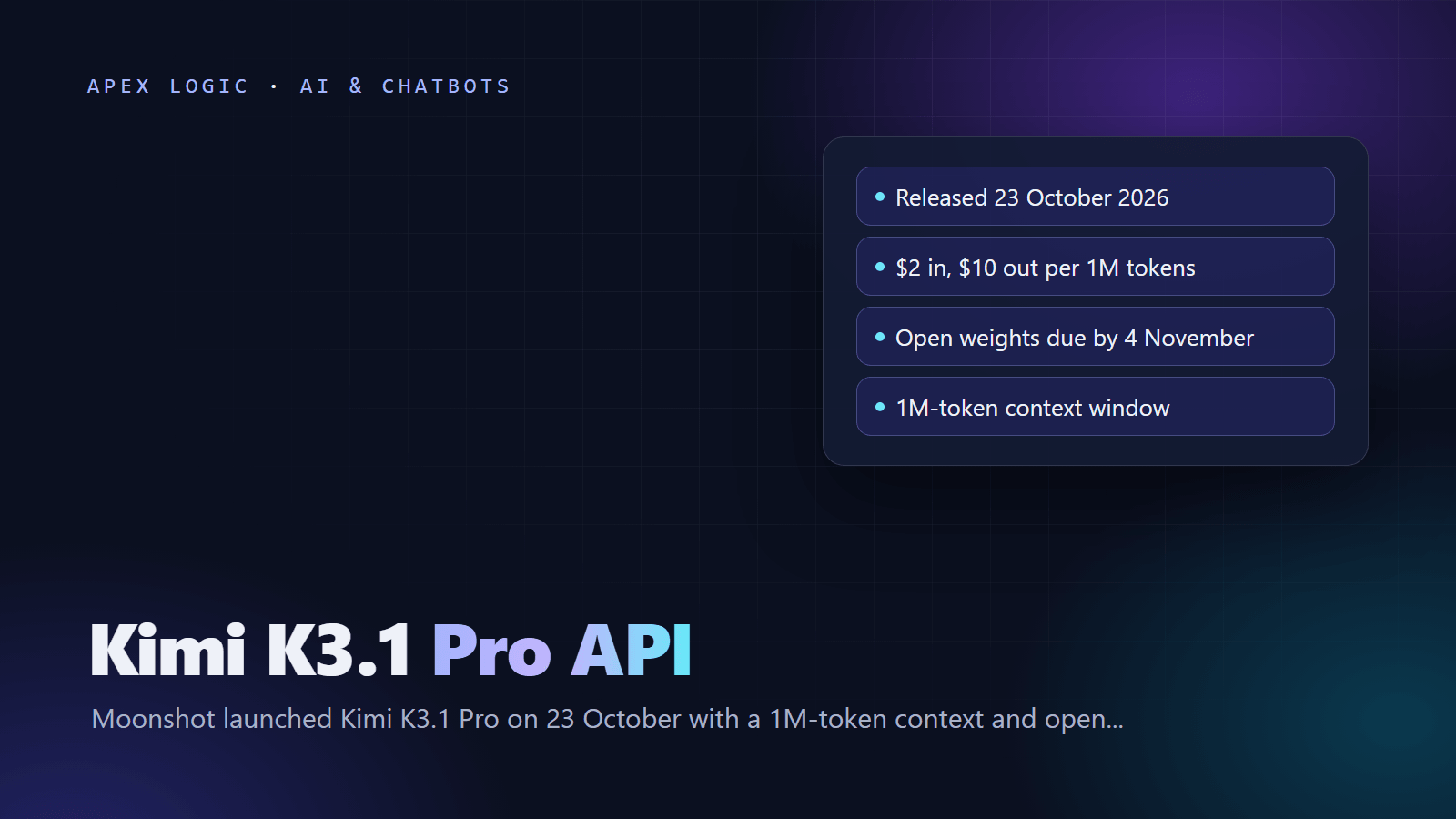
Updated 29 October 2026. Moonshot AI released Kimi K3.1 Pro on 23 October and says the open weights will follow by 4 November, and this guide covers API prices, setup, the K2 cutoff on 31 October and how the model compares.
Kimi K3.1 Pro is Moonshot AI's new flagship model, and you can use it today through the Kimi API with the model ID kimi-k3.1-pro. As of 29 October 2026 it costs $2 per million input tokens, $10 per million output tokens and $0.20 per million cached tokens, with a 1M-token context window and no extra charge for long prompts. A faster version, kimi-k3.1-pro-highspeed, costs twice as much for about 2 to 3 times the speed.
The open weights are not out yet. Moonshot says the full model weights will be released by 4 November 2026, and as of 29 October its Hugging Face page lists Kimi-K3 but no K3.1 repository. Below: the release timeline, API pricing, a Python setup, benchmarks against Claude, GPT and Gemini, and what the K2 cutoff on 31 October means if you use older Kimi models.
Kimi K3.1 Pro at a glance
From Moonshot's launch post, the K3.1 Pro quickstart and the model list, checked on 29 October 2026:
| Item | Kimi K3.1 Pro, as of 29 October 2026 |
|---|---|
| Released | 23 October 2026, together with K3.1 Pro Highspeed |
| Maker | Moonshot AI |
| API model IDs | kimi-k3.1-pro and kimi-k3.1-pro-highspeed |
| Size | "3T-class"; Moonshot gives no exact parameter count |
| Context window | 1M tokens (1,048,576) |
| Output length | 131,072 tokens by default, settable up to 1,048,576 with max_completion_tokens |
| Inputs | Text, images and video |
| Thinking | Always on; reasoning_effort can be low, high or max (default max) |
| API price | $2 input, $10 output, $0.20 cache hit per 1M tokens |
| Highspeed price | $4 input, $20 output, $0.20 cache hit per 1M tokens |
| API access | Opens after a top-up of at least $1 |
| Open weights | Promised by 4 November 2026; license not yet published |
| Also available in | kimi.ai, the Kimi apps for iOS, Android and HarmonyOS, Kimi Work 3.1.0 or later, and Kimi Code |
When will Kimi K3.1 Pro open weights be released?
Moonshot's launch post and API quickstart both say the full weights will be released by 4 November 2026. Until then, you can only use it as a hosted model, through the Kimi API and apps or other API providers, and Artificial Analysis, which counts five providers, lists it as not open weights. As of 29 October 2026, Moonshot's Hugging Face page shows Kimi-K3 and older models, but no K3.1 repository. Before you plan around the download, note three things:
- No license yet. The launch post does not name a license for the K3.1 Pro weights. Read the terms on the model card when it appears, especially for commercial or hosted use.
- Some cyber data removed. Moonshot says it removed cyber-related data from the mid-training and reinforcement learning stages for the open-weight release.
- It is very large. At 4 bits per parameter, a model in the 3-trillion-parameter class needs roughly 1.5 TB just for its weights, far more than one workstation holds. For most businesses, the practical route is the Kimi API or a hosting provider, with self-hosting only where data rules require it.
Our guide to open-weight LLMs vs API models explains when running weights yourself is worth the hardware and staff time.
Kimi K3.1 Pro API pricing
Prices from the Kimi API Platform, per million tokens, as of 29 October 2026. The pricing page says prices exclude taxes, which are calculated at checkout based on your location.
| Item | kimi-k3.1-pro | kimi-k3.1-pro-highspeed |
|---|---|---|
| Input | $2.00 | $4.00 |
| Output | $10.00 | $20.00 |
| Cache write | $2.00 | $4.00 |
| Cache hit | $0.20 | $0.20 |
| Speed | Standard | About 2 to 3 times faster |
There is no price tier by context length, so a very long prompt costs the same per token as a short one. Caching is automatic for repeated prompt prefixes. The default cache lifetime is 5 minutes; for gaps longer than that, you can request a 1-hour cache with prompt_cache_options, which is billed at its own cache-write rate. The cache works in blocks, and a partial block is billed as a cache miss.
Example (assumptions stated): an assistant answers staff questions about a 50,000-token handbook. Each question adds 500 new input tokens and gets 2,000 output tokens back, thinking included. On kimi-k3.1-pro:
- The first question writes the handbook to the cache, about $0.10, plus about $0.02 for the answer.
- Each later question inside the cache window costs about $0.01 for the cached handbook, $0.001 for the new input and $0.02 for the output, so about $0.03.
- 1,000 questions with a warm cache cost about $31. Without caching, each question would cost about $0.12, or about $121 per 1,000.
Thinking is always on, and Artificial Analysis found the model verbose: it used 110 million output tokens to run the Intelligence Index, against a median of 64 million. Check the usage figures returned with each response before you set a budget. For more ways to cut costs, see our LLM API cost guide.
How to use the Kimi K3.1 Pro API in Python
- Create an account on the Kimi API Platform and top up at least $1. K3.1 Pro becomes available after a successful top-up.
- Create an API key and save it as the environment variable MOONSHOT_API_KEY.
- Install the OpenAI Python SDK, version 1.0 or later, on Python 3.9 or later. The Kimi API is OpenAI-compatible, with the base URL https://api.moonshot.ai/v1.
# pip install "openai>=1.0"
import os

from openai import OpenAI

client = OpenAI(
    api_key=os.environ["MOONSHOT_API_KEY"],
    base_url="https://api.moonshot.ai/v1",
)

completion = client.chat.completions.create(
    model="kimi-k3.1-pro",
    reasoning_effort="low",
    messages=[
        {"role": "system", "content": "You answer questions about our refund policy. Be brief."},
        {"role": "user", "content": "Can I return an opened item after 20 days?"},
    ],
)

print(completion.choices[0].message.content)
print(completion.usage)
Rules from the quickstart that trip people up:
- Do not send temperature, top_p, n, presence_penalty or frequency_penalty. They are fixed (temperature 1.0, top_p 0.95), and the docs say to leave them out.
- reasoning_effort accepts low, high or max. The default is max, the slowest setting; low is the suggested way to cut reasoning time.
- When streaming, reasoning arrives in reasoning_content and the answer in content. Show and store only content.
- In multi-turn chats and tool calls, send back the complete assistant message, not just its content.
- Images must be base64 data or an ms:// file reference; public image URLs are not supported. Video is uploaded as a file first.
- The built-in web search tool is being updated, and Moonshot does not recommend it for production for now.
For structured data, such as fields pulled from an invoice, use response_format with a JSON schema in strict mode. This illustrative example follows the format in Moonshot's quickstart and reuses the client from above:
import json

completion = client.chat.completions.create(
    model="kimi-k3.1-pro",
    reasoning_effort="low",
    messages=[{"role": "user", "content": "Extract the fields from this invoice text: ..."}],
    response_format={
        "type": "json_schema",
        "json_schema": {
            "name": "invoice",
            "strict": True,
            "schema": {
                "type": "object",
                "properties": {
                    "supplier": {"type": "string"},
                    "invoice_number": {"type": "string"},
                    "total": {"type": "number"},
                },
                "required": ["supplier", "invoice_number", "total"],
                "additionalProperties": False,
            },
        },
    },
)

invoice = json.loads(completion.choices[0].message.content)
print(invoice["invoice_number"], invoice["total"])
Kimi K3.1 Pro vs Claude Opus 5.5, GPT-6.1 Terra and Gemini 4 Argon
List prices per million tokens from each provider's pricing page (OpenAI, Google, Anthropic), as of 29 October 2026:
| Model | Input | Output | Cached input | Context window |
|---|---|---|---|---|
| Kimi K3.1 Pro | $2.00 | $10.00 | $0.20 | 1M tokens |
| Kimi K3.1 Pro Highspeed | $4.00 | $20.00 | $0.20 | Not stated |
| GPT-6.1 Terra | $1.00 | $5.00 | $0.05 | 1.05M tokens; prompts over 272K cost more |
| Gemini 4 Argon | $2.00, then $4.00 from 1 December | $10.00, then $20.00 | $0.10, then $0.20 | 1,048,576 tokens |
| Claude Sonnet 5.5 | $2.00 | $10.00 | $0.10 | 1M tokens |
| Claude Opus 5.5 | $4.00 | $20.00 | $0.20 | 1M tokens |
Benchmarks published by Moonshot, which are vendor-reported, so treat them as a starting point:
- Terminal-Bench 4.0: K3.1 Pro 65.7%, just behind Claude Opus 5.5 at 66.4% and ahead of GPT-6 Astra at 58.2%.
- Hallucination rate without tools (Kimi Hallu Bench, lower is better): GPT-6 Astra 4.2, K3.1 Pro 5.4, Claude Opus 5.5 6.8, Claude Fable 5.1 11.4.
- Finance: 64.4 on OfficeQA Pro v2, which Moonshot calls state of the art, and 58.6 on Frontier Finance.
Independent results from Artificial Analysis, as of 29 October 2026:
- 46 on its Intelligence Index v5.0, 21st of 52 models; Gemini 4 Carbon leads at 59.
- 1678 Elo on AA-Briefcase, its agentic knowledge-work test, ahead of Muse Wonder (1659), Grok 4.7 (1638) and Gemini 4 Carbon (1609), according to its Gemini 4 Carbon report.
- 35.1 output tokens per second and 2.93 seconds to the first token on Kimi's own API, which makes it one of the slowest models it tracks. If speed matters, test the Highspeed version.
- $3.68 per Intelligence Index task.
In short, K3.1 Pro matches Claude Sonnet 5.5 on token price, gives you a full 1M-token context and does well on agentic and finance tests, but it is slow at default settings and uses many tokens. GPT-6.1 Terra is cheaper per token. Choose by testing on your own tasks. Our guides to MiniMax M3.1 Flash and DeepSeek V4.1 Flash cover two other open-weight models worth comparing.
Kimi K2 models: what changes on 31 October?
If you already use Kimi, this matters more than the launch. Moonshot's model page says that, starting 31 October 2026, K2 series models will no longer be available to newly registered users. Existing users are not affected for now, but Moonshot plans to retire all K2 series models by the end of December 2026 and recommends kimi-k3.1-pro as the replacement. On the same page, the K2-generation models still listed as active are kimi-k2.6, kimi-k2.7-code and kimi-k2.7-code-highspeed.
A short migration checklist:
- Change the model ID to kimi-k3.1-pro and keep the same base URL.
- Remove temperature, top_p, n and the penalty parameters from your requests.
- Choose a reasoning_effort level. Thinking cannot be turned off, so start with low for chat and raise it only where quality improves.
- Update your parser to read content and ignore reasoning_content, and return full assistant messages in tool loops.
- Re-test cost and speed. The context is larger (1M tokens against 256K on kimi-k2.6), but every answer now includes thinking.
- Finish the switch before the end of December, when Moonshot plans to retire the K2 series.
Is Kimi K3.1 Pro safe for business data?
Moonshot says Zero Data Retention is available for API customers. On Kimi Business and Enterprise plans, administrators have to turn K3.1 Pro on, because access is off by default at launch. Before you send customer or employee data:
- Ask Moonshot for its Zero Data Retention terms in writing, and check where your data is processed.
- Write down which data may go to which AI provider. Our AI policy template is a starting point.
- If data must stay on your own servers, consider the open weights once they ship, and budget for the hardware.
If you are weighing Kimi against other models for a document assistant or an analysis tool, such as an AI data analyst or a knowledge base assistant, we can help you compare them on your own data. Contact us with what you have in mind.
Kimi K3.1 Pro FAQ
Is Kimi K3.1 Pro open source?
Not yet. As of 29 October 2026, Kimi K3.1 Pro is available through the Kimi API and apps, and Moonshot says the full model weights will be released by 4 November 2026. Moonshot has not published the license for the K3.1 Pro weights, so check the terms on the model card when it appears. The earlier Kimi-K3 weights are already on Moonshot's Hugging Face page.
How much does the Kimi K3.1 Pro API cost?
As of 29 October 2026, kimi-k3.1-pro costs $2 per million input tokens, $10 per million output tokens, $2 per million for cache writes and $0.20 per million for cache hits, with no extra charge for long prompts within its 1M-token context. The Highspeed version costs $4 input and $20 output. Prices exclude taxes, and access opens after a top-up of at least $1.
What is the difference between K3.1 Pro and K3.1 Pro Highspeed?
Moonshot describes Highspeed as the same intelligence at about 2 to 3 times the speed. It costs twice as much per input and output token, $4 and $20 per million instead of $2 and $10, while cache hits cost the same $0.20. Highspeed suits chat and other interactive uses where waiting matters, and the standard model suits background jobs where speed matters less.
Can I turn off thinking in Kimi K3.1 Pro?
No. Moonshot's quickstart says thinking is always on and cannot be disabled. You can lower reasoning_effort to low to cut reasoning time; the other options are high and max, and max is the default. When streaming, the reasoning arrives in a separate reasoning_content field, so your app should show and store only the content field.
Is the Kimi API compatible with the OpenAI SDK?
Yes. Moonshot's quickstart uses the official OpenAI Python SDK, version 1.0 or later, with the base URL https://api.moonshot.ai/v1 and an API key from the Kimi API Platform. Some parameters behave differently: temperature, top_p, n and the penalty parameters are fixed and should be left out, images must be sent as base64 or file references, and full assistant messages must be returned in multi-turn calls.
What happens to Kimi K2 models after 31 October?
From 31 October 2026, K2 series models are no longer available to newly registered Kimi API users. Existing users keep access for now, but Moonshot plans to retire all K2 series models by the end of December 2026 and recommends kimi-k3.1-pro as the replacement. If you run a K2-generation model such as kimi-k2.6, test K3.1 Pro on your own prompts and plan the switch before December.
Sources
- Kimi: Kimi K3.1 Pro and K3.1 Pro Highspeed launch post
- Kimi API Platform (prices)
- Kimi API: K3.1 Pro quickstart
- Kimi API: model list and K2 notice
- Kimi API: model inference pricing
- Hugging Face: moonshotai
- Artificial Analysis: Kimi K3.1 Pro
- Artificial Analysis: Gemini 4 Carbon report (28 October 2026)
- OpenAI API pricing
- Gemini API pricing
- Gemini API: Gemini 4 Argon model page
- Claude API pricing
- Hacker News: Kimi K3.1 Pro discussion (23 October 2026)
Loading comments...