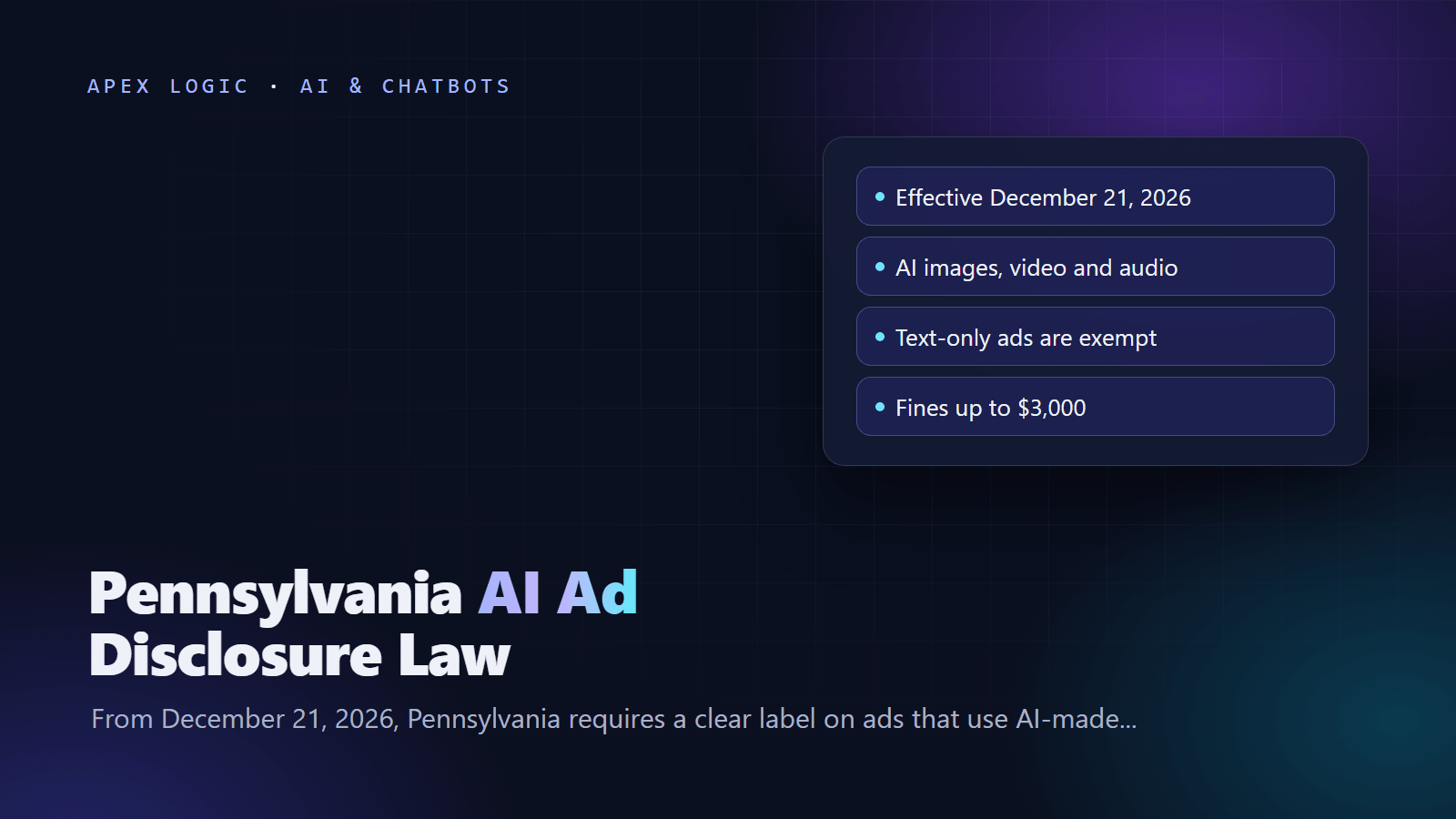
Updated 10 November 2026. Pennsylvania's Artificial Intelligence Deceptive Advertising Act, signed on October 22, takes effect on December 21, 2026, in the last week of holiday ad season.
The Pennsylvania AI ad disclosure law takes effect on December 21, 2026. From that date, an advertiser may not use AI-generated or significantly AI-modified images, video, audio or other content in an ad in a way that creates a false consumer perception about the nature, origin or authenticity of the product or service, unless the ad carries a clear and conspicuous disclosure. The disclosure must state that the advertisement contains content that was modified or generated using artificial intelligence, appear the first time the content is shown, use the same medium, and be permanent or very hard to remove where technically feasible.
Content limited to text, parody, satire, commentary, criticism and evidently fictional content are exempt. Only the Pennsylvania attorney general or a district attorney can enforce the Act, through injunctions and a civil fine of up to $3,000 plus attorney fees and court costs. The final version also removed an earlier "knowingly, recklessly or willfully" standard, as Holland & Knight and Kelley Drye both noted, so the rule has no written intent requirement. This is a practical summary for marketers, not legal advice.
Pennsylvania AI advertising law at a glance
| Topic | Rule | What it means for you |
|---|---|---|
| Law | Artificial Intelligence Deceptive Advertising Act, Senate Bill 806, Act 99 of 2026 | A standalone act on deceptive advertising |
| Signed | October 22, 2026, by Governor Josh Shapiro | Passed the Senate 48 to 2 and the House 163 to 40 |
| Effective | December 21, 2026, 60 days after signing | Holiday and January campaigns are in scope |
| Who | Advertisers who create and disseminate an ad, or cause it to be created and disseminated | Brands, sellers and the agencies that run their ads |
| Covered content | Synthetic content: an image, video, audio clip or text significantly modified or generated by AI | Text-only content is exempt |
| Trigger | A false consumer perception about the nature, origin or authenticity of the goods or services | Judge each creative, not each tool |
| Required statement | The ad contains content that was modified or generated using artificial intelligence | No fixed wording beyond that meaning |
| Placement | First instance, same medium, permanent where technically feasible | Put the label inside the creative |
| Exempt | Evidently fictional content, parody, satire, commentary, criticism, text only | Obvious fantasy scenes need no label |
| Enforcement | Attorney general or a district attorney; injunctions and civil actions | No private right of action in this Act |
| Penalty | Civil fine of up to $3,000 plus actual attorney fees and court costs | Other false advertising laws still apply |
What does the Pennsylvania AI advertising law require?
The Act is short. It defines artificial intelligence broadly, including generative AI, and defines synthetic content as information such as an image, video, audio clip or text that has been significantly modified or generated by AI. Section 4 then bars advertisers from creating and disseminating, or causing others to create and disseminate, an ad that uses synthetic content in a manner that creates a false consumer perception about the nature, origin or authenticity of the goods or services, without a clear and conspicuous disclosure.
The disclosure has to say that the ad contains content that was modified or generated using artificial intelligence. It must appear in the first instance whenever the synthetic content is presented, in the same medium as that content, and, to the extent technically feasible, be permanent or extraordinarily difficult to remove. Section 4(c) adds that disclosing AI use does not limit any other legal recourse, so a label never turns a misleading ad into a lawful one.
The terms advertiser and advertisement are not defined. Holland & Knight noted that this leaves room to argue the duty reaches platforms or publishers as well as brands, so agencies and publishers should not assume the duty sits only with the brand.
Which ads need an AI label?
Not every ad made with AI. The trigger is a false consumer perception about the nature, origin or authenticity of what you sell. Loeb pointed out two possible readings: that showing a product through AI is enough on its own, or that the ad must misrepresent the product beyond the use of AI. Loeb also noted that the sponsor's own statements read more broadly than the final text, with an example of an AI image that could lead buyers to think they are seeing the actual product. CBS Pittsburgh reported that the sponsor, Senator Nick Pisciottano, said the law is meant to protect consumers and that groups representing older residents had reported scams involving fake AI ads.
Loeb noted on October 23 that there was no guidance or enforcement yet to settle the question, and its advice is simple: when in doubt, disclose. That is cheaper than a dispute, and a short label rarely hurts a good ad.
Examples: does this ad need a label?
These are hypothetical examples with our reading of the Act. They are not legal advice.
| Example ad | Label? | Why |
|---|---|---|
| A restaurant ad with an AI-generated burger that looks larger than the one served | Likely yes | It shapes what buyers expect of the product itself |
| A real dress shown on an AI-generated model, with the fit and fabric altered by AI | Likely yes | The AI changes how the product looks |
| "Handmade in our workshop" with AI-made photos of a workshop that does not exist | Likely yes | It misleads about origin and authenticity |
| A real product photo placed on an AI-generated holiday background | Unclear | Depends on the reading of the trigger; many advertisers will label |
| An AI voiceover reading an accurate script | Probably not | Loeb's view is that accurate information may not create a false perception |
| Ad copy written with AI next to real product photos | No | Content limited to text is exempt |
| A cartoon Santa delivering parcels by rocket | No | Evidently fictional content is exempt |
What must the AI disclosure say, and where does it go?
The Act does not prescribe exact words, but the label must convey that the ad contains content modified or generated using artificial intelligence. The clear and conspicuous standard in the Act sets the format:
- Noticeable: size, color, contrast, location, duration and audibility that make it easy to notice, read, understand and hear.
- Same language: in the language the consumer uses to engage with the content.
- Close and consistent: near the content it explains, not contradicted by anything else in the ad, and not obscured.
- Video and images: large enough and on screen long enough to read.
- Audio: spoken at a volume and pace a listener can follow.
- Print and point of sale: type size, placement and contrast a shopper can read.
In practice, burn the label into the image or video itself, because captions, alt text and metadata can be stripped when ads are resized or shared. Show it from the first frame where the AI content appears, and for audio ads, say it when the AI voice or sound first plays.
Sample disclosure lines (illustrative)
- "This ad contains content generated using AI."
- "Images in this ad were modified using AI."
- Audio: "This ad includes an AI-generated voice."
Does the law apply to advertisers outside Pennsylvania?
The Act regulates advertisers that create and disseminate ads and does not limit itself to Pennsylvania businesses. CBS Pittsburgh reported that the law covers ads shown in Pennsylvania even when they are made elsewhere. Most national social, search and marketplace campaigns reach Pennsylvania buyers, so the simple plan is to label covered creatives everywhere rather than build state-by-state versions. Excluding Pennsylvania from targeting is possible, but it is blunt and easy to get wrong across platforms.
Is AI-written ad copy covered?
Not on its own. The definition of synthetic content includes text, but the Act exempts content limited to text. If AI wrote your headline or product description and the images are real, the exemption applies. Ordinary truth-in-advertising rules still do, so claims must be accurate. Our guides to the AI product description generator, Amazon product descriptions with AI and bulk descriptions from a CSV cover review steps that keep AI copy factual.
What are the penalties for an unlabeled AI ad?
The attorney general or the appropriate district attorney can sue to stop the practice with a temporary or permanent injunction, and can bring a civil action. A court may award a civil fine of up to $3,000 plus actual attorney fees and court costs. Holland & Knight noted that the Act does not say whether the fine applies per ad, per day or per violation, and that there is no warning or cure process. The Act gives no private right of action, but Pennsylvania's broader consumer protection law still lets consumers sue over deceptive ads, and Loeb noted that a misleading ad is likely unlawful under existing false advertising law and the FTC Act whether or not it carries a label.
How does Pennsylvania compare with New York and California?
Kelley Drye contrasted the Act with rules in California and New York, which focus on synthetic performers and appear designed to protect actors and models. Pennsylvania's rule has a broader consumer protection angle and reaches AI-made product images, video and audio, not only digital people. Loeb noted that three states now take three different approaches, so a national advertiser needs one internal standard that covers the strictest case.
8 steps to get your ads ready before December 21
- List every live and scheduled creative that uses AI-made or AI-edited images, video or audio, including holiday, retargeting and marketplace ads.
- For each one, ask whether the AI part could change what a buyer believes about the product, where it comes from, or whether it is real.
- When the answer is unclear, add the label.
- Put the label inside the creative, from the first instance, in the same medium, and check it on a small phone screen.
- Update briefs and contracts so agencies and freelancers tell you when they use AI and deliver labeled versions.
- Keep a record for each creative: the tool used, source photos, prompts, approvals and dates.
- Keep text-only AI copy under normal fact checks, since the exemption does not excuse false claims.
- Add the rule to your AI policy and review it in early 2027 for attorney general guidance or new state laws.
Other US marketing rules are changing at the same time, such as the TCPA opt-out rules for texts and calls. If you want help building a creative workflow that tracks AI use and adds labels automatically, our AI solutions team can scope it on a fixed quote, or you can contact us with your current process.
FAQ
When does the Pennsylvania AI ad disclosure law take effect?
The Artificial Intelligence Deceptive Advertising Act takes effect on December 21, 2026. Governor Josh Shapiro signed Senate Bill 806 on October 22, 2026, as Act 99 of 2026, and the Act says it takes effect in 60 days. Holiday campaigns that run past December 21, and January sales creative, should already carry labels where the rule applies.
Do I need to label every ad made with AI?
No. The duty applies when AI-made or significantly AI-modified content is used in a way that creates a false consumer perception about the nature, origin or authenticity of the goods or services. An obviously fictional scene, parody or text-only AI content needs no label. Because the trigger is not defined and law firms saw no guidance when the Act was signed, many advertisers will label whenever AI changes how a product looks.
What wording does the AI label need?
The Act sets the meaning, not the exact words. The disclosure must state that the advertisement contains content that was modified or generated using artificial intelligence. A short line such as "This ad contains content generated using AI" fits that meaning. It must be clear and conspicuous, appear the first time the content is shown, use the same medium, and be hard to remove where technically feasible.
Are AI-written product descriptions covered?
Not by this disclosure rule. The Act's definition of synthetic content includes text, but it exempts content limited to text, so AI-written copy alongside real photos does not need the AI label. The copy must still be accurate under general false advertising law, and a single ad that combines AI text with AI-made images is judged on the images.
Who enforces the law, and what are the fines?
Only the Pennsylvania attorney general or the appropriate district attorney can enforce the Act. They can seek a temporary or permanent injunction and bring a civil action, and a court may award a civil fine of up to $3,000 plus actual attorney fees and court costs. The Act does not create a private right of action, though other consumer protection laws still apply.
Does adding a label protect me from false advertising claims?
No. Section 4(c) of the Act says that disclosing AI use does not limit any other recourse under law. If an ad misleads buyers about a product, a label will not cure it, and other state and federal rules on deceptive advertising still apply. The label is a minimum for covered AI content, not a defense for an untrue claim.
Sources
- Pennsylvania General Assembly: Senate Bill 806 (2025 to 2026 session), history and status
- Pennsylvania General Assembly: Senate Bill 806, Printer's No. 1808 (final text)
- Holland & Knight: Did AI Touch Your Ad? Pennsylvania May Require You to Say So (October 29, 2026)
- Kelley Drye: Pennsylvania Enacts an AI Ad Disclosure Law (October 28, 2026)
- Loeb & Loeb: A New AI Disclosure Law from Pennsylvania (October 23, 2026)
- CBS Pittsburgh: Pennsylvania one of the first states to require disclosures on AI-generated ads (October 22, 2026)

Loading comments...