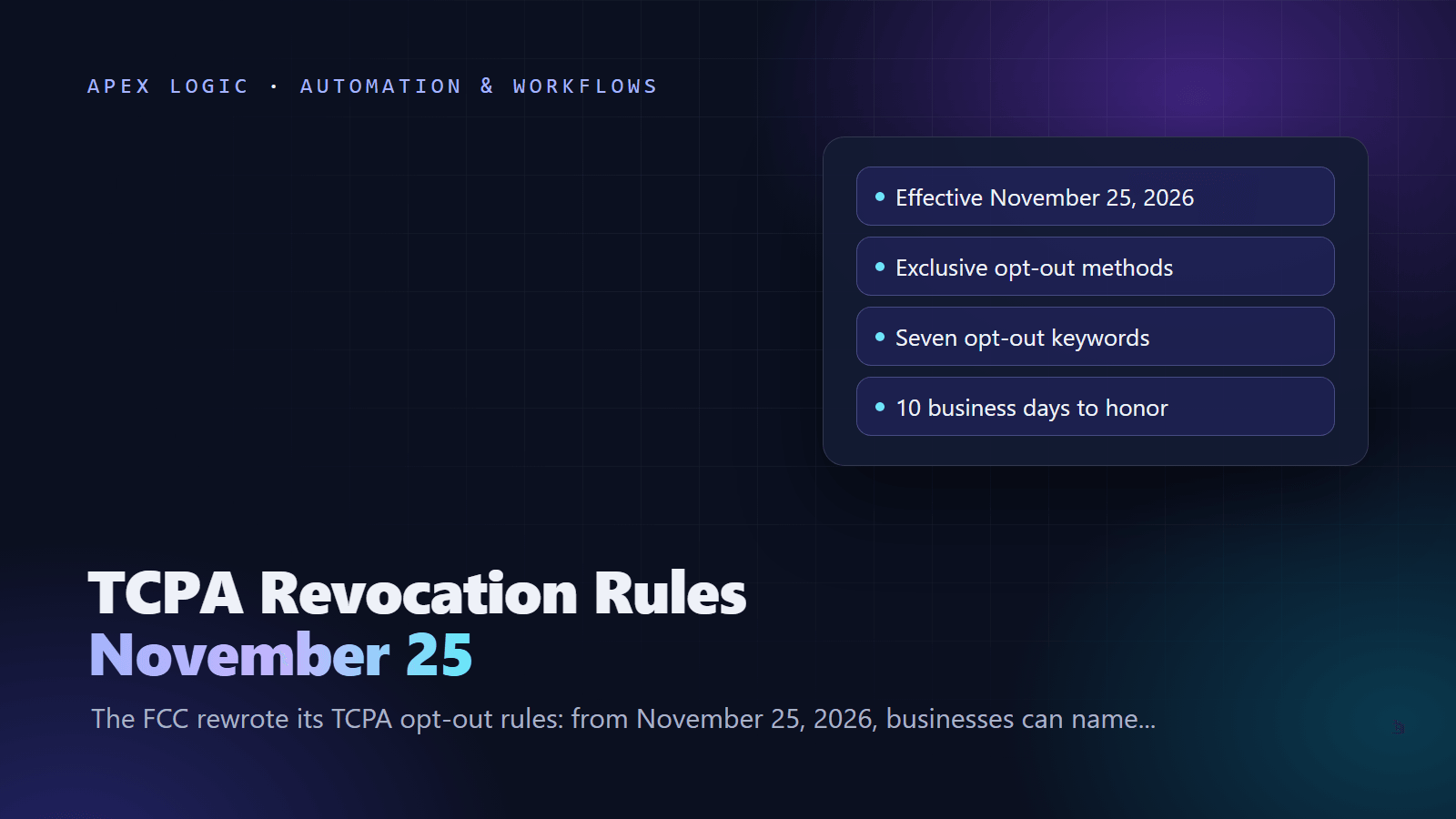
Updated 29 October 2026. The FCC published its revised TCPA revocation of consent rules in the Federal Register on October 26, 2026, and they take effect on November 25, 2026.
The new TCPA revocation rules take effect on November 25, 2026. From that date, a business that sends autodialed texts or makes artificial or prerecorded voice calls may designate one or more approved opt-out methods as the only ones it has to process, as long as it discloses them clearly on every call and in every text. It may also treat an opt-out from one kind of informational message, such as payment reminders, as covering only that kind. An opt-out from marketing still ends all future marketing calls and texts from that business.
The change replaces the strict "revoke all" rule from 2024, which had been pushed back to January 31, 2027. Every valid opt-out must still be honored within a reasonable time, no later than 10 business days, and you may still send one plain confirmation text. November 25 is the day before Thanksgiving, in the middle of holiday SMS season, so finish the work now. This is a practical summary, not legal advice.
TCPA revocation rules at a glance
| Topic | Rule from November 25, 2026 | What to do |
|---|---|---|
| Effective date | November 25, 2026 (91 FR 67214, published October 26, 2026) | Finish your changes by November 24 |
| Exclusive opt-out methods | Designate one or more of three approved methods as the only ones you process | Choose your methods |
| Disclosure | Clear and conspicuous, on the call or in the text | Add an opt-out line to every template |
| Text keywords | stop, quit, end, revoke, opt out, cancel, unsubscribe | Recognize all seven, even if you only show one |
| Informational opt-outs | May apply only to that category | Store consent per message category |
| Marketing opt-outs | Revoke consent to all future marketing calls and texts from you | Keep one marketing suppression list |
| Time to honor | A reasonable time, no more than 10 business days | Process opt-outs in minutes, not days |
| Confirmation text | Allowed if it only confirms; presumed fine if sent within five minutes | Send one short reply with no promotion |
| No exclusive method designated | You must process opt-outs made by any reasonable means | Catch free-text requests too |
What did the FCC change, and when?
The FCC adopted the Report and Order and Further Notice of Proposed Rulemaking (FCC 26-67, CG Docket No. 02-278) on September 30, 2026 and released it on October 1. It was published in the Federal Register on October 26, 2026 as "Enhancing the Ability of Consumers To Control the Robocalls", effective November 25, 2026, and the FCC confirmed that date in Public Notice DA 26-1159 on October 27. The order makes three changes to section 64.1200 of the FCC's rules:
- Category opt-outs. An opt-out sent in reply to an informational call or text may be read as applying only to that category.
- Exclusive opt-out methods. A business may designate approved methods as the only ways to revoke consent, instead of honoring requests made "using any reasonable method".
- Fraud alerts. Financial institutions may send exempt fraud alerts to a wireless number from a "reliable source": a spouse or other family member authorized on the account, a call from the customer, or records from another financial institution.
The 2024 TCPA Consent Order treated an opt-out from one type of message as an opt-out from all of them. Most of it took effect on April 11, 2025, but waivers delayed the "revoke all" part to January 31, 2027. The new rule supersedes that date.
Who has to follow the new TCPA opt-out rules?
For this order, the FCC defines a "robocall" as any call made or text sent using an automatic telephone dialing system, or any call made using an artificial or prerecorded voice. The revocation rules cover calls and texts that need prior express consent, which can include much of the automated outreach a small business runs:
- SMS marketing, abandoned cart texts and promo codes
- Order, delivery, appointment and payment reminders sent from a platform
- Prerecorded voice messages and outbound calls placed by AI voice agents
On the last point, the FCC confirmed in a 2024 ruling (FCC 24-17) that the TCPA's limits on "artificial or prerecorded voice" cover AI technologies that generate human voices, so those calls need prior express consent unless an exemption applies. If you plan outbound calls with an AI voice receptionist, build opt-out handling into the design. Our AI voice receptionist guide compares the main tools. Whether your texting platform counts as an autodialer is a question for counsel; if you are unsure, build as if the rules apply.
What are the three exclusive opt-out methods?
From November 25, a caller may designate one or more of these as the exclusive means to revoke consent:
- An automated, interactive voice or key press opt-out on a call.
- A reply text with any one of seven standardized words: "stop", "quit", "end", "revoke", "opt out", "cancel" or "unsubscribe".
- A website or telephone number the caller designates to process opt-out requests.
The condition is disclosure: you must clearly and conspicuously disclose the designated method on the call or in the text. If you designate reply texts, including at least one of the seven words in each message, such as "Reply STOP to opt out", meets that duty, but you must still treat any of the seven words as a valid opt-out.
If you designate an exclusive method and disclose it, the rule says you are not required to process opt-outs made any other way. If you do not, you must keep processing requests made by any reasonable means, and under revised paragraph (a)(11) such a request creates a rebuttable presumption that consent was revoked.
How do category opt-outs work for informational texts?
An informational message is one with no advertisement and no telemarketing. In the FCC's example, a customer who opted out of payment reminders would, under the old reading, also lose fraud alerts, multi-factor authentication codes, appointment reminders and utility outage calls. From November 25, you may treat that opt-out as covering payment reminders only.
Marketing works differently: an opt-out sent in reply to a marketing call or text revokes consent to all future marketing calls and texts from that caller.
| Message category | Example text | Scope of an opt-out sent in reply |
|---|---|---|
| Marketing | "20% off everything this weekend" | All future marketing calls and texts from you |
| Payment reminders | "Your invoice is due on Friday" | May be limited to payment reminders |
| Appointment reminders | "See you at 3 pm tomorrow" | May be limited to appointment reminders |
| Order updates | "Your order has shipped" | May be limited to order updates |
The category rule is a permission, not a duty, so if someone clearly wants no messages at all, stop everything. It also only works if your systems know each message's category. If your SMS platform stores one yes or no flag per number, you will need consent per category in your CRM; our guide to CRM automation for small business covers how to structure those fields.
How fast must you honor an opt-out?
Every valid opt-out must be honored within a reasonable time, no more than 10 business days after receipt, whether or not you designate exclusive methods. The FCC's Further Notice asks whether to shorten that, with seven business days as an example, so build for speed now.
A single confirmation text is allowed if it only confirms the request and contains no marketing; sent within five minutes, it is presumed to fall within the person's consent. If you use a texting protocol that does not allow replies, each text must say that two-way texting is not available and give reasonable alternative ways to opt out.
10 steps to take before November 25, 2026
- List every automated message stream. Include SMS platforms, CRM sequences, booking tools, payment reminders, IVR systems and AI voice agents.
- Label each stream. Mark it as marketing or informational, and give informational streams a category name such as "order updates".
- Decide on exclusive methods. Reply keywords suit texts, key press opt-out suits calls, and a web form or phone number can serve both.
- Update every template. Add a clear opt-out line to each text and call script, starting with short templates.
- Recognize all seven words. Test each word in upper and lower case, with spaces and punctuation, on every sending number.
- Split consent by category. Store consent per informational category, plus one marketing flag that covers every brand and number.
- Shorten processing time. Ten business days is the ceiling. Aim for near real time in every tool that can send.
- Fix the confirmation text. One plain reply within five minutes, such as "You are unsubscribed from marketing texts." No offers or links.
- Handle the edge cases. Decide what staff do with free-text requests, voicemails and emails, and add the required disclosure if you use one-way texting.
- Write it down. Update your SMS terms and privacy notice, and log every opt-out with a timestamp, channel and category.
Example: matching the seven opt-out words in code
Here is an illustrative Python function for an inbound SMS webhook. An exact match of one of the seven words counts as an opt-out, and longer messages that contain one go to a review queue. It is a starting point, not a complete compliance system.
import re

OPT_OUT_WORDS = {"stop", "quit", "end", "revoke", "opt out", "cancel", "unsubscribe"}


def normalize(text):
    text = text.lower().replace("-", " ")
    text = re.sub(r"[^a-z ]", " ", text)
    text = " ".join(text.split())
    return text.replace("optout", "opt out")


def classify_reply(text):
    clean = normalize(text)
    if clean in OPT_OUT_WORDS:
        return "opt_out"
    padded = " " + clean + " "
    if any(" " + word + " " in padded for word in OPT_OUT_WORDS):
        return "review"
    return "other"


for sample in ["STOP", "Opt-Out", "please stop texting me", "What time do you open?"]:
    print(sample, classify_reply(sample))
It prints opt_out for "STOP" and "Opt-Out", review for "please stop texting me" and other for the last question. In production, also store the sending number, the category of the message replied to and the time, so you can show when each opt-out was honored.
What else is the FCC considering?
The same document opened a Further Notice of Proposed Rulemaking. The FCC asks whether to:
- shorten the 10 business day limit, with seven business days as an example;
- remove the option to use one-way texting protocols;
- require a one-step way to revoke consent to all covered calls and texts; and
- clarify how affiliates are treated.
Comments are due November 25, 2026 and reply comments December 28, 2026. None of this is a rule yet, but an opt-out flow that runs fast and can stop everything with one request is cheap to build now.
How this fits with your other messaging channels
Email and WhatsApp have their own consent and opt-out rules, so keep one consent record per customer with a field for each channel and category. See our guides to email automation for small business and WhatsApp chatbots for business. If an AI lead qualification assistant texts your leads, it should pass any opt-out word straight to your suppression list before it says anything else.
If you want help mapping categories, consent fields and opt-out syncing across your SMS, CRM and voice tools, our automation team can scope it on a fixed quote. Send a list of the tools you send from through our contact page.
TCPA revocation rules FAQ
When do the new TCPA revocation rules take effect?
They take effect on November 25, 2026. The FCC adopted the order, FCC 26-67, on September 30, 2026, and its publication in the Federal Register on October 26 set the effective date 30 days later, which the FCC confirmed in a public notice on October 27. Until then, the current rules apply, including processing opt-outs made by any reasonable means.
Is the TCPA "revoke all" rule gone?
The 2024 version, which would have made one opt-out stop every robocall and robotext from a caller from January 31, 2027, has been replaced. From November 25, an informational opt-out may be limited to its category, while a marketing opt-out still covers all marketing. The FCC is asking whether to require a separate one-step way to revoke everything.
Do I still have to act on "please stop texting me"?
It depends on whether you designated an exclusive method. If you designated reply keywords and disclosed them in each text, the rule says you need not process requests made other ways. If you did not designate one, you must process requests made by any reasonable means, and a plain request like this is the kind that standard is about. Honoring it anyway is easy to automate.
Can I send a confirmation text after someone replies STOP?
Yes. One text that only confirms the opt-out, with no marketing or promotional content, does not violate the rules. If you send it within five minutes, it is presumed to fall within the person's prior consent; if it takes longer, you need to show the delay was reasonable. Keep the wording short and leave out links, offers and surveys.
Do these rules apply to AI voice agents?
Calls using an artificial or prerecorded voice are robocalls under the TCPA, and the FCC confirmed in its 2024 ruling, FCC 24-17, that AI-generated human voices count as artificial voices. Those calls need prior express consent unless an exemption applies, and that consent can be revoked under the same rules. Give your AI voice agent a key press or voice opt-out.
Does a STOP reply to a payment reminder end all my texts?
From November 25, it does not have to. The revised rule lets you treat an opt-out sent in reply to an informational message as covering only that category, so the customer can keep receiving fraud alerts or appointment reminders they agreed to. This is a permission, not a duty. If their words show they want no texts at all, stop everything.
Sources
- FCC: Report and Order and Further Notice of Proposed Rulemaking, FCC 26-67 (PDF)
- Federal Register: Enhancing the Ability of Consumers To Control the Robocalls, 91 FR 67214 (PDF)
- FCC Public Notice DA 26-1159: effective date and comment dates (PDF)
- FCC Declaratory Ruling FCC 24-17 on AI-generated voices (PDF)
- The CommLaw Group: summary of the new consent revocation rules

Loading comments...