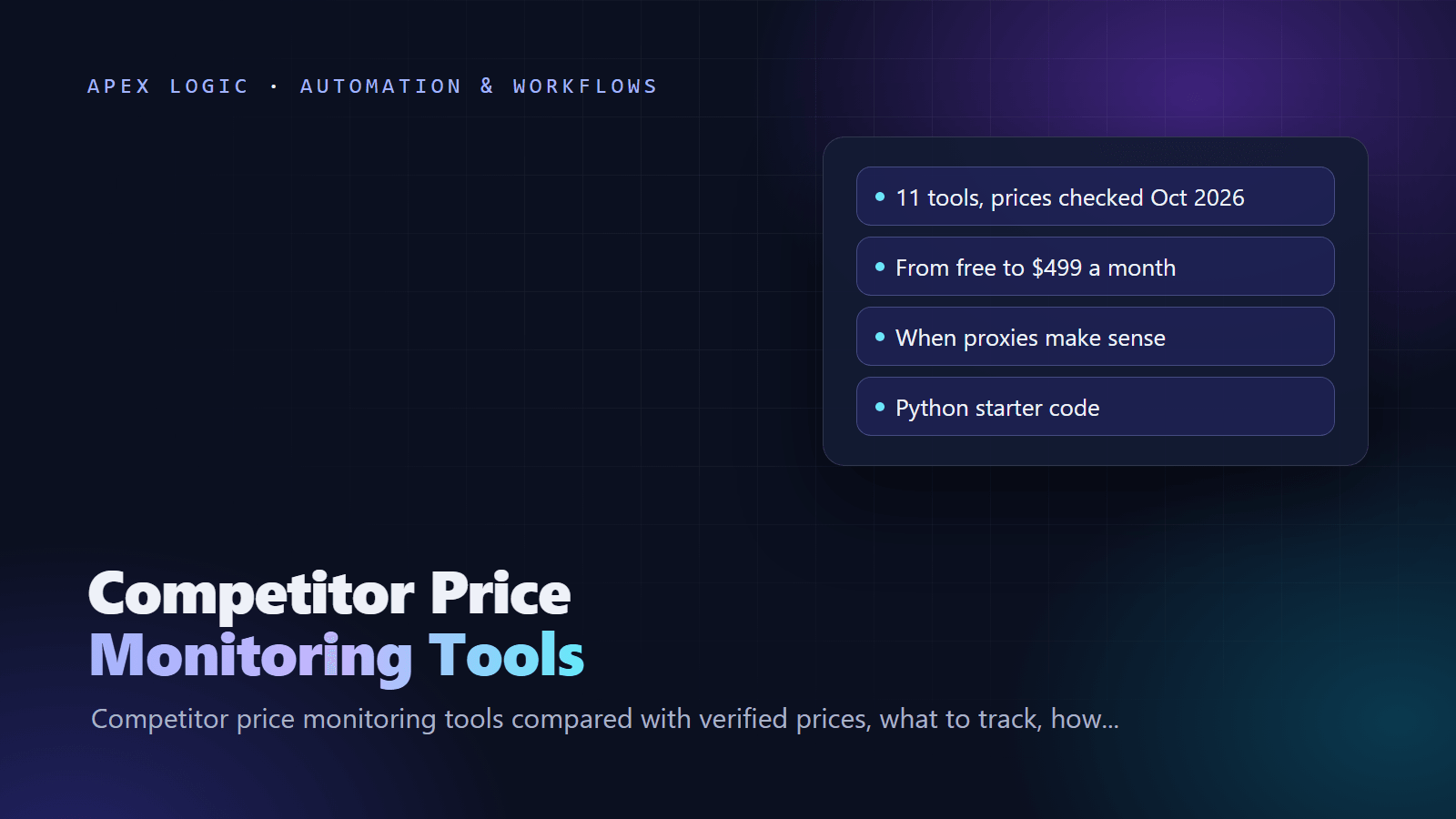
Updated 23 October 2026. New guide: competitor price monitoring tools compared with prices checked today, a build-your-own plan with starter code, when proxies make sense, legal limits and a setup checklist.
Competitor price monitoring is the practice of checking your competitors' public prices, stock and promotions on a schedule, matching their products to yours and alerting you when something changes. A competitor price monitoring tool does this automatically, usually once or several times a day, and keeps a price history so you see patterns instead of single snapshots.
You can buy a tool or build your own. As of 23 October 2026, ready-made competitor price tracking tools range from free plans for 50 products to $499 a month for 25,000, and enterprise platforms quote on request. Building makes sense for niche competitors, messy catalogs, SaaS and AI pricing pages, or when you want the data in your own database. Either way, stay on public pages and respect each site's terms.
Quick answer: buy or build?
| Your situation | Good fit | Price, as of 23 October 2026 |
|---|---|---|
| Small store, under 100 products | Pricefy Free or Starter | Free for 50 SKUs; $49 a month for 100 SKUs |
| Store tracking known competitor URLs | Prisync | $99 a month for 100 products up to $399 for 5,000 |
| Competitor pricing pages for SaaS or AI tools | Visualping | Free for 5 pages; paid from $14 a month |
| Large retailer, repricing at scale | Competera, Intelligence Node or Minderest | Demo and quote |
| Niche sites, custom matching, your own database | A custom monitor | From $1,500 to build with Apex Logic, plus small running costs |
What should you track besides the price?
- Price and sale price, with the time seen, the currency and any member or bulk price.
- Shipping cost and delivery promise, because a lower price with paid shipping may not be cheaper.
- Stock status: a competitor out of stock is a chance to hold your price.
- Promotions: coupons, bundles and free gifts.
- New and removed products in your categories.
- MAP compliance, if you are a brand watching resellers.
- Plan and feature changes on SaaS and AI pricing pages.
Start with your top 50 to 200 products by revenue and three to five real competitors. Tracking everything everywhere creates noise.
Competitor price monitoring tools compared
List prices in US dollars from official pages, as of 23 October 2026.
| Tool | Type | Price | Worth knowing |
|---|---|---|---|
| Prisync | Price tracking for online stores | $99 a month for 100 products, $199 for 1,000, $399 for 5,000 | Unlimited competitors; URL-based plans update 3 times a day; API access costs 20% extra; 14-day free trial |
| Pricefy | Price tracking and repricing | Free for 50 SKUs; $49 to $499 a month billed monthly, about 25% less yearly | AI product matching; two updates a day on paid plans; repricing from Pro |
| Price2Spy | Price tracking and repricing | Starter, Basic and Premium tiers, quoted individually | Free trial; Premium allows up to 8 price checks a day |
| Visualping | Web page change monitoring | Free for 5 pages; $14 a month for 1,000 checks; Business from $140 | AI change summaries; suits pricing pages better than catalogs |
| Browse AI | No-code scraping and monitoring | Free with 50 credits a month; paid from $19 a month | Point-and-click robots that rerun on a schedule |
| Apify | Scraping platform for developers | Free with $5 of usage; Starter $19 a month plus usage | Ready-made scrapers; residential proxies $8 per GB on Starter |
| Zyte API | Managed scraping API | Pay as you go $0.13 to $1.27 per 1,000 responses; from $0.06 with a monthly commitment; $5 free credit | Five price tiers by site difficulty; browser rendering costs more |
| Competera, Intelligence Node, Minderest | Enterprise price intelligence | No public prices; demo first | Aimed at large retailers |
| Google Merchant Center | Pricing reports for Shopping merchants | Part of Merchant Center Analytics | Benchmarks from retailers selling the same GTIN; you need valid GTINs |
How to build your own competitor price monitor
A custom monitor has five parts. Our web scraping architecture guide covers the engineering at large scale; this is the version for a few thousand products.
- Watch list. A table of your products and the competitor URLs that match them.
- Scheduler and fetcher. A daily job, or two to three runs a day for fast-moving categories, that fetches each page politely: about one request per second per site or slower, with retries and backoff.
- Extractor. Many product pages publish schema.org Product data as JSON-LD, with an Offer holding price, priceCurrency and availability. Read that first and fall back to page selectors only when it is missing.
- Matching. Match on GTIN, EAN or UPC where available, then manufacturer part number, then brand plus model and size. A language model can propose matches for messy titles, and a person confirms uncertain pairs once.
- Storage, alerts and dashboards. Store every observation with a timestamp, check for suspicious values such as a price that halves overnight, and alert only on changes above your thresholds. Tools like n8n, Zapier or Make can route alerts to Slack or email, and our automated reporting guide covers dashboards.
Here is an illustrative starter in Python. It checks robots.txt with the standard library, waits the site's crawl delay, then reads the JSON-LD offer. It needs the requests and beautifulsoup4 packages:
import json
import time
import urllib.robotparser
from urllib.parse import urlparse

import requests
from bs4 import BeautifulSoup

USER_AGENT = "ExamplePriceBot/1.0 (+https://example.com/bot)"


def robots_rules(url):
    parts = urlparse(url)
    rp = urllib.robotparser.RobotFileParser()
    rp.set_url(parts.scheme + "://" + parts.netloc + "/robots.txt")
    rp.read()
    return rp.can_fetch(USER_AGENT, url), rp.crawl_delay(USER_AGENT)


def find_offer(data):
    if isinstance(data, list):
        items = data
    elif isinstance(data, dict):
        items = data.get("@graph", [data])
    else:
        return None
    for item in items:
        if not isinstance(item, dict):
            continue
        types = item.get("@type")
        types = types if isinstance(types, list) else [types]
        if "Product" in types:
            offer = item.get("offers")
            if isinstance(offer, list):
                offer = offer[0] if offer else None
            if isinstance(offer, dict):
                return offer
    return None


def read_price(url):
    allowed, delay = robots_rules(url)
    if not allowed:
        return None
    time.sleep(delay or 5)
    resp = requests.get(url, headers={"User-Agent": USER_AGENT}, timeout=30)
    resp.raise_for_status()
    soup = BeautifulSoup(resp.text, "html.parser")
    for tag in soup.find_all("script", type="application/ld+json"):
        try:
            data = json.loads(tag.string or "")
        except json.JSONDecodeError:
            continue
        offer = find_offer(data)
        if offer:
            return {
                "url": url,
                "price": offer.get("price") or offer.get("lowPrice"),
                "currency": offer.get("priceCurrency"),
                "availability": offer.get("availability"),
            }
    return None
In production, cache robots.txt per site, log every fetch, and alert when a page stops returning a price, which usually means the site was redesigned.
Do you need proxies for competitor price monitoring?
Often not. A few thousand pages a day from one server at a polite rate rarely needs them. Proxies help in two legitimate cases: seeing the prices shoppers in another country see, and spreading a larger crawl so no single IP address loads a site. They are not a tool for getting past logins, CAPTCHAs or blocks; a block is a signal to stop or to ask for a data feed. Prices as of 23 October 2026:
- Residential proxies bill per GB. Oxylabs lists $6 per GB on entry plans, falling to $2.5 at 1,000 GB or more. Decodo charges $4 per GB pay as you go and $3.75 to $2.75 per GB on monthly plans. Apify charges $8 per GB on its Starter plan.
- Managed scraping APIs such as Zyte API bill per successful response instead: $0.13 to $1.27 per 1,000 on pay as you go, depending on how hard the site is, and more with browser rendering.
Rough sizing, by our estimate: 3,000 product pages a day at about 250 KB of HTML each comes to around 22 GB a month, so roughly $55 to $132 a month if every request went through residential proxies at $2.5 to $6 per GB.
Is competitor price monitoring legal?
This is general information, not legal advice. Watching competitors' public prices is common, and prices are facts rather than creative work. The risk comes from how you collect and use the data. Our guide Is web scraping legal? covers logins, terms, personal data and copyright. Three points matter most here:
- Terms of service. Some sites forbid it outright. Amazon's Conditions of Use, last updated 14 August 2026, say the license to use the site does not include collecting and using product listings, descriptions or prices, or using robots and similar data extraction tools. On marketplaces like that, use their seller tools or official programs instead.
- robots.txt. The standard, RFC 9309, says its rules are not a form of access authorization. That cuts both ways: it is not a security barrier, but honoring it is basic good faith. Logins, paywalls and CAPTCHAs are hard stops.
- Competition law. Setting your own prices from public data is ordinary competition. Sharing nonpublic pricing data with competitors is different: in August 2024 the US Justice Department sued RealPage, alleging that landlords shared nonpublic, competitively sensitive information through its pricing software. Be wary of any vendor that pools private pricing data across competing clients.
Buy vs build: what competitor price monitoring costs
Worked example: 1,000 products, three competitors each, checked daily. Prices as of 23 October 2026; running costs are our estimates.
| Option | Up front | Monthly | Trade-off |
|---|---|---|---|
| Pricefy Pro | $0 | $99, or $74 billed yearly | Fast start; their matching and schedule |
| Prisync Premium | $0 | $199 | Unlimited competitors; API access extra |
| Custom monitor | From $1,500 | A small server, a few dollars of AI usage, proxies only if needed | Your matching rules, any public site, data in your database; you pay for upkeep |
AI usage really is small. Matching 3,000 competitor listings once with a small model such as OpenAI's gpt-6-luna, at $0.10 and $0.50 per million input and output tokens, costs under $1 at about 1,500 tokens per listing, by our arithmetic. The hidden cost of building is upkeep: when a competitor redesigns its site, that scraper needs a fix. Over three years a $199 subscription costs $7,164, so build when you need what the tools do not do, not only to save money. Our AI automation ROI guide shows how to run your own numbers.
How to monitor AI and SaaS pricing pages
If your competitors sell software or AI services, their pricing pages change more often than retail prices: new plans, renamed tiers and promotions with end dates. As of 23 October 2026, OpenAI's API pricing page notes a promotional price that runs at least through 21 November 2026, and Microsoft's Copilot Business discount offer ends on 31 December 2026. Page-change tools such as Visualping suit this job: they check a page on a schedule, summarize what changed with AI and flag whether it matters. For a few dozen pages the free or $14 tier is enough. A custom monitor makes sense when you want plan prices extracted into a table and compared with your own.
Prefer to have it built? Our AI competitor and price monitor starts from $1,500 on a fixed quote as of 23 October 2026, typically 2 to 4 weeks, and the price history stays in your database. Send us your competitor list for an estimate.
Competitor price monitoring setup checklist
- Goal written down: match, undercut, hold margin or police MAP
- Top products and three to five real competitors chosen
- Terms of service and robots.txt checked for each site
- Products matched by GTIN or part number, uncertain pairs confirmed
- Check frequency set per category
- Price, shipping, stock and promotion fields captured
- Checks for missing or suspicious values before any alert
- Alert thresholds agreed, such as a 5% undercut on a top seller
- Price history stored in a database you control
- Owner named for the weekly review and scraper fixes
Competitor price monitoring FAQ
What is the best competitor price monitoring tool?
It depends on catalog size and where your competitors sell. For small stores, Pricefy's free and Starter plans are the cheapest way to start, and for tracking known competitor URLs several times a day, Prisync costs $99 to $399 a month, as of 23 October 2026. Large retailers usually need an enterprise platform with matching services, and niche markets often need a custom monitor.
How often should I check competitor prices?
Daily is enough for most categories. Fast-moving categories such as electronics or marketplace listings may justify two or three checks a day, which is what Pricefy's paid plans and Prisync's URL-based plans offer. Checking every few minutes rarely changes decisions, adds load to competitors' sites and raises your costs, so match the frequency to how quickly you can actually respond.
Do I need proxies to monitor competitor prices?
Usually not for a few thousand pages a day at a polite rate from one server. Proxies make sense to see country-specific prices or to spread a larger crawl. Residential proxies cost about $2.5 to $8 per GB on the plans we checked as of 23 October 2026. Never use them to get around logins, CAPTCHAs or blocks; treat a block as a signal to stop.
Can AI do competitor price monitoring?
AI helps with the hard parts rather than the whole job. Language models are good at matching messy product titles, reading changes on pricing pages and writing a short morning summary. Fetching pages, storing history and catching bad values are ordinary engineering. Pricefy advertises AI product matching and Visualping offers AI change summaries, and a custom build can use a small, low-cost model for the same tasks.
Is it legal to scrape competitor prices?
Collecting public prices politely is common and usually low risk, but it depends on the site's terms, how you collect and where you operate. Amazon's terms, for example, exclude collecting prices with robots. Never log in, bypass blocks or collect personal data, and keep your pricing decisions independent. For anything large or unusual, ask a lawyer in your jurisdiction before you start.
Sources
- Prisync: Compare plans
- Pricefy: Pricing
- Price2Spy: Price plan comparison
- Visualping: Pricing
- Browse AI: Pricing
- Apify: Pricing
- Zyte: Pricing
- Oxylabs: Residential proxy pricing
- Decodo: Residential proxy pricing
- Competera
- Intelligence Node
- Minderest
- Google Merchant Center Help: About Pricing in Merchant Center Analytics
- Amazon: Conditions of Use
- RFC 9309: Robots Exclusion Protocol
- US Department of Justice: RealPage lawsuit
- Python docs: urllib.robotparser
- Schema.org: Offer
- OpenAI: API pricing
- Microsoft: Copilot for small business, pricing
Loading comments...