Is Web Scraping Legal? A Practical Guide for Businesses
The honest answer is: it depends on what you scrape, how, and what you do with it afterwards. Here is what it depends on.
A scheduled tool checks the public pages of the competitors you choose, records prices, stock and offers, and spots what changed. AI turns the changes into a short summary and alerts you when something needs a decision.
Your competitors change prices, run promotions and launch products, and you usually find out from a customer or too late to respond. Checking their sites by hand takes hours and gets skipped when things are busy. Spreadsheets of prices go stale within days. Generic price tools often focus on big marketplaces, miss the niche competitors in your market and flood you with alerts about changes that do not matter.
Example: An online cycling parts store competes with a handful of specialist shops on the same brands. The monitor checks those shops' public product pages each morning, matches their listings to the store's own catalog and stores the prices. The owner gets a short Slack summary before opening: two rivals cut prices on a popular groupset, and one is out of stock on tires the store has plenty of. The owner decides what to change, if anything, and the price history helps spot seasonal sales early next year.
You pick the competitors, products and pages to track. We check each site's terms and robots.txt, and only collect public information that any visitor can see without logging in.
Scrapers visit those pages at a polite rate, daily or more often for fast-moving categories. Each price, stock status and promotion is stored with a timestamp, building a history you own.
Competitor products are matched to yours by name, model number and specs, with AI handling messy titles. A person confirms uncertain matches once, and every later price check uses that confirmed pairing.
Each morning you get a short summary of what changed and why it might matter. Big moves, like a rival undercutting your best seller, trigger an alert. Pricing decisions stay with you.
Collects only what is publicly visible, with no logins, no personal data and no attempts to get around blocks, following each site's terms.
AI matches competitor listings to your catalog even when titles differ, and a person confirms the uncertain ones so comparisons are like for like.
Set thresholds, such as a price drop beyond a set amount or a new promotion on a key product, so you hear about meaningful changes only.
Instead of a spreadsheet of changes, you read a short note: who changed what, how it compares with your price and any pattern worth noticing.
Every observation is stored in your own database, so you can chart a competitor's prices over months and spot seasonal patterns.
Track stock status, new product launches, shipping offers and changes to pricing pages or plan features, not just the headline price.
Most of this tool is ordinary engineering: scrapers, a database and a scheduler. AI is used where rules struggle, like matching messy product titles, reading changes on a pricing page and writing the morning summary. Those are routine jobs, so a small, low-cost model from OpenAI, Anthropic or Google, or an open-weight model on your server, handles them well. A larger GPT, Claude or Gemini model is only worth it for weekly trend write-ups. Each step keeps its own model setting, so we can swap one without touching the scrapers.
Typical build: 2 to 4 weeks. A small server and light AI usage are the main running costs, growing with how many pages you watch and how often; we estimate them for your watch list.
Watching competitors' public prices is common practice. Legal risk in scraping usually comes from logging in, collecting personal data, copying protected content or ignoring a site's terms. The monitor avoids all four, respects robots.txt and keeps request rates low. Laws differ by country, so check with your own adviser if unsure. Our guide on web scraping law covers this in more depth.
A monitor covering a set of competitor sites, with product matching, a price history database, daily summaries and alerts, starts from $1,500. The price depends mostly on how many sites you track and how hard they are to read reliably. Each site gets its own small scraper, so the quote lists them and adding more later is straightforward.
Most monitors are running in 2 to 4 weeks. The first sites are usually collecting data within the first week. The rest of the time goes on product matching, alert thresholds and making each scraper reliable. Expect some ongoing upkeep: when a competitor redesigns their site, that scraper needs a small fix.
Scrapers can misread a page after a redesign or confuse a sale price with a member price. Each run is checked for missing or suspicious values, such as a price that suddenly halves, and those are flagged instead of reported as fact. Summaries link to the source page, so you can confirm before you act. Decisions stay with you.
Everything goes into a database on your own cloud account or a server we manage for you, and you own it. The tool is built to collect public product and pricing information only, not personal data about anyone. AI calls see page snippets and your matching rules, under paid API terms that exclude training.
Ask your database questions in plain English and get answers without waiting on reports
4 to 6 weeksFrom $3,000 → E-commerceLaunch new products faster with on-brand descriptions written from your photos and specs
2 to 3 weeksFrom $1,500 → Customer serviceAnswer every review in your own voice, and spot the problems customers keep mentioning
2 to 3 weeksFrom $1,500 →
The honest answer is: it depends on what you scrape, how, and what you do with it afterwards. Here is what it depends on.
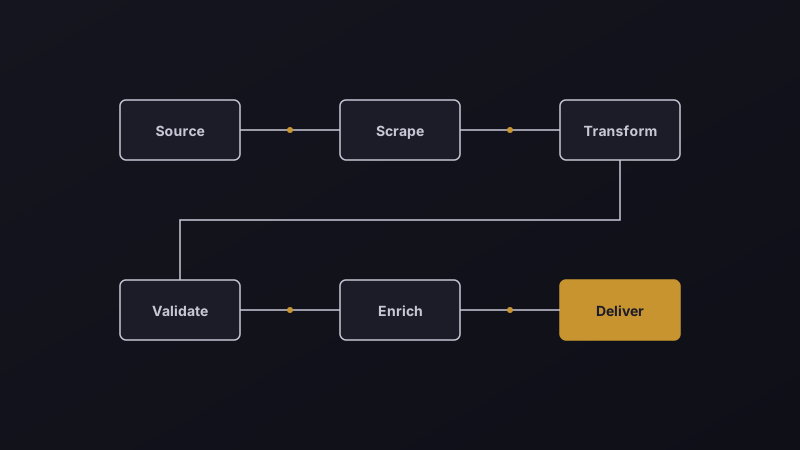
How to design a scalable, reliable web scraping system: URL frontier, queues, fetcher workers, proxy rotation, deduplication, observability, and how to stay legal and ethical.

Someone spends every Monday morning copying numbers between tabs. That job can be done by a machine, and done more accurately.
Send us a few real examples of the task. You get a written scope, a fixed price and a timeline within two working days.