Updated 23 October 2026. The EU published the €2 handling fee regulation in its Official Journal on 22 October 2026, confirming that it applies from 1 November 2026, the same day product identifiers become mandatory.
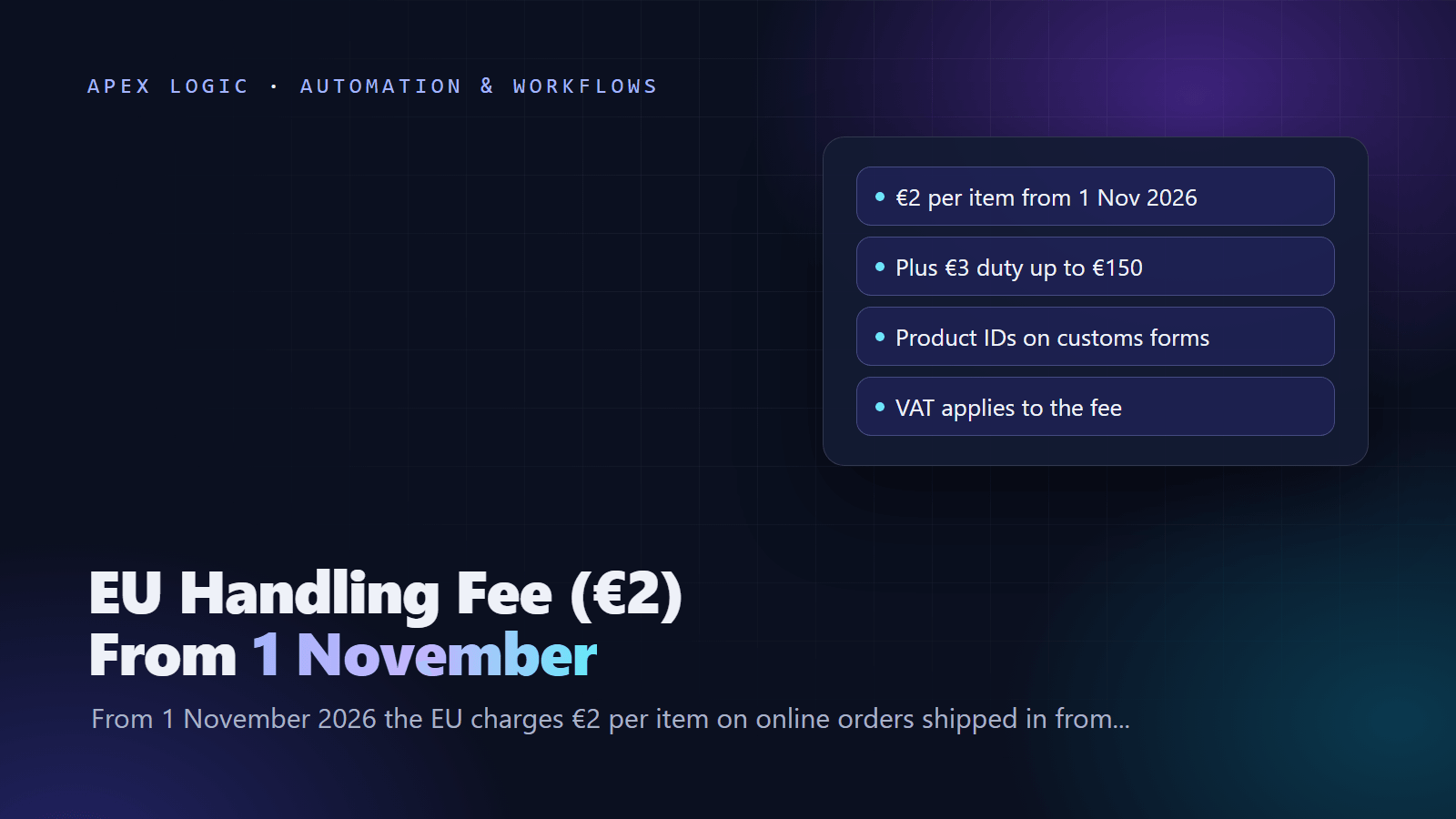
The EU handling fee is a fixed €2 per item, charged from 1 November 2026 on goods sold online to consumers in the EU and shipped from outside the EU. Delegated Regulation (EU) 2026/2152, published on 22 October 2026, sets the amount and the start date. An item is not each unit but a customs declaration line: goods with the same tariff code, description and origin. The fee applies at any order value, comes on top of the €3 per-item duty on parcels worth up to €150 that began on 1 July 2026, and VAT is charged on it.
The same day, customs declarations for these parcels must carry product identifiers: your merchant ID such as a SKU, the manufacturer's product code, and a barcode number where one exists. Royal Mail says it will require this data on EU items posted from 26 October 2026, so for many UK sellers the real deadline is Monday 26 October.
EU handling fee at a glance
| Question | Answer, as of 23 October 2026 |
|---|---|
| Amount | €2 per item, fixed, set by Delegated Regulation (EU) 2026/2152 |
| Start date | 1 November 2026 |
| What counts as an item | Each customs declaration line: same tariff code, description and origin |
| Which sales | Online sales to EU consumers shipped from outside the EU, at any value |
| Comes on top of | €3 duty per item on parcels worth up to €150 (until 1 July 2028) |
| VAT and refunds | VAT is due on the fee, and the fee is not refundable |
| Who pays | The declarant (platform, seller, carrier or agent); carriers collect from the buyer if not prepaid |
| Product IDs | Mandatory from 1 November 2026 for parcels up to €150 |
What is the EU €2 handling fee?
The Union handling fee is part of the EU customs reform. Article 20 of the new Union Customs Code, Regulation (EU) 2026/2108, published on 19 September 2026, tells customs authorities to collect a fixed fee per item for handling goods sold in distance sales. The Commission set the amount in a delegated act adopted on 21 September 2026 and published on 22 October 2026 as Delegated Regulation (EU) 2026/2152. Article 1 says the fee "shall be EUR 2 per item", and Article 2 says it applies from 1 November 2026.
The Commission's guidance for traders, in its version of 5 October 2026, adds three details that matter for pricing:
- It is not temporary. The €3 duty ends on 1 July 2028, but the handling fee has no end date.
- It applies above €150 too. The duty covers only parcels worth up to €150. The fee covers distance sales of any value.
- It is non-refundable, and VAT is due on it.
Is the €2 fee per parcel, per order or per item?
Per item, and item has a narrow customs meaning: goods in one parcel that share the same tariff classification, description and, where declared, origin. The guidance adds that, because of IT limits, the duty and the fee apply to each declaration line, however many units it holds. Royal Mail also describes the fee as €2 per line.
So two identical mugs are one item, while a mug, a T-shirt and an art print are three. The examples below are illustrative, with amounts as of 23 October 2026; your carrier's declaration lines decide the real charge.
| Example parcel (illustrative) | Declaration lines | €3 duty | €2 handling fee | Total before VAT |
|---|---|---|---|---|
| 2 identical mugs, goods worth €25 | 1 | €3 | €2 | €5 |
| Mug, T-shirt and art print, goods worth €40 | 3 | €9 | €6 | €15 |
| 1 jacket, goods worth €220 | 1 | Normal tariff rate instead | €2 | Normal duty plus €2 |
Import VAT on the goods works as before. Each parcel counts on its own: goods from one order shipped in two parcels are two consignments, and two customers' orders must never be declared together.
Goods that qualify for a preferential tariff under an EU trade deal can claim it instead of the €3 duty only on a full H1 declaration without IOSS, the guidance says, and the €2 fee still applies.
Who pays the handling fee: the seller or the buyer?
Legally, the declarant pays: the platform, seller, carrier or agent that declares the goods. Where an Import One-Stop Shop (IOSS) number is used, the IOSS holder or its representative comes first, so marketplaces that collect EU VAT through IOSS are first in line.
In practice, it depends on your shipping terms:
- Delivered duty paid (DDP or PDDP): you prepay duty and fees with the carrier, and the buyer pays nothing on delivery, as Bandcamp told its sellers on 20 October 2026.
- Delivered duty unpaid (DDU or DAP): the carrier collects the charges before delivery. Bandcamp warned that parcels may be held until they are paid, and that carriers can add their own handling charge.
Surprise charges at the door cause refused parcels and bad reviews, so show the fee at checkout or build it into EU prices. If you charge it at checkout and use IOSS, the guidance says the fee is part of the amount you declare VAT on in your IOSS return.
What are the new EU product identifiers (C127, C128, C129)?
From 1 November 2026, customs declarations for distance sales of goods worth up to €150 must include product identifiers (PIDs) for each item. Sending them has been voluntary, without penalties, since 1 July 2026. The aim is traceability: if customs finds one unsafe product, it can find every parcel with the same ID. Business-to-business shipments are, in principle, not covered.
| Code | Identifier | Who assigns it | Required? |
|---|---|---|---|
| C127 | Merchant product identifier (M-PID) | The seller, marketplace or platform running the offer | Always |
| C128 | Non-standardized manufacturer identifier (NS-PID), such as a model or part number | Manufacturer or supplier | Always |
| C129 | Standardized manufacturer identifier (S-PID), such as an EAN barcode or ISBN | Manufacturer or supplier | Where one exists |
| Y081 | Statement that no standardized identifier exists | The declarant | When there is no S-PID |
The guidance settles some edge cases. On a marketplace, the merchant ID is the platform's ID for the product, not each seller's code. A manufacturer with no internal code is expected to create one, and may reuse the barcode number. Assigning IDs per batch or unit to defeat the rule is an infringement, and a bundle needs the IDs of each product in it.
Royal Mail lists the kind of references it expects: SKUs, listing IDs, catalog numbers and manufacturer identifiers such as series codes or model numbers.
Handmade, personalized and second-hand goods
The guidance accepts conventional placeholder IDs for a short list of commodity codes covering some handmade and artisanal goods, antiques and art (codes 9701 to 9706) and unprocessed agricultural goods. Most handmade goods sold online, such as jewelry, candles or clothing, are not on that list. For personalized and print-on-demand products you declare the ID of the underlying product, such as the blank T-shirt, and for second-hand goods the ID of the original product.
Does the fee apply to stock you hold in the EU?
Not if the goods are already in free circulation. A distance sale of imported goods requires the goods to be outside the EU when you sell them. If you import stock in bulk, pay duty and VAT, and ship orders from an EU warehouse, those orders do not pay the €3 duty or the €2 fee.
Customs (bonded) warehouses are different. The guidance treats goods sold before they enter one as shipped from outside the EU, so the duty and fee apply, and the Commission is amending the rules to cover goods sold while stored there too. From 1 July 2028, a new customs warehouse for distance sales gets a lower fee, not yet set.
9 steps for sellers before 1 November 2026
- Measure your EU exposure. Count last quarter's EU consumer orders, split at €150.
- Clean your product data. Each product needs an HS code of at least 6 digits, a plain description and a country of origin.
- Add the three IDs. Store your merchant ID, the manufacturer's code and any EAN or ISBN. Ask suppliers for missing codes.
- Update your shipping software. Make sure your label tool sends the IDs with each parcel. Royal Mail needs them from 26 October 2026.
- Choose DDP or DDU. Decide who pays the charges, you or the buyer, and say so at checkout.
- Update prices or checkout. Show the expected duty and fee at checkout or build them into EU prices, plus VAT on the fee.
- Review multi-item baskets. Five different products in a parcel under €150 now carry €25 in duty and fees before VAT.
- Update your policies. The fee is non-refundable, and Royal Mail notes that duty is not automatically refunded on consumer returns.
- Test one parcel. Send a real order to an EU address before the holiday peak and check the charges.
Estimate your charges from an order export (illustrative)
This short Python script reads a CSV of EU parcels and estimates the €3 duty and €2 handling fee per parcel, counting one line per unique tariff code, description and origin. It is an estimate: your carrier's declaration decides the real lines, and VAT is not included.
# Illustrative estimate, amounts as of 23 October 2026.
# CSV columns: parcel_id, hs_code, description, origin, unit_price_eur, qty
import csv
from collections import defaultdict

DUTY_PER_LINE = 3.00  # EUR, parcels up to EUR 150, until 1 July 2028
FEE_PER_LINE = 2.00   # EUR, from 1 November 2026, any value

parcels = defaultdict(list)
with open("eu_parcels.csv", newline="", encoding="utf-8") as f:
    for row in csv.DictReader(f):
        parcels[row["parcel_id"]].append(row)

for parcel_id, rows in parcels.items():
    goods_value = sum(float(r["unit_price_eur"]) * int(r["qty"]) for r in rows)
    lines = {(r["hs_code"], r["description"].strip().lower(), r["origin"]) for r in rows}
    fee = FEE_PER_LINE * len(lines)
    if goods_value <= 150:
        duty = "%.2f" % (DUTY_PER_LINE * len(lines))
    else:
        duty = "normal tariff"
    print(parcel_id, "lines:", len(lines), "goods:", "%.2f" % goods_value,
          "duty:", duty, "handling fee:", "%.2f" % fee, "(plus VAT on the fee)")
Run it on last month's EU orders to see what the change would have cost.
What else changes for EU shipments after 2026?
- 1 July 2028: the €3 duty ends, normal duty rates apply, and the EU Customs Data Hub becomes mandatory for e-commerce, according to the Commission.
- National fees: Royal Mail reports an Italian €2 customs administration fee since 1 October 2026 on items under €150, collected from recipients for now, and a Romanian RON 25 logistics tax per shipment since 1 January 2026.
Expect more data requirements, not fewer, so keep product data in one place. Our guides on automating data entry and Shopify vs WooCommerce cover the store side, and our piece on Google Sheets as a database explains when a spreadsheet of SKUs stops being enough.
If your store needs to send product IDs to a carrier automatically, or show EU charges at checkout, that is a typical automation or web development job. Contact us with your platform and carrier, and we will tell you plainly what it would take.
EU handling fee FAQ
When does the EU €2 handling fee start?
It applies from 1 November 2026. Delegated Regulation (EU) 2026/2152, which sets the fee at €2 per item, was published in the Official Journal on 22 October 2026 and names 1 November 2026 as its date of application. The guidance says the fee arises when customs accepts the declaration, so a parcel posted in late October can still be charged if it clears after that date.
Is the EU handling fee charged per parcel or per item?
Per item, where an item means goods in one parcel that share a tariff code, description and origin. In practice, the guidance says, the fee and the €3 duty apply to each declaration line regardless of quantity. Three identical mugs on one line cost €2 in handling fees, while three different products cost €6, plus VAT on the fee.
Does the €2 fee apply to orders over €150?
Yes. The €3 duty only applies to parcels whose goods are worth €150 or less, but the handling fee covers all distance sales shipped to EU consumers from outside the EU, whatever their value. A €300 parcel pays normal import duty for its tariff code, import VAT and €2 per declaration line, and the fee, unlike the duty, is not temporary.
Do I pay the fee if I sell through Etsy, eBay or Amazon?
The declarant pays, and where a marketplace's IOSS number is used, the marketplace or its representative comes first under the Commission's guidance. How each marketplace passes on the cost and collects product IDs depends on its own seller terms, so check your seller center before 1 November, and keep sending any IOSS number it gives you with every parcel.
What product identifier do I use if my product has no barcode?
You still declare your merchant ID, such as the SKU or listing ID, under code C127, and the manufacturer's own product code under C128. If you make the product yourself, you are the manufacturer and assign that code. Where no standardized ID such as an EAN exists, the declaration uses code Y081, and the guidance says manufacturers are not obliged to buy one.
Does the handling fee apply to gifts sent to friends in the EU?
Royal Mail says genuine gifts between consumers worth €45 or less stay exempt. For gifts above €45, it says the €3 duty and the new €2 fee apply per HS code and are collected on delivery. Shipments to businesses follow normal customs rules, and the guidance says business-to-business flows are, in principle, outside the product identifier requirement.
Sources
- EUR-Lex: Commission Delegated Regulation (EU) 2026/2152 establishing the amount of the Union handling fee (OJ L, 22 October 2026)
- European Commission: EU Customs Reform
- European Commission: The temporary EUR 3 customs duty and the Union handling fee, guidance for Member States and trade (version of 5 October 2026, PDF)
- European Commission Access2Markets: EU applies €3 customs duty per item on low-value e-commerce consignments (30 June 2026)
- Royal Mail: EU Trade Insights
- Bandcamp: EU customs beginning November 1, a new €2 handling fee and product IDs (20 October 2026)


Loading comments...