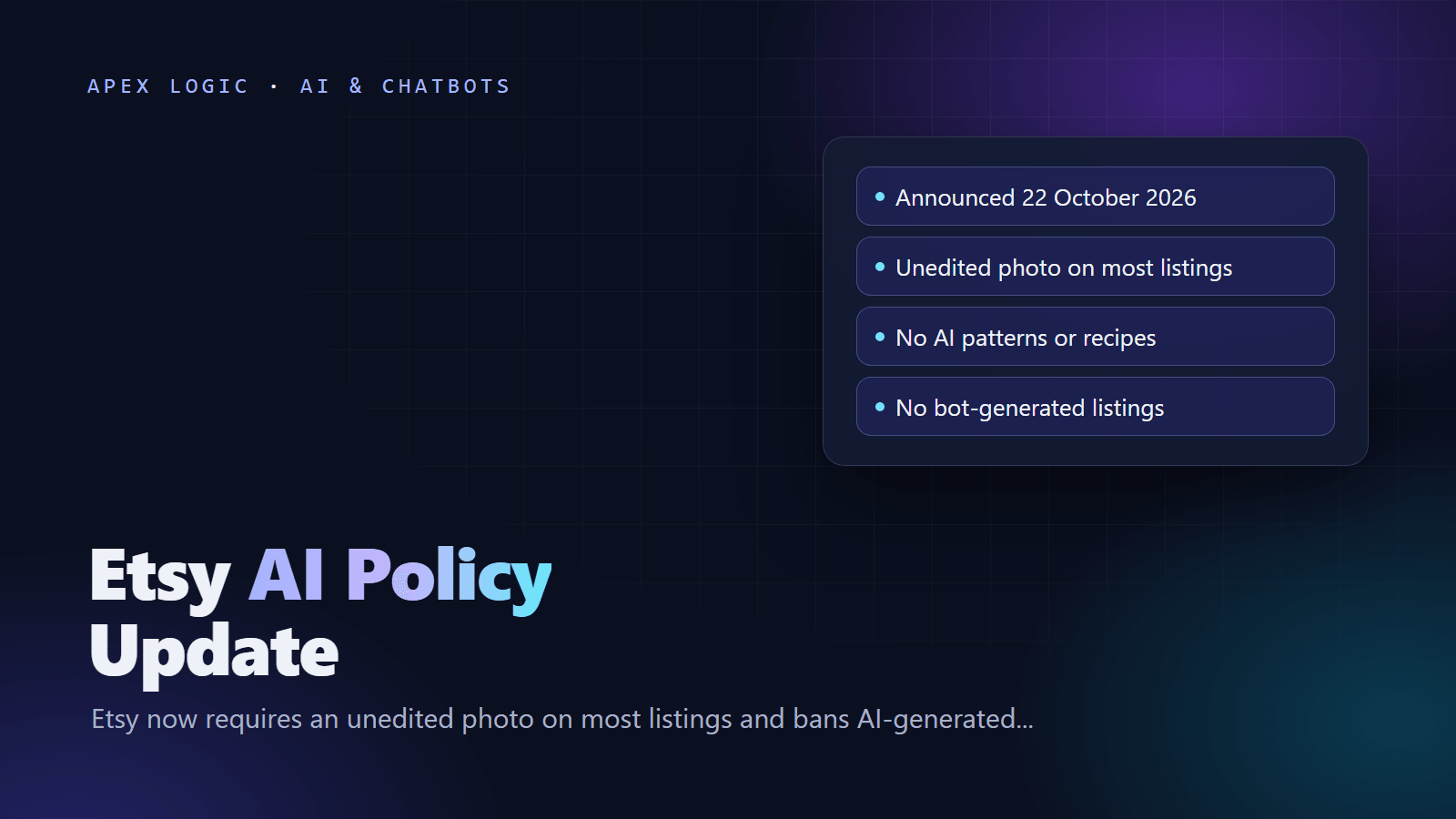
Updated 23 October 2026. Etsy changed its AI rules and its Listing Image Requirements on 22 October 2026, and this guide covers what changed and what sellers should fix first.
The Etsy AI policy update of 22 October 2026 does three things. Most listings must now include at least one unedited photo of the actual item against a real background. AI-generated functional guides, such as knitting patterns, recipes and assembly instructions, are banned. And bot-generated listings with no human involvement are not allowed. AI art is still allowed when you play a clear creative role and say in the listing description that you used AI.
Etsy set no deadline, but its FAQ says listings that do not meet the new image rules need to be updated, and that you may have to pay the refund if a buyer opens a case because the item is materially different from the listing. Etsy also says new buyer reports about misleading AI images will not lead to immediate enforcement at first. That makes the next few weeks the right time to fix your shop calmly.
Etsy AI policy changes at a glance
| Rule | What it means | Who it hits | What to do |
|---|---|---|---|
| Unedited photo | At least one photo of the actual item, on a real background, not edited in any way | Most physical products | Add one plain, untouched photo per listing |
| Accurate images | No photo may hide flaws or make the item look different | All listings | Check AI-edited and retouched images |
| Functional guides | Patterns, recipes and instructions must be your own work, not AI-generated | Pattern, recipe and guide sellers | Replace AI-written guides and show a real finished result |
| Bot-generated listings | Each item needs direct human prompting, curation and creative input | Shops using scripts or bulk listing tools | Add a human review step for every listing |
| AI art | Still allowed with a clear creative role | AI art and print sellers | Disclose AI use in the listing description |
| Prompt bundles | Still prohibited | Prompt sellers | Do not sell prompts without the finished artwork |
What changed on Etsy on 22 October 2026?
Etsy published "Important updates to AI use on Etsy" in its Seller Handbook on 22 October 2026, written by James Ossman, its Vice President of Customer Operations. The same day it updated the Listing Image Requirements policy and its page on AI creations.
Etsy's stated reason is buyer trust. It says many active buyers cannot tell which items involve AI-generated content, and that this is now one of the three biggest things holding buyers back from shopping on Etsy more. Besides the new rules, Etsy is adding AI image checks to the listing form, better detection of fake inventory, a new "Report this item to Etsy" reason for misleading AI imagery, and more buyer context about AI use in the coming months.
What counts as an unedited photo on Etsy?
The required photo must show the real item against a real background, with no edits or changes of any kind. In practice that means no cropping, filters, background swap or AI cleanup on that one photo. Your other photos can still be edited, as long as they show the item accurately. In short, the Listing Image Requirements policy draws the line like this:
| Allowed on your other photos | Prohibited on any photo |
|---|---|
| Fixing light, exposure or color so the photo matches real life | Altering the product's real color, texture or condition |
| Cropping, resizing or straightening the frame | Hiding or erasing defects, cracks or damage |
| Tidying or swapping the background while the product stays accurate | Changing the item's core design or features with AI |
Etsy also recommends making your first photo the clearest, most realistic view of the item and, as a best practice rather than a rule, noting any AI-edited photos in the description.
Exceptions by product type
- Print-on-demand: sellers whose production partner prints their original design on standard products, like T-shirts or mugs, may use a stock mockup if they have the stock photo owner's permission.
- Digital downloads: most need a preview or sample of what the buyer gets. Items with nothing visual to show, such as audio files, may use representative images, AI images included, if they do not mislead.
- Customized and made-to-order items: use photos of real pieces you completed for past customers, so buyers can judge your work.
- Patterns, recipes, seeds and similar items: add at least one real, unedited photo of a result made with your product, for example a crochet piece made from your pattern or a plant grown from your seeds. The finished result cannot be shown only through AI images.
Is AI allowed on Etsy now?
Yes, with limits. Etsy's page on AI creations says sellers may still use their own original prompts with AI tools to create products. Its examples are a fantasy scene made from a seller's prompt and a custom pet portrait made with AI tools. Two conditions apply: you must play a clear creative role, and you must disclose in the listing description that the item was created with AI. You also cannot present AI work as handmade or as entirely your own creation.
Three things are not allowed:
- Bot-generated content: items and listings made entirely by bots or scripts.
- AI-generated functional instructions: covered in the next section.
- AI prompt bundles: selling prompts without the finished artwork remains prohibited.
AI-edited listing images are fine only if they honestly show what the buyer will receive, and Etsy treats using AI to create fake inventory as fraud.
Are AI-generated patterns and recipes banned on Etsy?
Yes. Etsy defines functional instructions as content whose main purpose is to show a buyer how to make, prepare, build, repair or use something, or how to reach a specific result. Its list includes:
- craft patterns for knitting, crochet, sewing, embroidery, quilting or beading
- recipes
- building, woodworking and other project plans
- instruction and assembly manuals
- instructional guides and e-books that give directions for a task
Etsy's reasoning is practical: AI-written instructions are more likely to contain errors, and buyers often find out only after spending time and materials. The steps, measurements and quantities must come from you, and the listing must show a real result made from your instructions.
Does the bot-generated listing ban affect listing tools?
It can. Etsy's AI creations page says each item needs direct, individual human input: a person prompting, curating and making creative choices for that specific item. It also bans using scripts or other automation to mass-produce listings or products without a person overseeing each one. Bot-generated listings will be removed and can lead to the shop being removed.
Value Added Resource pointed out that Etsy does not say how much human involvement is enough, or whether the rule covers third-party listing and cross-listing tools that connect through Etsy's API. Until Etsy clarifies, the safe reading is simple: automation may prepare drafts, but a person must review, edit and approve each item before it goes live.
An example, with assumptions stated: a shop with 300 printable planners creates draft listings from a spreadsheet with a script. The script can keep handling titles, tags and file uploads, but the owner opens each draft, checks the previews against the real file, edits the description and publishes by hand. A simple approval log (who approved which listing, and when) gives you evidence if a listing is questioned.
The same applies to AI-written product copy. Our guide to AI product description generators and our bulk product descriptions walkthrough both assume a person edits every description before it is published, which matches Etsy's new wording.
Do I need to update existing Etsy listings, and by when?
Yes. Etsy's FAQ says that if any of your listings do not meet the new Listing Image Requirements, you need to update them. As of 23 October 2026, Etsy has given no deadline and no grace period.
Enforcement will grow in steps:
- When you add new images, the listing form will flag images Etsy detects as AI-generated and give tips. Etsy plans to extend this check to existing images over time.
- Buyers get a new report option for misleading AI imagery. Etsy says these reports "won't result in immediate enforcement action" at first.
- Misleading listings can be removed, and repeated violations can lead to further action, up to shop removal. You can appeal through the Policy violations page in Shop Manager.
- If a buyer opens a case because the item is materially different from the images, Etsy may refund the buyer and you may be responsible for that amount.
How to update your Etsy shop: 7 fixes
- List your active listings. Export your listing data or list every active listing with its type and photo count.
- Tag each listing by type. Physical, print-on-demand, digital, made-to-order, or pattern and recipe. The photo rule differs for each.
- Add one unedited photo. For physical items, add one plain photo of the real item on a real surface, with no edits at all. Make your first photo the most realistic one.
- Check every edited image. Remove any image where AI or retouching changed the item's color, texture, size or condition, or hid a flaw.
- Review functional guides. Rewrite and test any AI-written pattern, recipe or guide, or take it down, then add a real, unedited photo of a finished result.
- Add AI disclosures. For AI-created art, state in the description how you used AI and what your creative role was.
- Put a human gate on automation. Set any script, app or cross-listing tool to save drafts only, and have a person approve each one.
Start with your best sellers and newest listings, which get the most views.
What about the California AI disclosure law Etsy mentions?
Etsy's FAQ also points sellers with US buyers to California's SB 1050. Etsy says listing images or videos may count as advertisements under it and may need a clear disclosure if they prominently feature an AI-generated synthetic performer, a realistic AI person who is not a real, identifiable human. Etsy says the law takes effect on 1 January 2027. If your photos use AI models, check with your own legal counsel before then.
What this means if you sell on more than one channel
Honest images and a record of how each item was made help on every marketplace. If you write an AI use policy for your business, add a line on product photos and listing automation. Amazon has its own rules, covered in our Amazon product description guide.
If you want listing work automated without breaking the human approval rule, that is the kind of workflow we design in our automation projects: software prepares drafts and checks images, and a person approves. You can also browse our AI tools for small businesses, or tell us about your shop.
Etsy AI policy FAQ
When did Etsy's new AI rules start?
Etsy announced the changes on 22 October 2026 in a Seller Handbook post titled "Important updates to AI use on Etsy". The Listing Image Requirements policy and the AI creations page were updated the same day, so the rules apply now. Etsy did not set a separate deadline for existing listings, but its FAQ says listings that fall short of the image rules need updating, and sellers may have to cover refunds in the meantime.
Can I still sell AI art on Etsy?
Yes. Etsy says it will keep allowing AI-generated art when the seller plays a clear creative role, for example a fantasy scene made from the seller's own prompt. You must disclose in the listing description that the item was created with AI, and you cannot present it as handmade or as entirely your own creation. Selling prompt bundles without the finished artwork is still prohibited under the same policy.
Can I crop or brighten my unedited photo?
No. The one required photo must show the real item against a real background with no edits or changes of any kind. Cropping, brightening and background changes are allowed only on your other photos, and only if they still show the item accurately. Value Added Resource noted that Etsy has not explained how it treats automatic processing by phone cameras, so use a plain shot without filters.
Do print-on-demand sellers need an unedited photo?
Not necessarily. Etsy's Listing Image Requirements let print-on-demand sellers, whose production partner prints an original design on a standard product such as a T-shirt or mug, use a stock photo mockup if the stock photo's owner has authorized its use. Every image must still be accurate, so the mockup should match the colors, print placement and product that the buyer will actually receive.
Are AI-made planners and e-books still allowed on Etsy?
It depends on what they do. Etsy bans AI-generated functional instructions, and its list includes instructional guides and e-books that give directions for completing a task or producing a result. A planner template or an AI art print is not mainly a set of instructions, so on Etsy's definition it appears to fall under the AI creations rules instead: a clear creative role plus disclosure. A how-to e-book written by AI falls under the ban.
What happens if Etsy removes my listing for AI misuse?
You can appeal through the Policy violations page in Shop Manager, the same way as for other policy violations. Etsy says bot-generated listings will be removed and can lead to the shop being removed, and repeated breaches of the image rules can lead to further action, up to shop removal. Fix similar listings before you appeal, so the same problem is not found elsewhere in your shop.
Sources
- Etsy Seller Handbook: Important updates to AI use on Etsy (22 October 2026)
- Etsy: Listing Image Requirements policy (last updated 22 October 2026)
- Etsy Seller Handbook: What's Etsy's stance on AI creations?
- Value Added Resource: Etsy bans AI-generated patterns, tightens listing photo rules (22 October 2026)
Loading comments...