Updated 10 November 2026. Anthropic released Claude Fable 5.2 and Claude Mythos 5.2 on 9 November, so this guide covers what changed from Fable 5.1, the new prices, fast mode, limits and who should use it.
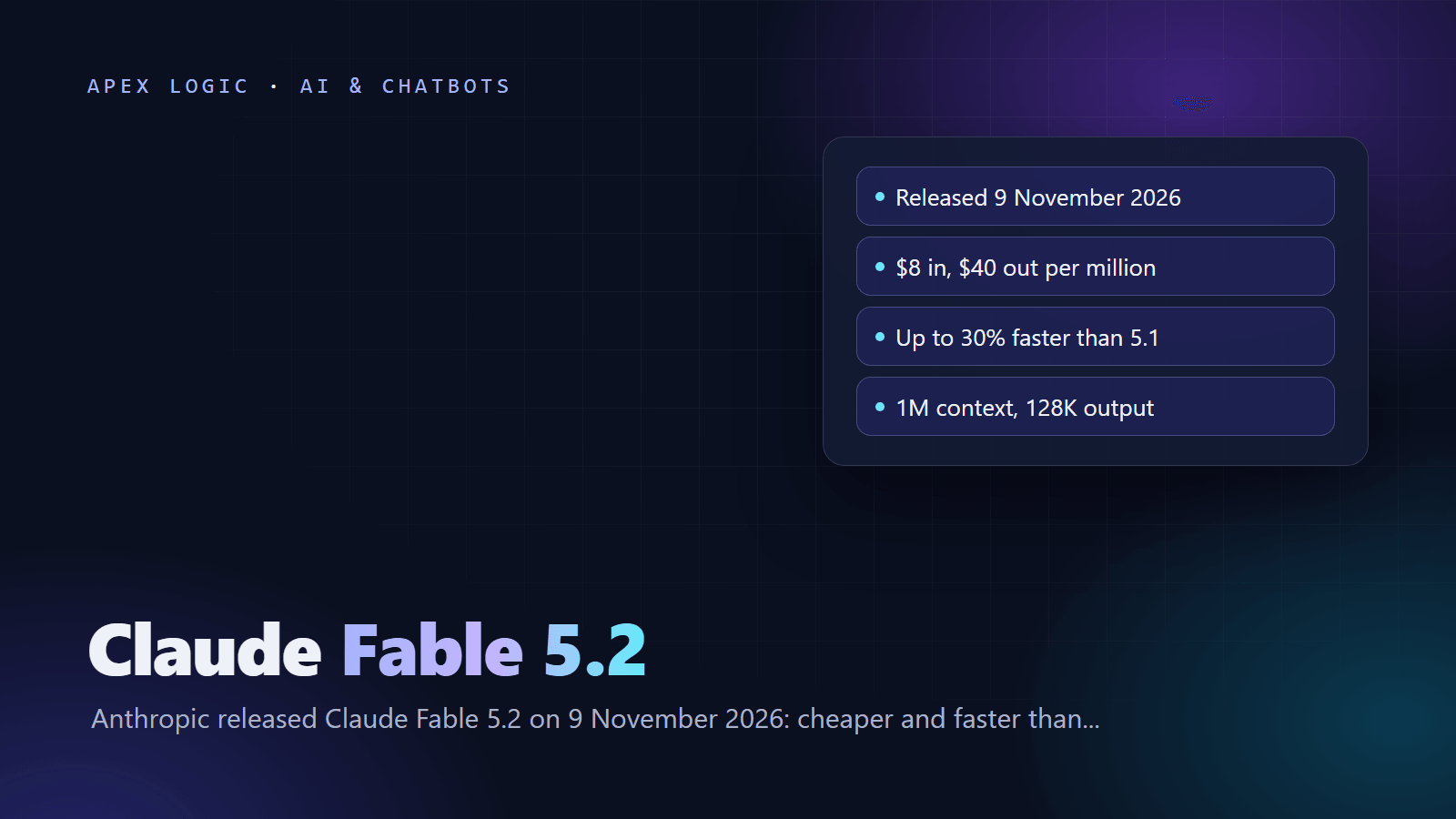
Claude Fable 5.2 is the model Anthropic positions for its hardest technical work, released on 9 November 2026 with the API model ID claude-fable-5-2. As of 10 November 2026 it costs $8 per million input tokens and $40 per million output tokens, 20% less than Fable 5.1 at $10 and $50, and Anthropic says it generates output up to 30% faster than Fable 5.1. It keeps the 1M-token context window and 128K max output, and adds an optional fast mode at $16 and $80 per million tokens.
Fable 5.2 is available on the Pro, Max, Ultra, Team and Enterprise plans, on the Claude API, and through Amazon Bedrock, Google Cloud and Microsoft Foundry. Anthropic still tells most people to start with Claude Opus 5.5 for coding and knowledge work, and to move to Fable 5.2 for the most ambitious, open-ended technical tasks, or when Opus 5.5 at higher effort falls short in their own tests.
Claude Fable 5.2 at a glance
From Anthropic's Fable 5.2 model page, its what's new page and the pricing page, checked on 10 November 2026:
| Question | Answer |
|---|---|
| Release date | 9 November 2026, alongside Claude Mythos 5.2 |
| API model ID | claude-fable-5-2 (Amazon Bedrock: anthropic.claude-fable-5-2) |
| Price | $8 input, $40 output per million tokens (Fable 5.1: $10 and $50) |
| Cache reads and batch | $0.20 per million cached input tokens; Batch API $4 input, $20 output |
| Fast mode | Up to 2.5x faster output for $16 input, $80 output per million tokens |
| Context and output | 1M-token context window, 128K max output tokens |
| Thinking | Adaptive thinking, always on; default effort high on the API |
| Knowledge cutoff | June 2026 |
| Plans | Pro, Max, Ultra, Team and Enterprise; not the Free plan |
| Clouds | Amazon Bedrock, Claude Platform on AWS, Google Cloud, Microsoft Foundry |
| Data retention | 30-day retention required; zero data retention only if Anthropic authorizes it |
| Retirement | Not sooner than 9 November 2027 |
What is Claude Fable 5.2?
Fable sits above Opus 5.5 in Anthropic's current lineup, aimed at demanding reasoning and long-horizon agent work. Anthropic's docs list typical uses such as agent sessions that run for hours, multistep research, and analysis carried all the way to a finished document, spreadsheet or slide deck. The product page pitches it for coding, finance and the sciences.
Fable 5.2 and Mythos 5.2 are the same underlying model. The difference is the safeguards. Fable 5.2 ships with cyber and biology classifiers, which lets Anthropic offer it to every customer. Mythos 5.2 drops some of those safeguards and goes only to vetted organizations in the Cyber and Life Sciences Verification Programs, plus Claude Enterprise customers through Claude Security. Our Claude Mythos 5.2 access guide covers how to apply.
What changed from Claude Fable 5.1?
In short, it is cheaper, faster and scores higher on Anthropic's evaluations, while the API surface stays almost the same. The changes that matter:
| Item | Fable 5.1 | Fable 5.2 |
|---|---|---|
| Input and output price | $10 and $50 per million | $8 and $40 per million |
| Cache reads | $0.25 per million | $0.20 per million |
| Output speed | Baseline | Up to 30% faster, per Anthropic |
| Fast mode | Not supported | $16 and $80, up to 2.5x faster output |
| FrontierCode 2.0 at xhigh effort | 32.4% | 49.1% |
| Check on edited history | Accounts created on or after 31 August 2026 | Every account |
| Computer use | Toolset or the older computer_20251124 tool | Toolset only, except on Amazon Bedrock |
| API rate limit | Shared with Fable 5 | Its own separate limit |
Unchanged: the context window, max output, always-on adaptive thinking, the high default effort, the ban on forced tool choice and the 30-day retention rule. Anthropic adds that Fable 5.2 improves on coding, reasoning and vision, that testers found it communicates more clearly, and that at medium effort, the default in the Claude apps and Claude Code, finishes hard tasks with fewer tokens than Fable 5.1.
How much does Claude Fable 5.2 cost?
These are Anthropic's first-party API rates in US dollars per million tokens, as of 10 November 2026. Microsoft Foundry bills the same rates through the Azure Marketplace, while Amazon Bedrock and Google Cloud's own listing publish their prices separately.
| Rate per million tokens | Standard | Fast mode |
|---|---|---|
| Input | $8 | $16 |
| Output, including thinking | $40 | $80 |
| 5-minute cache write | $10 | $20 |
| Cache read | $0.20 | $0.40 |
| Batch API | $4 input, $20 output | Not available |
A 1-hour cache write costs $16 at standard speed. Thinking tokens are billed as output even when the thinking text is hidden, so a hard prompt can cost more than the visible answer suggests. US-only inference with inference_geo: "us" adds a 1.1x multiplier. Long prompts carry no surcharge: the whole 1M-token window is billed at the standard per-token rate.
Example (illustrative): an agent step that sends 20,000 input tokens and gets 4,000 output tokens back costs $0.16 + $0.16 = $0.32 on Fable 5.2, $0.40 on Fable 5.1 and $0.16 on Opus 5.5. Our Fable 5.2 API tutorial works through caching and batch examples, and our LLM API costs guide covers budgeting in general.
Is Fable 5.2 included in Claude subscriptions?
On paid plans, yes, with limits. Anthropic's help center says Pro plans and standard Team seats get Fable for up to 50% of their weekly limits during launch week, through 16 November 2026 at 11:59 pm PT; after that, Fable use there bills to usage credits if they are turned on. Max, Ultra and premium Team seats include Fable and get one to three free Fable resets, usable until 8 March 2027. For Claude Code users, our guide to the Claude Code 5-hour limit explains how usage windows drain.
How fast is Fable 5.2, and what is fast mode?
At standard speed, Anthropic says Fable 5.2 generates output up to 30% faster than Fable 5.1. Its docs still rate the model's latency as moderate, the same label Opus 5.5 gets, so it is not the pick for snappy chat.
Fast mode is a separate, optional setting: the same model on a faster inference configuration, with up to 2.5x higher output tokens per second at double the price. It speeds up output, not the wait for the first token. Turn it on with speed: "fast" in the Messages API or /fast in Claude Code. It works on the Claude API, both Google Cloud options and Microsoft Foundry, but not on Amazon Bedrock, in the Batch API or in Claude Managed Agents. Our Fable 5.2 fast mode guide has the setup steps and cost tradeoffs.
Context window, output and rate limits
- Context window: 1M tokens, both the default and the maximum, roughly 555,000 words by Anthropic's estimate.
- Max output: 128K tokens per synchronous request, thinking included. Stream large outputs.
- Tokenizer: the one introduced with Claude Opus 4.7, so token counts carry over from Fable 5.1.
- Rate limits: its own limit, separate from Fable 5.1 and Fable 5, and lower than Opus 5.5 at every tier.
| API usage tier | Requests per minute | Input tokens per minute | Output tokens per minute |
|---|---|---|---|
| Start | 4,000 | 500,000 | 100,000 |
| Build | 10,000 | 1,500,000 | 300,000 |
| Scale | 13,000 | 4,000,000 | 800,000 |
Input read from the prompt cache does not count toward the input-token limit, so caching raises real throughput. For comparison, Opus 5.5 gets 2,000,000 input and 400,000 output tokens per minute on the Start tier, four times Fable 5.2's figures.
Where is Claude Fable 5.2 available?
As of 10 November 2026, per Anthropic, AWS, Google Cloud and Microsoft:
| Where | How to get it | Notes |
|---|---|---|
| Claude apps | Pro, Max, Ultra, Team or Enterprise plan | Not on Free; usage rules above |
| Claude Code | /model fable or claude --model fable | Needs v2.1.321 or later; default effort is medium |
| Claude API | claude-fable-5-2 | No access approval; workspace needs 30-day retention |
| Amazon Bedrock | anthropic.claude-fable-5-2 | US and Global cross-Region inference profiles, per AWS |
| Claude Platform on AWS | claude-fable-5-2 | Every Region where the service runs, per AWS |
| Google Cloud | claude-fable-5-2 | Generally available; global, US and EU multi-region endpoints |
| Microsoft Foundry | claude-fable-5-2 | Generally available, hosted on Anthropic; Global Standard and US DataZone |
Google's Claude documentation now sits under the Gemini Enterprise Agent Platform name, so look there if you search for Fable 5.2 on Vertex AI. Fable 5.2 is a Covered Model everywhere: AWS says Amazon staff do the safety review inside the AWS boundary, and Google says prompts and responses are stored for up to 30 days for abuse monitoring.
Official benchmarks and evaluations
These are Anthropic's own published results, run at each model's highest available effort unless noted and with safeguards on. Treat them as a vendor's claims and test on your own tasks.
| Benchmark (area) | Fable 5.2 | Fable 5.1 | Opus 5.5 |
|---|---|---|---|
| FrontierCode 2.0 (agentic coding) | 49.1% (xhigh) | 32.4% (xhigh) | 45.5% |
| FrontierSWE v2 (agentic coding) | 69.9% | 56.3% | 62.3% |
| AutomationBench (business workflows) | 51.4% | 31.4% | 42.5% |
| Terminal-Bench-Science 0.1 (research) | 74.6% | 52.6% | 58.7% |
| WANDR, relaxed score (agentic search) | 82.1% | 68.7% | 72.3% |
| OSWorld 2.1, offline set, partial (computer use) | 89.3% | 83.5% | 87.2% |
| Remote Labor Index (knowledge work) | 41.3% (high) | 17.9% | 21.3% |
| Humanity's Last Exam, with tools | 74.2% | 65.6% | 67.7% |
| Chartography, no tools (chart reading) | 73.4% | 44.8% | 64.4% |
Two details are easy to miss. On AutomationBench, the same table puts Gemini 4 Carbon at 53.9%, ahead of Fable 5.2. On AA-Briefcase, Fable 5.2 has the best rubric score, 66.1% against 61.2% for Opus 5.5, but Opus 5.5 has the higher Elo rating, 1800 against 1785. For numbers against OpenAI's GPT-6 Astra, see Claude Fable 5.2 vs GPT-6 Astra.
How was Fable 5.2 safety tested?
Anthropic says outside evaluators tested the model before release, including the UK AI Security Institute, Frontier Design and METR, and that it judges the risk of these models acting unsafely in high-stakes situations to be low. It also published a system card covering both models' safety evaluations and deployment decisions.
- Safeguards: classifiers block high-risk cyber activity, such as penetration testing, and most research biology tasks. Blocked queries get an answer from Opus 4.8 (cyber) or Opus 5 (biology) instead.
- Fewer false blocks: about 55% fewer blocks than Fable 5.1, Anthropic says.
- AI research skills held back: Anthropic says it limited the capabilities that most directly speed up AI development, so on work such as accelerator kernel tuning Fable 5.2 performs at about Opus 5.5's level.
- Anti-distillation: new protections cut the data harvested by distillers by 90% to 99%, per Anthropic.
- Open problems: both models voice suspicion that they are being evaluated more often than recent models, and Anthropic says evaluations that catch every failure before release remain unsolved.
Teams whose legitimate security or life sciences work gets blocked can apply to Anthropic's verification programs. On the API, a decline is a normal HTTP 200 response with stop_reason: "refusal", so check for it.
Known limitations of Claude Fable 5.2
- Data retention: it needs 30-day retention; a workspace without it gets a 400 error on every request. Anthropic says eligible customers can use zero data retention until its Enterprise Frontier Safeguards arrive.
- API restrictions: thinking cannot be turned off, forced tool use and sampling parameters such as
temperaturereturn 400 errors, assistant prefill is not supported, and there is no Priority Tier. - Behavior quirks: lines asking it to think less do not stop it thinking at medium effort and above; long tasks can end a turn with a list of remaining work, more often at low and medium effort; and at xhigh and max it may start subagents to review its work, which adds cost.
- Customer-managed keys: organizations using them cannot use structured outputs or strict tool use with Fable 5.2.
Who should use Fable 5.2, and who should stay on Opus 5.5?
Anthropic's own advice is to start with Opus 5.5 and move up only when your evaluations show Opus 5.5 at higher effort is not enough. The numbers back that up: Opus 5.5 costs half as much at $4 and $20, has four times the Start-tier token limits, can run under zero data retention and keeps structured outputs for organizations with customer-managed keys.
Pick Fable 5.2 for:
- Agent runs that last hours, such as large refactors, migrations or research carried through to a finished report.
- Hard coding work where Opus 5.5 at xhigh effort still fails your tests.
- Science, finance and data analysis where a wrong answer is expensive.
- Heavy computer use and multistep search, where it leads Anthropic's tables.
Stay on Opus 5.5, or go lower, for:
- Everyday coding, writing and analysis, and anything cost-sensitive.
- High-volume traffic that needs higher rate limits.
- Workloads that require zero data retention.
- Chatbots, extraction and routing, where Sonnet 5.5 or Haiku 5.5 is usually enough; see Claude Haiku 5.5 vs GPT-6 Luna.
Our Fable 5.2 vs Opus 5.5 comparison goes deeper on cost per task.
How to start using Claude Fable 5.2
- In the Claude apps: on a paid plan, choose Claude Fable 5.2 as the model. Settings, then Usage, shows your limits and resets.
- In Claude Code: run
claude updateto get v2.1.321 or later, then/model fable. Use/effortto go above the medium default. - On the API: confirm 30-day retention, then call the Messages API with
model: "claude-fable-5-2"and an explicitoutput_config.effort. - On a cloud: use
anthropic.claude-fable-5-2on Amazon Bedrock, the Model Garden card on Google Cloud, or the Microsoft Foundry model catalog. - Before production: rerun your evals with an effort sweep that starts at high, and make sure your code never edits earlier turns.
If you are deciding whether a feature needs Fable 5.2 or will run well on a cheaper Claude model, we can help you set up the evals and a cost model before you commit. Get in touch or see our AI solutions.
Claude Fable 5.2 FAQ
When was Claude Fable 5.2 released?
Anthropic released Claude Fable 5.2 on 9 November 2026, together with Claude Mythos 5.2, the same model with fewer safeguards for verified organizations. It went live that day in the Claude apps, on the Claude API as claude-fable-5-2, and on Amazon Bedrock, Google Cloud and Microsoft Foundry. Anthropic commits to keeping it available until at least 9 November 2027 on the platforms it operates.
How much does Claude Fable 5.2 cost?
As of 10 November 2026, the API price is $8 per million input tokens and $40 per million output tokens, down from $10 and $50 for Fable 5.1. Cache reads cost $0.20 per million, the Batch API halves the price to $4 and $20, and fast mode doubles it to $16 and $80. Thinking tokens bill as output, and US-only inference adds 10%.
Is Claude Fable 5.2 free?
No. As of 10 November 2026 it is not on the Free plan. Pro plans and standard Team seats get Fable included for up to half of their weekly limits during launch week, to 16 November 2026, and then pay through usage credits. Max, Ultra and premium Team seats include Fable and get one to three free resets. On the API you pay per token from the first request.
Is Claude Fable 5.2 better than Opus 5.5?
On Anthropic's benchmarks Fable 5.2 scores higher on most tests, for example 69.9% against 62.3% on FrontierSWE v2. But it costs twice as much, has lower rate limits and needs 30-day data retention. Anthropic recommends starting with Opus 5.5 for most coding and knowledge work and moving to Fable 5.2 only when your own evaluations show Opus 5.5 falls short.
What is the difference between Claude Fable 5.2 and Mythos 5.2?
They are the same underlying model with the same specs and prices. Fable 5.2 runs cyber and biology classifiers that block high-risk requests and hand them to Opus 4.8 or Opus 5, which lets Anthropic offer it to all customers. Mythos 5.2 removes some of those safeguards and is available only to organizations verified through Anthropic's programs, or through Claude Security on Enterprise plans.
Sources
- Anthropic: Introducing Claude Fable 5.2 and Claude Mythos 5.2
- Anthropic: Claude Fable 5.2 product page and benchmark table
- Claude Platform docs: Claude Fable 5.2
- Claude Platform docs: What's new in Claude Fable 5.2
- Claude Platform docs: Claude Fable 5.2 and Claude Mythos 5.2 migration guide
- Claude Platform docs: Models overview
- Claude Platform docs: Pricing
- Claude Platform docs: Fast mode
- Claude Platform docs: Rate limits
- Claude Code docs: Model configuration
- Claude Help Center: Fable launch usage and resets
- AWS: Introducing Claude Fable 5.2 on AWS
- Google Cloud docs: Claude Fable 5.2
- Microsoft Foundry blog: Claude Fable 5.2 and Mythos 5.2 in Microsoft Foundry

Loading comments...