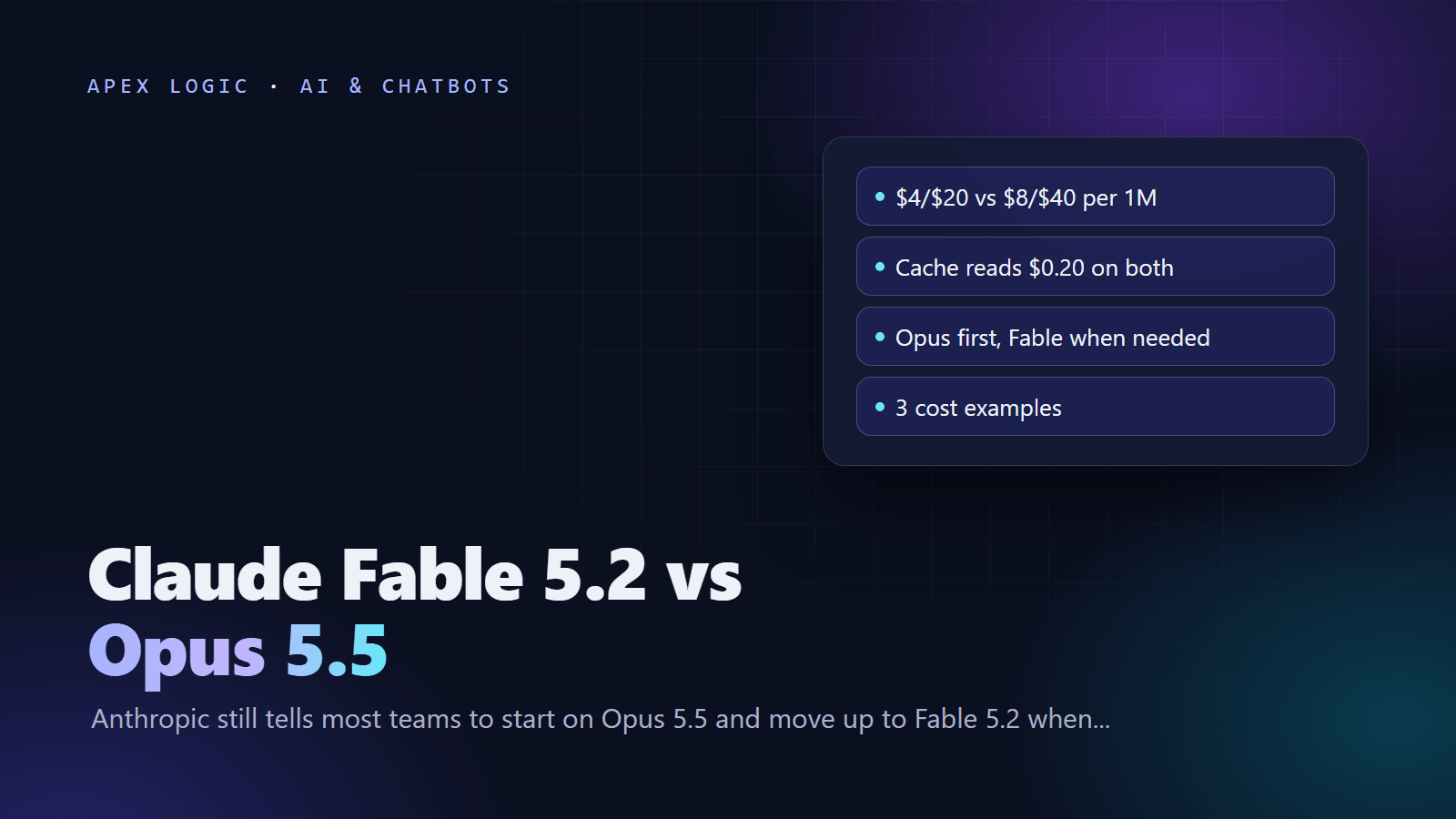
Updated 10 November 2026. Anthropic released Claude Fable 5.2 on 9 November 2026 at a lower price than Fable 5.1; this guide compares it with Claude Opus 5.5 using Anthropic's documentation as of 10 November 2026.
Start with Claude Opus 5.5 and move to Claude Fable 5.2 only when your own tests show Opus falls short. That is Anthropic's own advice: its docs make Opus 5.5 the starting point for most workloads and reserve Fable 5.2 for demanding reasoning and long-horizon agent work, or for cases where Opus at higher effort still misses. As of 10 November 2026, Opus 5.5 costs $4 per 1M input tokens and $20 per 1M output tokens, half of Fable 5.2's $8 and $40. Cache reads cost $0.20 per 1M on both.
Fable 5.2 scores higher on most of Anthropic's tests and on the Artificial Analysis Intelligence Index (65 against 59), but it brings lower rate limits, required 30-day data retention and a higher default effort. On Claude plans, only Max, Ultra and premium seats include it in their usage limits. Below: what each model is for, benchmarks, speed, limits, plans, a checklist and three cost examples.
Fable 5.2 vs Opus 5.5 at a glance
From Anthropic's models overview and pricing page, as of 10 November 2026. Prices are per 1M tokens.
| Item | Claude Fable 5.2 | Claude Opus 5.5 |
|---|---|---|
| Anthropic's description | Demanding reasoning and long-horizon agentic work | Long-running agentic coding and knowledge work |
| Released | 9 November 2026 | 22 September 2026 |
| Model ID | claude-fable-5-2 | claude-opus-5-5 |
| Input / output | $8 / $40 | $4 / $20 |
| Cache writes (5-minute / 1-hour) | $10 / $16 | $5 / $8 |
| Cache reads | $0.20 | $0.20 |
| Batch API | $4 / $20 | $2 / $10 |
| Fast mode | $16 / $80 | $8 / $40 |
| Context / max output | 1M / 128K | 1M / 128K (300K on Batch with a beta header) |
| Default effort | high | medium |
| Data retention | 30 days required (Covered Model) | Your normal settings, zero data retention possible |
| Platforms | Claude API, Amazon Bedrock, Google Cloud, Microsoft Foundry, Claude Platform on AWS | The same five platforms |
What is each model for, according to Anthropic?
- Opus 5.5 is what Anthropic calls its strongest daily driver. Its docs list multihour autonomous coding agents, large-scale refactoring, complex systems engineering, vision-heavy workflows and computer use, and Anthropic says it performs at the level of Fable 5.1 on most work.
- Fable 5.2 is for the most ambitious, open-ended technical work: agent sessions that run for hours, multistep deep research, analysis carried through to a finished document, spreadsheet or deck, and coordinating many subagents. Anthropic's model guide says to move up to it when Opus 5.5 evals at
xhighormaxeffort still fall short.
The two also work together. With the advisor tool, in beta, an Opus 5.5 agent can consult Fable 5.2 on hard steps while most tokens bill at Opus rates; Fable's advice comes back encrypted. Anthropic also suggests Fable 5.2 as an orchestrator that hands simpler tasks to smaller models. Our Claude Fable 5.2 guide covers the launch in full.
Fable 5.2 vs Opus 5.5 benchmarks
Most rows come from Anthropic's Fable 5.2 system card, which names the outside groups that ran some tests. The last row is independent.
| Benchmark (who ran it) | Fable 5.2 | Opus 5.5 |
|---|---|---|
| FrontierCode 2.0 (Cognition), best effort | 49.1% (xhigh) | 45.5% (max) |
| FrontierSWE v2 (Proximal), max effort | 69.9% | 62.3% |
| CursorBench 4.0 (Cursor), max effort | 60.0% | 57.8% |
| SWE-bench Pro (Anthropic) | 93.0% | 89.9% |
| Terminal-Bench 4.0 (Anthropic) | 67.6% (max) | 66.4% (xhigh) |
| Remote Labor Index (Anthropic) | 41.3% | 21.3% |
| GDPval-AA v2.1 Elo (Anthropic) | 1831 | 1866 |
| AA-Briefcase v1.1 Elo (Anthropic) | 1785 | 1800 |
| Artificial Analysis Intelligence Index v5.0.1, max effort | 65 | 59 |
Two details matter more than the headline. Opus 5.5 still leads both knowledge-work Elo ratings. And much of Fable's gain shows up below max effort: on FrontierCode 2.0, Fable 5.2 at high effort scored 45.3% for $6.72 a task, about level with Opus 5.5's best run (45.5%) at $12.82. At max effort, Fable cost $44.70 a task. For how Fable stacks up against OpenAI's flagship, see our Fable 5.2 vs GPT-6 Astra comparison.
Is Fable 5.2 faster than Opus 5.5?
Not in practice. Anthropic rates both at moderate latency, and its docs say Fable 5.2 thinks before almost every reply at high effort and above. As of 10 November 2026, Artificial Analysis measured 98 output tokens per second for Fable 5.2 and 115 for Opus 5.5, both at max effort, and 46.4 minutes per index task for Fable against 25.2 for Opus.
- Fast mode: both offer up to 2.5x the output speed at double the price, $16 / $80 for Fable 5.2 and $8 / $40 for Opus 5.5. Neither works with the Batch API, and in Claude Managed Agents fast mode is listed for Opus 5.5 only.
- Generation gains: Anthropic says Fable 5.2 writes output up to 30% faster than Fable 5.1, and Opus 5.5 more than 30% faster than Opus 5.
Our Fable 5.2 fast mode guide covers setup and costs.
Limits: rate limits, output and data rules
Fable 5.2 has its own rate-limit bucket, and its token limits are lower at every API tier. Figures are requests / input tokens / output tokens per minute, from Anthropic's rate limits page as of 10 November 2026:
| Tier | Fable 5.2 | Opus 5.5 |
|---|---|---|
| Start | 4,000 / 500,000 / 100,000 | 4,000 / 2,000,000 / 400,000 |
| Build | 10,000 / 1,500,000 / 300,000 | 10,000 / 5,000,000 / 1,000,000 |
| Scale | 13,000 / 4,000,000 / 800,000 | 13,000 / 10,000,000 / 2,000,000 |
Cache reads do not count toward the input-token limit, so a well-cached agent fits more work under Fable's cap. Anthropic's migration guide lists the other differences:
- Retention: a Fable 5.2 request from a workspace without 30-day retention returns an error, so teams running Opus 5.5 under zero data retention must sort this out first.
- Edited history: Fable 5.2 returns an error when earlier turns change under its thinking blocks, on every account; Opus 5.5 does so only for accounts created on or after 31 August 2026.
- Model switches: Opus 5.5 cannot read Fable 5.2's thinking blocks, so a fallback to Opus loses that reasoning.
- Structured outputs: in organizations with customer-managed encryption keys, Opus 5.5 supports them and Fable 5.2 does not.
Which Claude plans include Fable 5.2 and Opus 5.5?
From claude.com/pricing and Anthropic's help center, as of 10 November 2026:
| Plan | Price | Opus 5.5 | Fable 5.2 |
|---|---|---|---|
| Free | $0 | No | No |
| Pro | $20 a month, or $17 billed yearly | Yes | Usage credits (included until 16 November) |
| Max | $100 a month | Yes | Up to 50% of weekly limits |
| Ultra | $200 a month | Yes | Up to 50% of weekly limits |
| Team standard seat | $25 a month, or $20 billed yearly | Yes | Usage credits (included until 16 November) |
| Team premium seat | $125 a month, or $100 billed yearly | Yes | Up to 50% of weekly limits |
| Enterprise | $20 per seat a month plus usage at API rates | Yes | Yes, once an admin turns it on |
Fable models use limits faster than other Claude models, and Claude Code needs version 2.1.321 or later for Fable 5.2. For launch, Max, Ultra and premium seats also get one to three Fable limit resets. If you keep hitting limits, see our guide to Claude Code's 5-hour limit.
Decision checklist: Fable 5.2 or Opus 5.5?
- Run your own evals on Opus 5.5 at
high,xhighandmaxfirst. If it passes, stay there. - Move a task up only if it is long-horizon work, such as hours of agent runs, many subagents, deep research or hard science, and Opus still misses.
- Confirm you can accept 30-day data retention. If you need zero data retention, stay on Opus.
- Check peak tokens per minute against Fable's lower rate limits.
- Make sure your code never edits earlier turns, the system prompt or the tool list mid-conversation.
- Set effort explicitly. Fable defaults one level higher than Opus, so the same request costs more.
- Compare cost per finished task, not per token, and try Fable at
highbeforemax. - Consider the middle path: keep Opus 5.5 as the main model and call Fable 5.2 as an advisor.
Our Fable 5.2 API tutorial shows how to change the model ID and set effort in code.
Cost examples for typical jobs
These are hypothetical examples at list prices as of 10 November 2026. They assume both models use the same tokens, which they will not: thinking is billed as output, and effort changes how much each model thinks.
1. A coding agent
Assumptions: 300 tasks a month. Each task reads 1.5M input tokens across its turns, 90% from cache and 10% written to the 5-minute cache, and writes 60,000 output tokens. That is 405M cache reads, 45M cache writes and 18M output tokens.
- Opus 5.5: 405 x $0.20 + 45 x $5 + 18 x $20 = $666
- Fable 5.2: 405 x $0.20 + 45 x $10 + 18 x $40 = $1,251
Equal cache-read prices keep the gap under 2x. If Fable at high effort finishes tasks in fewer tokens, as in the FrontierCode runs above, the gap can close.
2. A customer support bot
Assumptions: 40,000 replies a month. Each call sends 4,000 input tokens, including a 2,000-token system prompt read from cache on 90% of calls and written on 10%, and returns 250 output tokens. That is 72M cache reads, 8M cache writes, 80M uncached input and 10M output tokens.
- Opus 5.5: 72 x $0.20 + 8 x $5 + 80 x $4 + 10 x $20 = $574.40
- Fable 5.2: 72 x $0.20 + 8 x $10 + 80 x $8 + 10 x $40 = $1,134.40
Neither is the right default here. The same traffic costs $21 a month on Claude Haiku 5.5 without caching (160 x $0.10 + 10 x $0.50). Our AI chatbot cost guide covers the full budget.
3. Document analysis
Assumptions: 200 contracts a month, each sent as one 150,000-token prompt with a 5,000-token report back, so 30M input and 1M output tokens. The work can wait overnight, so it runs on the Batch API at 50% off.
- Opus 5.5: 30 x $4 + 1 x $20 = $140, or $70 on Batch
- Fable 5.2: 30 x $8 + 1 x $40 = $280, or $140 on Batch
Neither model charges extra for long prompts inside its 1M-token window. For routine extraction, Opus or a smaller model is usually enough; our AI document processing guide shows how to set it up.
If you want a second opinion before moving traffic, we can run a short side-by-side test of both models on your own tasks and report cost per finished task. Send us a sample of the work.
FAQ
Is Claude Fable 5.2 better than Opus 5.5?
On most of Anthropic's published tests, yes: for example 69.9% against 62.3% on Proximal's FrontierSWE v2, and 65 against 59 on the Artificial Analysis Intelligence Index. Opus 5.5 still leads Anthropic's two knowledge-work Elo ratings, GDPval-AA and AA-Briefcase. Anthropic itself recommends Opus 5.5 for most coding and knowledge work and Fable 5.2 for the hardest long-horizon tasks.
How much more does Fable 5.2 cost than Opus 5.5?
Twice as much for input and output: $8 and $40 per 1M tokens against $4 and $20, as of 10 November 2026. Cache writes and Batch prices are also double. Cache reads cost the same, $0.20 per 1M tokens, so cache-heavy agents see a smaller gap. Fable also defaults to higher effort, which adds thinking tokens unless you set effort yourself.
Can I use Fable 5.2 on the Claude Pro plan?
Yes, but outside the launch offer it runs on usage credits, billed at API rates on top of your subscription. From 9 to 16 November 2026, Pro and standard Team seats can use Fable models for up to 50% of weekly limits at no extra cost, plus one limit reset. Max, Ultra and premium Team seats include Fable within their limits all the time.
Does Fable 5.2 have lower rate limits than Opus 5.5?
Yes. Requests per minute match at each tier, but Fable 5.2's token limits are lower. In the Start tier it allows 500,000 input and 100,000 output tokens per minute, against 2M and 400,000 for Opus 5.5. Cache reads do not count toward the input limit, so caching helps, and organizations that need more than the Scale tier can contact Anthropic's sales team.
Should I switch my Claude Code sessions from Opus 5.5 to Fable 5.2?
Only for the hard tasks. Fable 5.2 needs Claude Code 2.1.321 or later, uses your plan's limits faster, and on Pro it costs usage credits. Keep Opus 5.5 as the default, switch to Fable for long, open-ended work where Opus has stalled, and watch your usage page. Anthropic notes that medium effort is the default in Claude apps and Claude Code.
Sources
- Claude docs: Models overview
- Claude docs: Choosing the right model
- Claude docs: Claude Fable 5.2
- Claude docs: Claude Opus 5.5
- Claude docs: Fable 5.2 and Mythos 5.2 migration guide
- Claude docs: What's new in Claude Fable 5.2
- Claude docs: Pricing
- Claude docs: Rate limits
- Claude docs: Fast mode
- Claude docs: Thinking
- Anthropic: Introducing Claude Fable 5.2 and Claude Mythos 5.2
- Anthropic: Introducing Claude Opus 5.5
- Anthropic: Claude Fable 5.2 and Claude Mythos 5.2 System Card
- Claude pricing
- Claude Help Center: Claude Fable models on your plan
- Claude Help Center: Claude Fable 5.2 launch offers
- Artificial Analysis: Claude Fable 5.2
- Artificial Analysis: Claude Opus 5.5

Loading comments...