Updated 10 November 2026. Anthropic released Claude Fable 5.2 on 9 November; this comparison uses prices, limits and benchmark figures checked on 10 November 2026.
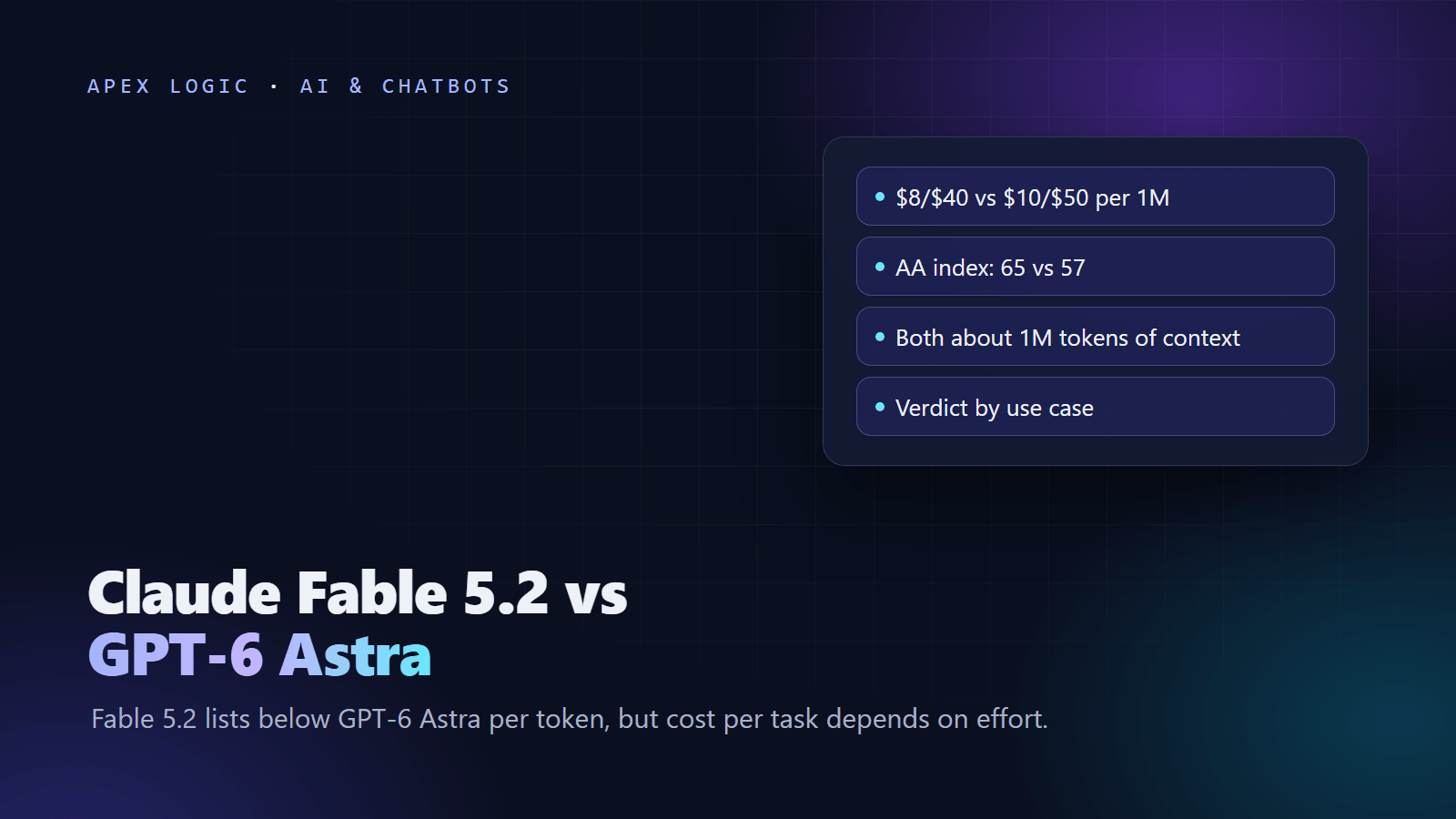
Claude Fable 5.2 is cheaper per token than GPT-6 Astra and leads most benchmarks published for both, but it is not always cheaper per task. As of 10 November 2026, Fable 5.2 costs $8 per 1M input tokens and $40 per 1M output tokens. GPT-6 Astra costs $10 and $50, and its cached input costs $1.00 against $0.20 on Fable. Both take about 1M tokens of context and return up to 128K tokens.
The catch is token use. At max effort Fable 5.2 writes far more tokens, so it costs more per task: Artificial Analysis measured $26.54 per Intelligence Index task for Fable 5.2 and $6.24 for Astra, both at max. Our verdict: use Fable 5.2 for the hardest long-running engineering and very long prompts, run it at high effort rather than max, and pick Astra when you need zero data retention or the lowest cost per task. Gemini 4 Carbon is not open to developers yet, so it appears only where official or independent figures exist. New to the model? Start with our Claude Fable 5.2 guide.
Claude Fable 5.2 vs GPT-6 Astra vs Gemini 4 Carbon at a glance
Prices are per 1M tokens in US dollars, as of 10 November 2026, from Anthropic's pricing page, OpenAI's GPT-6 Astra page, OpenAI's pricing page and Google's Carbon announcement.
| Item | Claude Fable 5.2 | GPT-6 Astra | Gemini 4 Carbon |
|---|---|---|---|
| Released | 9 November 2026 | 3 September 2026 | Announced 28 October 2026 |
| API model ID | claude-fable-5-2 | gpt-6-astra | Not published |
| Input / output | $8 / $40 | $10 / $50 up to 272K input tokens | $2 / $10 introductory, then $4 / $20 |
| Cached input | $0.20 | $1.00 | 95% off the input price |
| Cache writes | $10 (5-minute), $16 (1-hour) | $12.50 (30-minute), $25 (12-hour) | Not published |
| Long prompts | One rate across the 1M window | Above 272K input tokens: 2x input and cache rates, 1.5x output, whole request | Not published |
| Batch | $4 / $20 | $5 / $25 (Flex also 50% off) | Not published |
| Faster tiers | Fast mode $16 / $80 | Fast $20 / $100, Ultrafast $60 / $300 | None announced |
| Context window | 1M tokens | 1,050,000 tokens (max input 922,000) | Not published by Google |
| Max output | 128K tokens | 128,000 tokens | Not published |
| Effort levels | low to max, default high | low to max | Not published |
| Knowledge cutoff | June 2026 | 30 April 2026 | Not published |
| Data retention | 30 days by default | Zero data retention for eligible API customers | Not published |
How much do Claude Fable 5.2 and GPT-6 Astra cost?
On list price Fable 5.2 is 20% cheaper than Astra on input and output, and its cache reads cost a fifth of Astra's. Two rules move real bills. First, Astra bills the whole request at $20 input and $75 output once a prompt passes 272K input tokens, while Fable keeps one rate up to 1M. Second, Anthropic bills Fable's thinking as output tokens even when the thinking text is not returned, so the effort setting drives cost.
Worked cost example
This is a hypothetical example at list prices as of 10 November 2026. A team runs a coding agent on 1,000 tasks a month. Each task sends 150,000 input tokens across its requests, none over 272K, and gets 15,000 output tokens back. That is 150M input and 15M output tokens a month. We assume both models use the same tokens, which real runs will not.
| Scenario | Claude Fable 5.2 | GPT-6 Astra |
|---|---|---|
| A. No caching | 150 x $8 + 15 x $40 = $1,800 | 150 x $10 + 15 x $50 = $2,250 |
| B. 90% of input read from cache, 10% written to it | 135 x $0.20 + 15 x $10 + 15 x $40 = $777 | 135 x $1 + 15 x $12.50 + 15 x $50 = $1,072.50 |
| C. 200 requests with 400,000-token prompts and 4,000-token answers | 80 x $8 + 0.8 x $40 = $672 | 80 x $20 + 0.8 x $75 = $1,660 |
For scale, scenario A would cost $450 on Gemini 4 Carbon at its introductory price and $900 at the later price, if developers could buy it. Equal token counts flatter Fable 5.2, though. Measured per-task figures tell a different story at the top effort setting:
- Artificial Analysis reported $26.54 per Intelligence Index task for Fable 5.2 at max effort, $6.24 for Astra at max and $7.76 for Carbon at high. Fable produced 275M output tokens on the index, against 54.3M for Astra.
- In Cognition's FrontierCode 2.0 runs, reported in Anthropic's system card, Fable 5.2 at high effort scored 45.3% for $6.72 a task, ahead of Astra's best run (42.8% at $6.68). At max effort Fable cost $44.70 a task.
So start Fable 5.2 at high effort and raise it only where the score gain pays for itself. Our LLM API costs guide covers caching and batch savings for both.
Fable 5.2 vs GPT-6 Astra benchmarks
Most published numbers come from the model makers, so we list only rows where one source reports the models on the same benchmark version, and we say who ran or reported each one. Scores are each model's best effort unless noted.
| Benchmark (who ran or reported it) | Claude Fable 5.2 | GPT-6 Astra | Gemini 4 Carbon |
|---|---|---|---|
| Artificial Analysis Intelligence Index v5.0.1 (Artificial Analysis; Carbon at high) | 65 | 57 | 60 |
| FrontierCode 2.0 (Cognition, via Anthropic) | 49.1% (xhigh) | 42.8% (max) | 41.1% (medium) |
| FrontierSWE v2 (Proximal, via Anthropic) | 69.9% | 65.5% | 61.2% |
| AutomationBench (Anthropic; OpenAI also lists Astra at 41.4%) | 51.4% | 41.4% | 53.9% |
| Humanity's Last Exam with tools (both labs list Astra at 57.2%) | 74.2% | 57.2% | Not reported |
| OSWorld 2.1 offline set (Anthropic ran Astra on the same 82 tasks) | 89.3% | 79.5% | 81.5% |
| Terminal-Bench-Science 0.1 (Anthropic's table; Astra figure from OpenAI) | 74.6% | 68.1% | 64.8% |
Three cautions. OpenAI's launch post showed Astra at 64.6% on Terminal-Bench-Science, and its later GPT-6.1 Sol post reported 68.1%. OpenAI also reports Astra scores that Anthropic has not published for Fable 5.2, such as 97.6% on FrontierMath Tier 4 and 99.9% on ARC-AGI-3, so there is no head-to-head on math or abstract reasoning. And Carbon leads AutomationBench even in Anthropic's own table.
Which is faster: Fable 5.2 or GPT-6 Astra?
Neither company publishes a standard-speed tokens-per-second figure. What they do say, as of 10 November 2026:
- Fable 5.2: Anthropic says it generates output up to 30% faster than Fable 5.1. Fast mode gives up to 2.5x the output speed at $16 / $80, on the Claude API, Claude Code, Google Cloud and Microsoft Foundry, but not with the Batch API.
- GPT-6 Astra: OpenAI says Fast mode delivers up to 2x the speed at 2x the price, and Ultrafast is its fastest API tier, with WebSockets recommended for agent loops.
- Gemini 4 Carbon: Google has made no speed claim.
Artificial Analysis measured output speed at 98 tokens per second for Fable 5.2 and 38 for Astra, both at max effort, and 78 for Carbon at high. Fable still took longer per index task, 46.4 minutes against 22.8 for Astra and 26.4 for Carbon, because it wrote more. Our Fable 5.2 fast mode guide covers when paying double for speed makes sense.
Access and plans: where can you use each model?
- Claude Fable 5.2: all paid Claude plans, not Free. Max ($100 a month), Ultra ($200) and premium Team seats include Fable for up to 50% of weekly limits; Pro and standard Team seats pay with usage credits outside a launch week that ends 16 November 2026. Developers get
claude-fable-5-2on the Claude API, Amazon Bedrock, Google Cloud, Microsoft Foundry and Claude Platform on AWS. - GPT-6 Astra: OpenAI's pricing page lists it on ChatGPT Plus, with expanded use on Pro, and not on Free or Go; the launch post adds Business and Enterprise. In the API it works on Chat Completions, Responses and Batch, but not on the free tier, and tool calling needs the Responses API. It is also on Azure and Amazon Bedrock, with Google Cloud in private preview.
- Gemini 4 Carbon: as of 10 November 2026, Google offers it to a subset of cyber defenders and Fairwind Program partners, and the Gemini API models page lists only
gemini-4-argonunder Gemini 4. Our Gemini 4 Carbon guide tracks the rollout.
Tools, safeguards and data rules
Tools. Fable 5.2 supports your own tools with automatic tool choice (forcing a tool returns an error), web search at $10 per 1,000 searches, web fetch at no extra charge, code execution and computer use through the computer_toolset_20260801 toolset, and it can advise or orchestrate cheaper Claude models. Astra's Responses API tools include web search, file search, image generation, code interpreter, hosted shell, apply patch, skills, computer use, MCP and tool search. Our Fable 5.2 API tutorial shows the request format.
Safeguards. Fable 5.2 blocks high-risk cyber work, such as penetration testing and exploit generation, and most research biology. In Claude's apps those requests go to Opus 4.8 or Opus 5; on the API you configure fallbacks yourself or get a refusal. Anthropic says early testing showed about 55% fewer blocks than Fable 5.1. OpenAI says Astra refuses advanced tasks such as proof-of-concept exploits. The gated versions are covered in our Claude Mythos 5.2 access guide.
Data. Fable 5.2 is a Covered Model: prompts and outputs are kept at least 30 days for safety monitoring, and zero data retention is a limited-time option only for customers Anthropic deems eligible. OpenAI says Astra supports zero data retention for eligible API customers.
Verdict: which model should you use?
There is no single winner. Based on the figures above, as of 10 November 2026:
| If your job is... | Start with | Why |
|---|---|---|
| Long-running coding agents and large refactors | Fable 5.2 at high effort | Leads FrontierCode 2.0 and FrontierSWE v2; at high effort it matched Astra's cost per FrontierCode task |
| Lowest cost per task at near-top quality | GPT-6 Astra | $6.24 per index task against $26.54 for Fable 5.2 at max |
| Prompts over 272K tokens | Fable 5.2 | One rate across 1M tokens; Astra raises rates for the whole request |
| Zero data retention required | GPT-6 Astra | Fable 5.2 needs 30-day retention for most customers |
| Business workflow automation | Fable 5.2 | Ahead of Astra on AutomationBench; Carbon scored higher but is not open |
| Computer use, math research | Test both | Results come from different test versions or only one lab |
| High-volume chat or support bots | Neither | Both are priced for hard work; see our Haiku 5.5 vs GPT-6 Luna comparison |
Before you commit, run 20 to 50 of your own tasks through each model and compare cost per finished task. If you want help setting up that test or building the tool around it, our AI solutions team can scope it on a fixed quote.
FAQ
Is Claude Fable 5.2 cheaper than GPT-6 Astra?
Per token, yes. As of 10 November 2026, Fable 5.2 costs $8 per 1M input tokens and $40 per 1M output tokens, against $10 and $50 for GPT-6 Astra, and its cache reads cost $0.20 against $1.00. Per task it depends on effort: Artificial Analysis measured $26.54 per index task for Fable 5.2 at max effort and $6.24 for Astra, because Fable wrote about five times as many output tokens.
Which has the bigger context window, Fable 5.2 or GPT-6 Astra?
They are close. Fable 5.2 has a 1M-token context window and 128K tokens of output. GPT-6 Astra has a 1,050,000-token window, with at most 922,000 input tokens and 128,000 output tokens. The bigger difference is price: Astra charges double input rates for the whole request above 272K input tokens, while Fable 5.2 keeps one rate across its window.
Is Claude Fable 5.2 better than GPT-6 Astra for coding?
On the coding tests that include both, Fable 5.2 scores higher: 49.1% against 42.8% on Cognition's FrontierCode 2.0 runs and 69.9% against 65.5% on Proximal's FrontierSWE v2, both reported by Anthropic. Neither test is your codebase. Run 20 to 50 real tickets through each model at an effort level you can afford, and compare merged changes and cost per ticket.
Can I use Fable 5.2 or GPT-6 Astra for free?
Not as of 10 November 2026. Fable models are not on Claude's Free plan, and Pro users pay with usage credits once the launch week ends on 16 November. OpenAI's pricing page does not list GPT-6 Astra on ChatGPT Free or Go, and the API free tier does not support it. Both are pay-as-you-go through their APIs.
Is Gemini 4 Carbon available to compare yet?
Only in a limited way. Google announced Carbon on 28 October 2026 and is giving it to a subset of cyber defenders first, then Fairwind Program partners. As of 10 November 2026 it is not on the Gemini API models page and has no published model ID. Google set its introductory price at $2 input and $10 output per 1M tokens, rising to $4 and $20 later.
Does Claude Fable 5.2 support zero data retention?
Not by default. Anthropic designates Fable 5.2 a Covered Model, so prompts and outputs are kept for at least 30 days for safety monitoring. Customers Anthropic deems eligible get a time-limited zero data retention option while its Enterprise Frontier Safeguards roll out. OpenAI says GPT-6 Astra supports zero data retention for eligible API customers, which matters if you handle regulated data.
Sources
- Anthropic: Introducing Claude Fable 5.2 and Claude Mythos 5.2
- Anthropic: Claude Fable
- Claude docs: Pricing
- Claude docs: What's new in Claude Fable 5.2
- Claude docs: Fast mode
- Claude docs: Web search tool
- Claude docs: Code execution tool
- Anthropic: Claude Fable 5.2 and Claude Mythos 5.2 System Card
- Claude Help Center: Claude Fable models on your plan
- Claude Help Center: Covered Models
- OpenAI: GPT-6 Astra
- OpenAI: Introducing GPT-6.1 Sol
- OpenAI API docs: GPT-6 Astra
- OpenAI API docs: Pricing
- OpenAI API docs: Ultrafast mode
- ChatGPT pricing
- Google: Gemini 4 Carbon announcement
- Gemini API docs: Models
- Artificial Analysis: Claude Fable 5.2
- Artificial Analysis: GPT-6 Astra
- Artificial Analysis: Gemini 4 Carbon

Loading comments...