Updated 16 October 2026. Cloudflare, AWS and Perplexity released open decision models at the start of October, and this guide compares them with Jev.
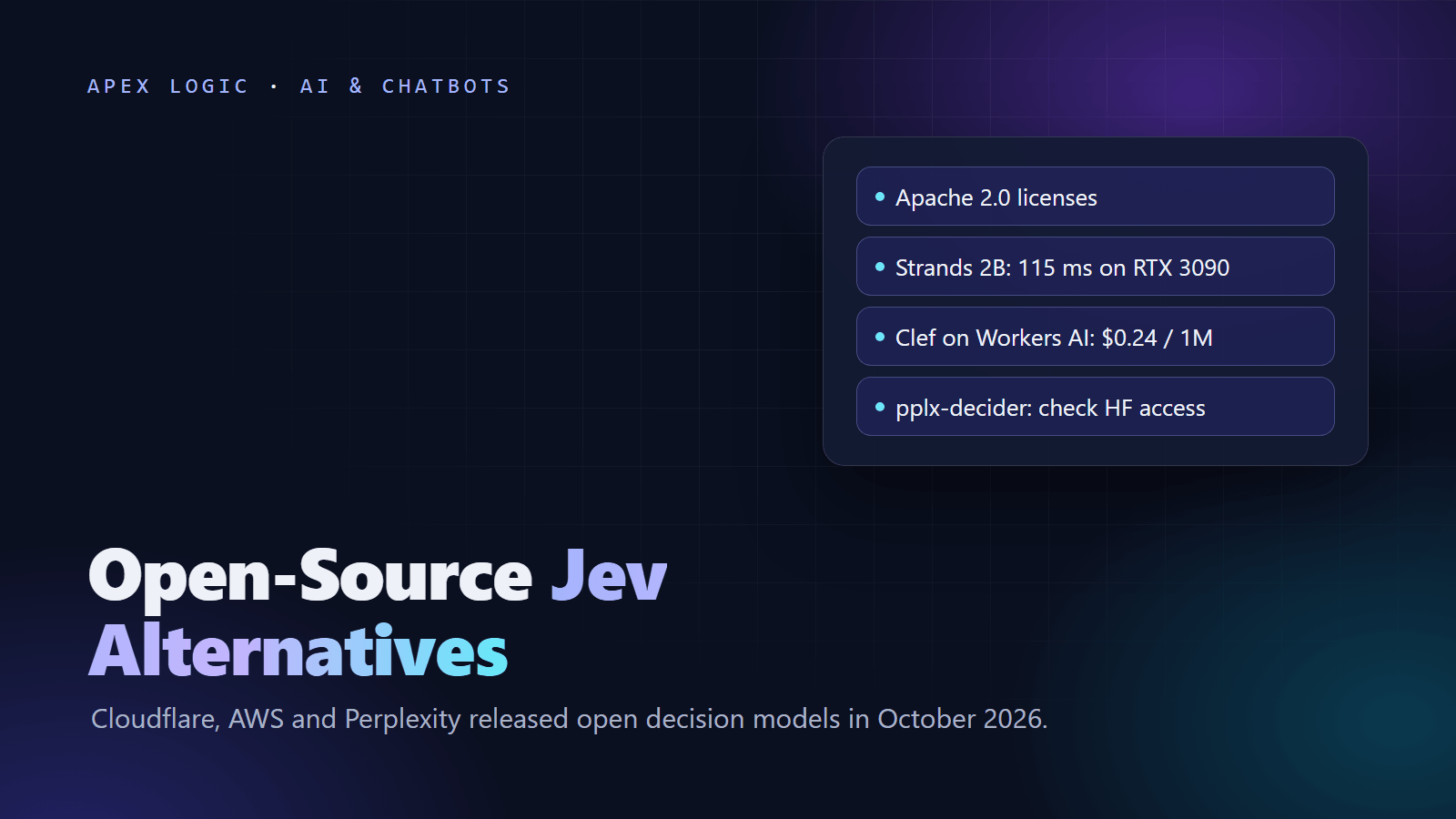
The main open-source Jev alternatives are Cloudflare's Clef (plus the smaller Clef-flash), AWS's Strands Decider and Perplexity's pplx-decider. Like Jev, they answer typed questions with probabilities instead of text. Unlike Jev, which you call through TypeSafe's API, their weights carry Apache 2.0 licenses, so you can run them yourself. The catch: pplx-decider's model card calls its Hugging Face repository private, so check access first.
Strands Decider is the easiest to self-host: a 2B model its makers measured at about 115 ms per question on one RTX 3090. Clef and pplx-decider are larger models built on Qwen3.8-27B, and both also run as hosted APIs. Choose an open model when data must stay on your servers or you want to fine-tune on your own labels; otherwise a hosted API such as Jev is usually simpler.
Open-source Jev alternatives at a glance
| Clef and Clef-flash | Strands Decider | pplx-decider | |
|---|---|---|---|
| Maker | Cloudflare | AWS Strands Agents team | Perplexity |
| Released | 1 October 2026 | 1 October 2026 | v1 on 1 October 2026, per AI Weekly; v1.1 later |
| License | Apache 2.0 | Apache 2.0 | Apache-2.0, per the model card |
| Base model | Qwen3.8-27B (Clef), Qwen3.5-9B (Clef-flash) | Qwen3.5-2B, plus Gemma 4 versions from E2B to 26B-A4B | Qwen3.8-27B, about 26B parameters |
| Weights | Cloudflare/clef, Cloudflare/clef-flash | StrandsAgents on Hugging Face, mirrored under amazon | perplexity-ai/pplx-decider-v1.1-27b, access unclear |
| Hosted option | Workers AI; Clef lists $0.24 per 1M input tokens | None; you host it | Perplexity API, $0.02 per 1M input tokens |
| Self-host route | /v1/systemone served with SGLang | /v1/systemone from the built-in server | Python helper, autojev |
| Images | Yes | Qwen3.5 version only, with the vision extra | Yes |
Prices and access are as of 16 October 2026. Other open decision-model projects, such as Laya, Ollaya, Jeff and Kev, drew big Hacker News threads in September; we have not checked their licenses or results, so they are not covered here.
Cloudflare Clef and Clef-flash
Cloudflare released Clef on 1 October 2026 in a blog post by Michelle Chen. Clef uses a frozen Qwen3.8-27B backbone and Clef-flash uses Qwen3.5-9B. Both are on Hugging Face under Apache 2.0.
- Jev compatibility: Cloudflare says Clef is fully compatible with the Jev API, and the model cards show SGLang serving a
/v1/systemoneendpoint for Jev-style requests. - Workers AI: both run as
@cf/cloudflare/clefand@cf/cloudflare/clef-flash. The Clef page lists $0.24 per 1M input tokens with output not charged, as of 16 October 2026, a 65,536-token context, 1 to 64 questions (noul,choice,score) and up to 4 embedded PNG, JPEG or WebP images. Remote image URLs are not accepted. - Privacy: Cloudflare says it does not read, store or train on requests unless you opt into fine-tuning.
- Fine-tuning: a managed reinforcement-learning service run by Cloudflare's engineers, with self-serve planned.
- Hardware: no minimum listed. Both cards report testing on a single H200, and Clef's SGLang guides cover H200, B200 and B300 GPUs.
Cloudflare's tables show mixed results against Jev: Clef scored 94.20 macro-F1 on BANKING77 against Jev's 79.74, while Jev led on When2Call accuracy, 80.97 to 72.37. Cloudflare reports median latency of 209.3 ms for Clef, 38.8 ms for Clef-flash and 524.1 ms for Jev.
Strands Decider from AWS
AWS's Strands Agents team (Marc Brooker, Mike Chambers and Fabio Nonato de Paula) published Strands Decider 2B on 1 October 2026: a Qwen3.5-2B model whose text head was replaced by a pointer head of about 1M parameters, tuned with a rank-16 LoRA. The repository also lists Gemma 4-based E2B, E4B, 12B and 26B-A4B versions, all Apache 2.0. Two commands from the repository get it running:
pip install strands-decider
strands-decider serve StrandsAgents/strands-decider-2B-qwen3.5-v1-2610 --port 8000
The server exposes POST /v1/systemone, taking a state and questions of type noul, choice or score, the same pattern Jev uses.
- Speed: a median of about 115 ms per question on an RTX 3090 and about 153 ms on an Apple M3 Pro.
- Devices: CUDA, MPS, MLX or CPU.
- Gemma 4 memory (bf16 weights): about 9 GB (E2B), 15 GB (E4B), 23 GB (12B) and 51 GB (26B-A4B). As of 16 October 2026 these versions are not on PyPI yet, so install from the GitHub main branch.
- Images: Qwen3.5 version only, with the
visionextra; the Gemma 4 versions read text only. - Agent checks: in Strands Agents, a check before each tool call can proceed, deny, ask a human to confirm, or send guidance back to the agent.
- Training: scripts are included and need Linux or WSL2 with NVIDIA GPUs.
- Ranking: the team says it placed 3rd of 33 models in the 2B class on JevBench's public set.
The stated limits: it is weaker than reasoning models on hard problems, and it cannot write text.
Perplexity pplx-decider
AI Weekly reported on 2 October that Perplexity opened its Decisions API on 1 October with an open-weight model, pplx-decider, and that v1 launched at $0.04 per 1M input tokens. As of 16 October 2026, Perplexity's docs list pplx-decider-v1.1-27b and pplx-decider-v1-27b at $0.02 per 1M input tokens, with free output and no per-request fee. The docs do not explain the difference, so budget with the docs figure and recheck before you commit.
The hosted API, POST https://api.perplexity.ai/v1/decisions, allows under 262,144 input tokens per request, 1 to 128 questions, 1 to 255 options per choice, 1 to 10 score levels, a 32 MiB body, base64 PNG, JPEG or WebP images, and 10 requests per second per organization. Perplexity says small requests take under 2 seconds and inputs near the limit about 23 seconds. Question types match Jev's: noul, choice and score.
Can you download pplx-decider?
Unclear. The v1.1 model card lists an Apache-2.0 license, about 26B parameters on a Qwen3.8-27B base, a CUDA GPU with about 49 GiB for the weights, and a local Python helper, autojev, that caps one decision at 8,192 tokens. But the same card calls the repository private and asks for an authenticated Hugging Face login, while some coverage says the model is ungated. Perplexity's quickstart, read on 16 October, does not mention open weights. Check access on Hugging Face before you plan to self-host.
Perplexity reports a Decision Index of 61.56 for v1.1, against 56.4 for v1 and 57.9 for Jev, on its own benchmark.
How they compare with hosted Jev
| Jev (hosted) | Clef | Strands Decider | pplx-decider | |
|---|---|---|---|---|
| Hosted price per 1M input tokens | $0.042 | $0.24 on Workers AI | No hosted option from the makers | $0.02 on Perplexity's API |
| Self-host | No | Yes | Yes | If you can get access |
| Context | 64k per request by default; 262k opt-in | 65,536 tokens on Workers AI | Not stated | Under 262,144 on the API; 8,192 per decision locally |
| Vendor speed claim | 70 to 500 ms | 209.3 ms median (38.8 ms for Clef-flash) | About 115 ms per question on an RTX 3090 | Under 2 seconds for small requests |
| Vendor accuracy claim | Used as the baseline by the others | Ahead of Jev on BANKING77, behind on When2Call | 3rd of 33 in its size class on JevBench | Decision Index 61.56 vs 57.9 for Jev |
Prices are as of 16 October 2026. Every speed and accuracy figure comes from a vendor, on different tests and hardware, so this is not a ranking.
Two outside reference points help. Red Hat's 2 October tests found that small pre-trained classifiers and LLM judges often match or beat decision models on prompt-injection and content-safety tasks. And Microsoft's benchmark for its hosted Microsoft-Decision-1 lists Strands-Decider 2B among its rivals. For hosted options, see Microsoft-Decision-1 vs Jev and our OpenAI Decisions API tutorial.
Hardware: what you need to run each
| Model | What the makers publish |
|---|---|
| Strands Decider 2B (Qwen3.5) | Measured on one RTX 3090 (about 115 ms) and an Apple M3 Pro (about 153 ms); runs on CUDA, MPS, MLX or CPU |
| Strands Decider, Gemma 4 versions | About 9 GB (E2B), 15 GB (E4B), 23 GB (12B) or 51 GB (26B-A4B) for bf16 weights |
| Clef-flash | Tested on a single H200 GPU; no minimum listed |
| Clef | Tested on a single H200 GPU; launch guides for H200, B200 and B300; no minimum listed |
| pplx-decider v1.1 | A CUDA GPU with about 49 GiB for the weights, plus working memory |
In our sources, only Strands Decider is shown on consumer hardware. For Clef and pplx-decider, check the cards against your GPUs or start with the hosted APIs.
When an open decision model makes sense for a business
Open weights are not automatically cheaper. At the hosted prices above, 100M input tokens a month costs about $4.20 on Jev, $2 on Perplexity's API and $24 on Workers AI, as of 16 October 2026, while your own server is a fixed monthly cost plus upkeep. Self-host for other reasons:
- Data must stay on your servers, such as patient notes, legal files or contracts.
- You want to fine-tune on your own labels. Strands Decider ships training scripts; Cloudflare offers managed fine-tuning for Clef.
- You need it offline or at the edge. A 2B model on one GPU, a Mac or a CPU can run in a clinic, a warehouse or on a laptop.
- You want no vendor lock-in. A
/v1/systemoneserver you control can sit behind the same code as a hosted Jev-style API. - Your volume is very high and steady. Per-token fees grow with volume, while your server costs the same each month. Compare with your own numbers.
Hosted is the better start when volume is modest, nobody on your team runs GPU servers, or you need results this month. Our comparison of open-weight models and API models covers the same trade-off for chat models.
How to get started
- Pick one narrow decision, such as routing tickets or checking an agent's tool calls.
- Label real examples from your own data.
- Run them through hosted Jev and one open model, such as Strands Decider on a single GPU.
- Compare accuracy, latency and monthly cost, and set thresholds with a human fallback.
- If the open model is close enough, fine-tune it on your labels and serve it behind
/v1/systemone.
Agent builders can start with a check before each tool call; see how to build an AI agent and AI agents for business. If you came from trading, Jev trading bots on GitHub covers a different kind of open-source Jev project, and our Jev model guide explains Jev itself.
If you want a private decision layer on your own servers, talk to us. Apex Logic can test a hosted API against a self-hosted model on your data and quote a fixed price for the build.
Jev alternatives FAQ
Is there an open-source version of Jev?
TypeSafe offers Jev through its own API and does not disclose the underlying model. The closest open alternatives are Clef, Strands Decider and pplx-decider, all with Apache 2.0 licenses. Cloudflare says Clef is fully compatible with the Jev API, and Strands Decider serves a Jev-style /v1/systemone endpoint, so Jev code needs fewer changes to try them.
Which Jev alternative is easiest to run locally?
Strands Decider. It installs with pip, serves a /v1/systemone endpoint with one command, and runs on CUDA, MPS, MLX or CPU, at about 115 ms per question on an RTX 3090 by its makers' measure. Clef-flash was tested on a single H200 GPU, and pplx-decider needs a CUDA GPU with about 49 GiB for its weights.
Can I use pplx-decider commercially?
Its v1.1 model card lists an Apache-2.0 license, which generally allows commercial use. Access is the open question: the card calls the repository private and asks for an authenticated Hugging Face login, while some coverage says it is ungated. Check access, read the license yourself, and get legal advice if the model is central to your product.
How much does Cloudflare Clef cost?
The weights are free under Apache 2.0, so self-hosting costs your hardware and time. On Workers AI, Clef costs $0.24 per 1M input tokens with no output charge, as of 16 October 2026. That is several times hosted Jev's $0.042, so Clef's appeal rests on self-hosting, fine-tuning or Cloudflare's privacy terms.
Are open decision models as accurate as Jev?
The makers report mixed results. Clef leads Jev on BANKING77 but trails on When2Call, and Perplexity reports a Decision Index of 61.56 for pplx-decider v1.1 against 57.9 for Jev. These are vendor-run tests on different benchmarks, so they cannot be ranked. Red Hat also found that small classifiers often match decision models.
When should a business self-host a decision model?
Self-host when data cannot leave your servers, when you want to fine-tune on your own labels, when you need the model offline or at the edge, or when steady volume makes a fixed server cheaper than per-token fees. With modest volume and no one to run GPU servers, a hosted API such as Jev or Perplexity's is simpler.
Sources
- Cloudflare blog: Clef decision models
- Hugging Face: Cloudflare/clef model card
- Hugging Face: Cloudflare/clef-flash model card
- Cloudflare Workers AI docs: Clef
- Strands Agents blog: Introducing Strands Decider
- GitHub: strands-labs/strands-decider
- Perplexity docs: Decisions API quickstart
- Hugging Face: pplx-decider-v1.1-27b model card
- TypeSafe docs: Jev models and pricing
- Microsoft Command Line blog: Microsoft-Decision-1
Loading comments...