Related: Jev Trading Bots on GitHub: 5 Open-Source Projects Explained
This article is general information about software, not financial advice. Trading carries a real risk of loss. Test any system with paper money first, and never trade money you cannot afford to lose.
Jev, sometimes written JEV, is a new AI model from TypeSafe AI, released in limited early access on 15 September 2026. It does not chat or write. It answers typed questions about data you give it, and returns each answer with probabilities attached. Within ten days its launch video had been viewed around 40 million times on X, and Bloomberg reported that investors had approached TypeSafe with offers valuing it at more than $10 billion.
Traders noticed fast, and open-source Jev trading bots appeared on GitHub within days. This guide explains what the Jev AI model is, what it is good at in trading, what it cannot do, and how it fits into a trading system. It is also the index for our Jev trading series, listed near the end.
What is Jev AI?
Jev is what TypeSafe calls a "System One model", named after the fast, intuitive thinking described by the psychologist Daniel Kahneman. Where a chatbot such as ChatGPT generates text word by word, Jev makes a structured decision in one step.
You send Jev two things:
- State: the information to judge, as text or JSON. In trading, that might be a summary of the order book, a few indicators, and your current position.
- Questions: one or more typed questions about that state, with the possible answers defined in advance.
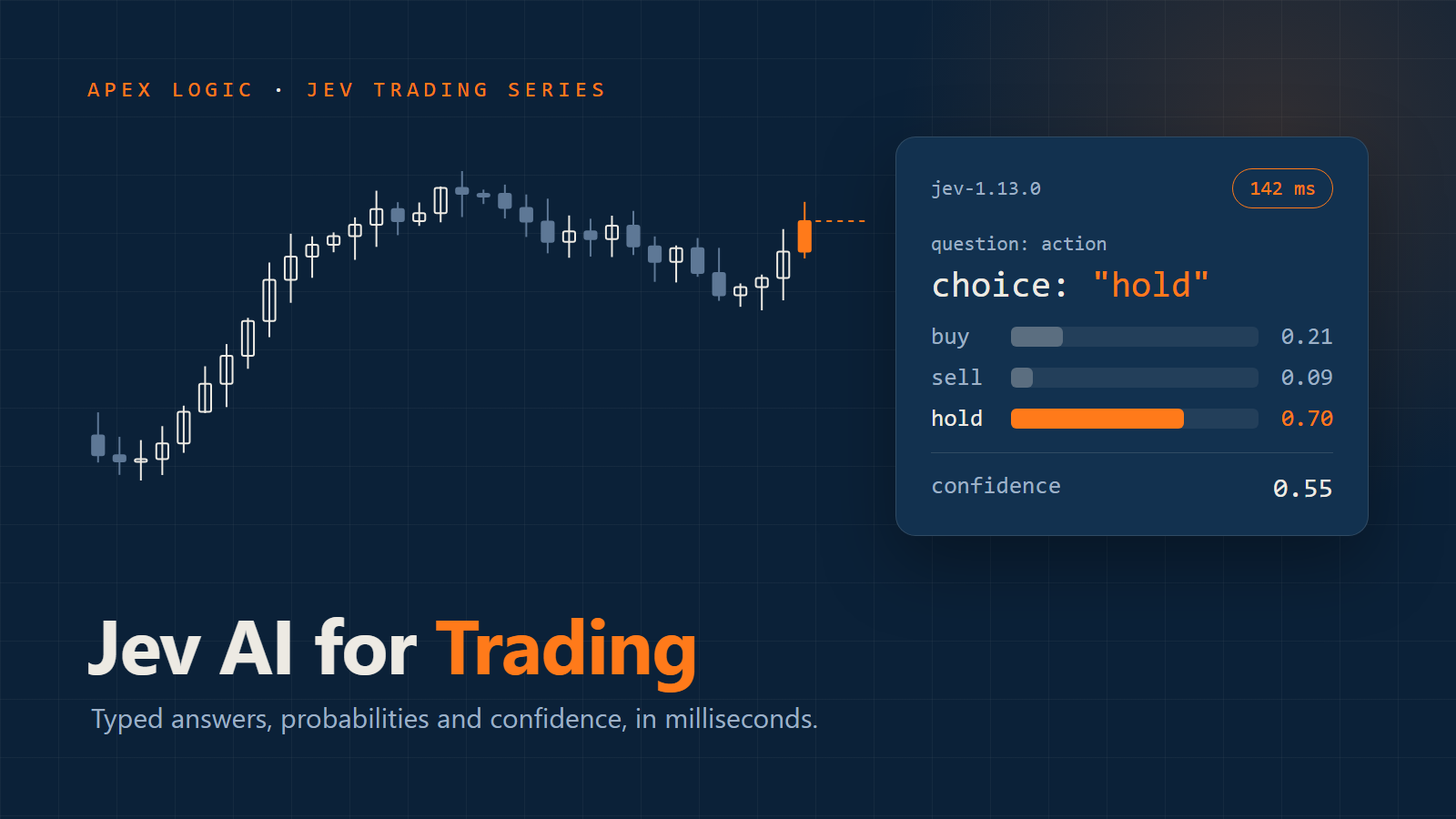
Jev sends back typed answers with probabilities and, for most question types, a confidence score. Your code reads them directly. There is no text to parse, and the model cannot reply with an option you did not offer.
Key facts about Jev:
- Maker: TypeSafe AI, based in San Francisco and founded in 2024 by Diogo Almeida, Erik Gafni and Sasha Sheng. Almeida previously worked at OpenAI on InstructGPT, ChatGPT and GPT-4.
- Launch: 15 September 2026, in limited early access, alongside a $40 million seed round led by DCVC.
- Current version:
jev-1.13. The model is proprietary, and no weights or technical paper have been published. - Training: synthetic data, with a method TypeSafe calls Reinforcement Learning for Calibrated Decisions, aimed at honest probabilities.
- Name: after the economist William Stanley Jevons. The Jevons paradox says that making a resource cheaper to use can increase how much of it gets used.
How Jev works: three question types
Every Jev request is built from three kinds of question. Here is how each might look in a trading system.
| Type | What it answers | Trading example | What comes back |
|---|---|---|---|
| Choice | Pick one option from a list of up to 255 | Buy, sell or hold? | The chosen option, a probability for every option, and a confidence score |
| Score | Rate the state on 2 to 10 ordered levels | How strong is the trend, from "none" to "very strong"? | A score, a probability for each level, and a confidence score |
| Noul | Is this statement true? | Does this headline report a trading halt? | The probability of yes, from 0 to 1 |
You can send many questions in one call. Jev answers them in parallel and independently, so one answer cannot sway another.
Why Jev matters for trading
Jev speed
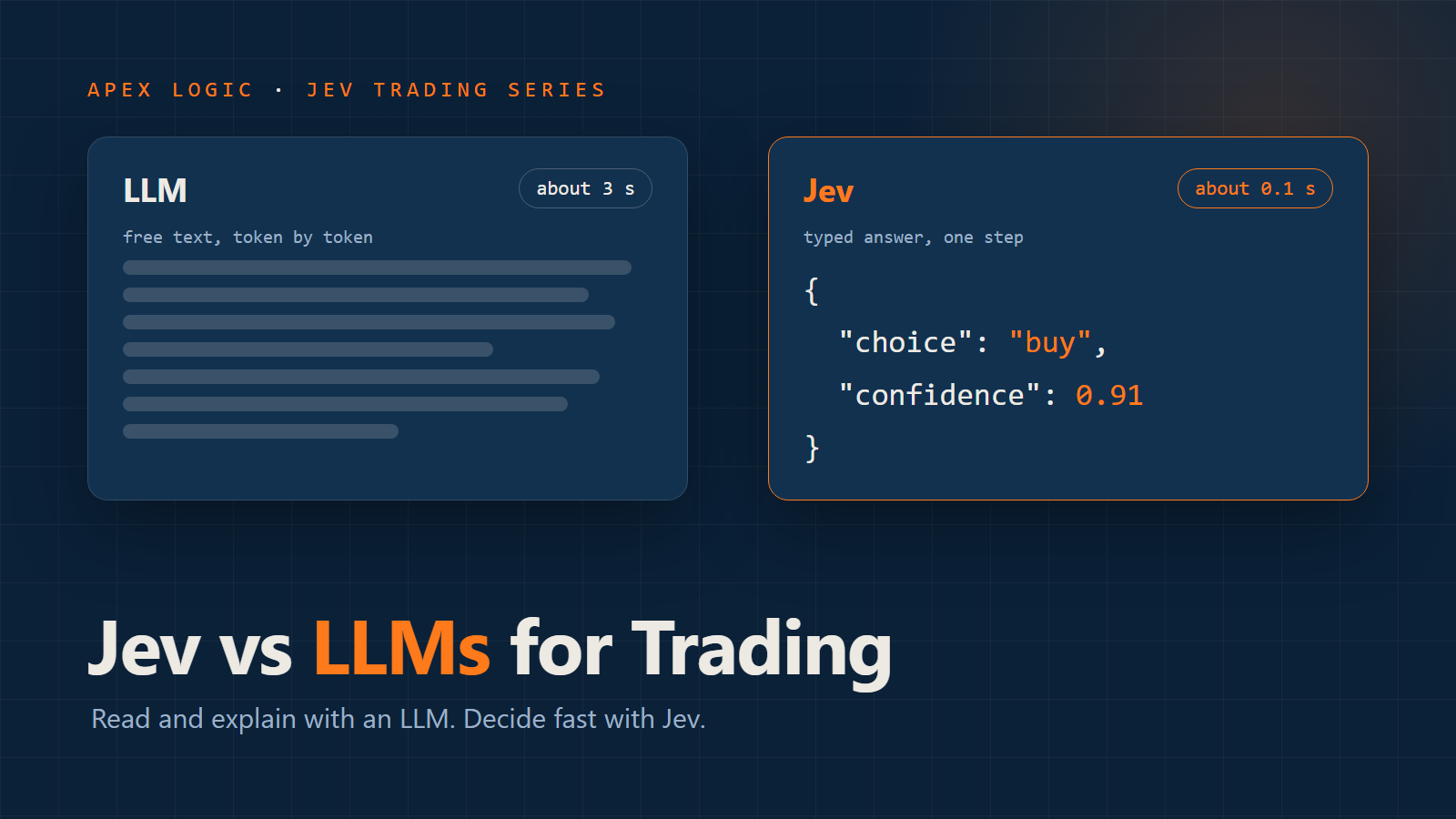
TypeSafe quotes end-to-end responses of 70 to 500 milliseconds. A typical large language model (LLM) takes seconds. That is fast enough for a decision on every block of a fast blockchain, or every few seconds on an exchange. It is far too slow for high-frequency trading, where decisions take microseconds.
Jev pricing
Jev costs $0.042 per million input tokens, which is $42 per billion. Output tokens are free. A bot sending a 400-token request once a second, all day, uses about 35 million tokens. At that price, that is roughly $1.45 a day. For most bots, trading fees and slippage will cost far more than the model.
Answers that are always well-formed
Ask an LLM for "BUY, SELL or HOLD" and it will sometimes reply with a paragraph, a typo, or "it depends". Jev cannot. Its output always matches the options you defined. TypeSafe calls this type safety.
Type safety is not the same as being right. A perfectly formatted "buy" can still be a bad trade.
Probabilities, not just answers
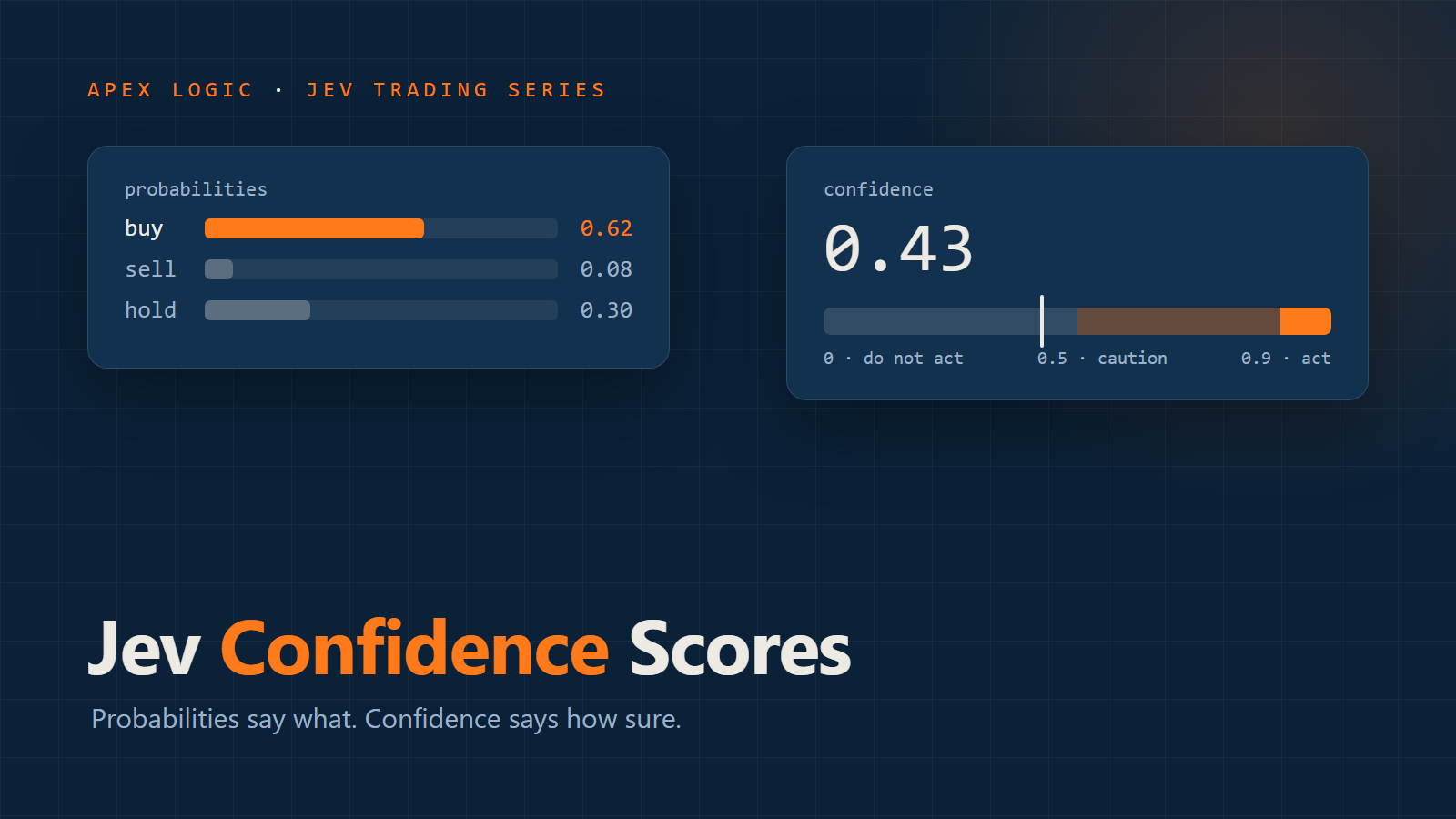
Every Jev answer says how sure it is. That lets your code skip trades when the model is unsure, which is often the most valuable thing a filter can do. See Jev confidence scores explained for how to use them.
What Jev cannot do
TypeSafe publishes a list of known weaknesses for jev-1.13. Several matter a lot in trading.
- It is not a calculator. That is TypeSafe's own description. Work out returns, spreads, indicators, position sizes and profit in code.
- It does not count reliably. Do not ask how many candles closed green. Count them in code and send the result.
- It reads dates as text. Sort timestamps and measure durations in code.
- It prefers labels to raw numbers. TypeSafe recommends turning numbers into named categories before asking. "RSI: overbought" works better than "RSI: 78.3".
- Accuracy falls as irrelevant data grows. Send a small, focused state, not your whole price history.
- Text only. Jev cannot look at a chart image.
- No market knowledge. Jev knows nothing about today's market unless you put it in the state, and TypeSafe advises against relying on knowledge stored in the model at all.
- English works best. Other languages are supported with lower accuracy, so test before using non-English news.
Can Jev predict stock or crypto prices?
Not reliably, as far as any public evidence shows, and it was not built to. Jev judges the state you give it. If that state holds no real edge, the model cannot invent one.
One early open-source project is a useful reality check. It asked Jev to call the next day's move for four Hong Kong stocks as up, flat or down. In its own backtest of 120 cases, Jev was right 54 times, or 45 percent. The author is careful to call this one small historical window, not a verdict. It is still a reminder that a fast, cheap, well-formatted answer is not the same as a profitable one.
TypeSafe's headline benchmarks, up to 193.6 times faster and 444.6 times cheaper than leading LLMs, come from workflows its own team built. TypeSafe says so openly, and describes the gains as likely to sit at the high end of real results. Independent testing has only just started.
Where Jev fits in a trading system
Nearly every serious Jev trading project so far follows one rule: Jev judges, code executes.
- Code collects market data and calculates features.
- Code turns those features into a small, labelled state.
- Jev answers narrow questions about that state.
- Code turns the answers into an action, using thresholds you set.
- Hard risk rules in code can veto anything.
- Code places and manages orders, and logs everything.
Good jobs for Jev in that picture:
- A pre-trade check. Before an entry order goes out, does it fit the strategy's rules and current exposure?
- Market regime labels. Trending, ranging or disorderly, judged from indicators computed in code.
- News and filing triage. Is this headline about this company? Is it material? Is it positive or negative?
- Auditing another model. Does an LLM's written trade thesis actually support the direction it picked?
- Turning plain requests into commands. "Show me the biggest losers today" becomes a typed function call.
Keep these away from Jev: arithmetic, order management, stop losses, position limits, and anything that must keep working when an API is slow or down.
How to get Jev API access
Jev is in early access. You join the waitlist at typesafe.ai, and TypeSafe says it is letting developers in as quickly as it can. Once in, you get a web playground, an HTTP API, and SDKs for Python and JavaScript. The default limits are 1,200 requests a minute and 250,000 tokens a second, and TypeSafe notes they can change. The request limit works out at 20 a second, which a bot trading several markets on a fast loop can reach.
The Jev trading series
Start here, then go deeper:
- How to Build a Jev AI Trading Bot: the architecture, a real API request, and the risk controls that matter.
- Jev Confidence Scores Explained: turning probabilities into safer trades, and checking they are honest.
- Jev vs ChatGPT and Other LLMs for Trading: speed, cost and accuracy, and how to use both together.
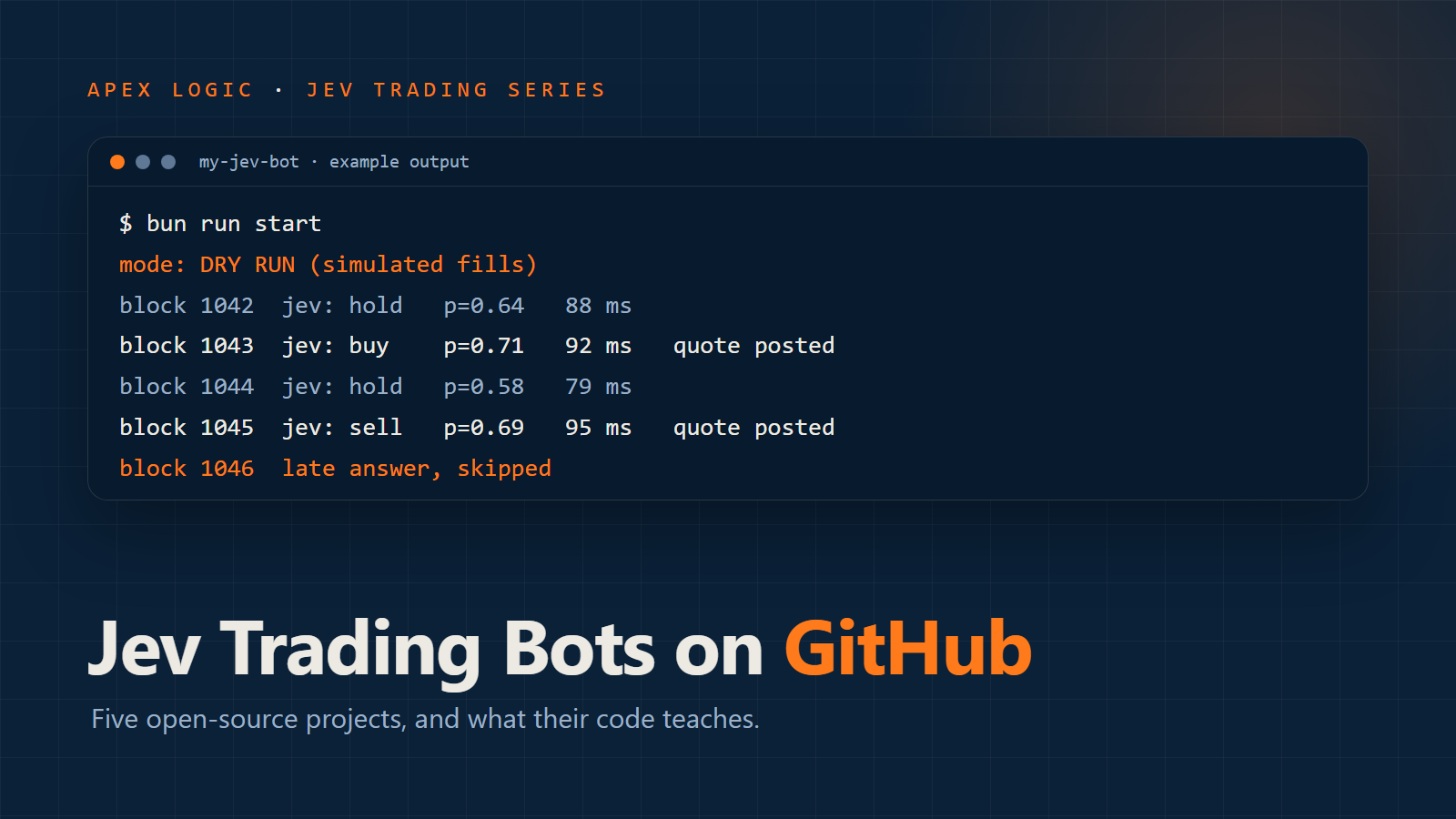
- Jev Trading Bots on GitHub: what developers built in the first two weeks, and the lessons they share.
For the wider picture on model costs, see how to estimate and cut your LLM API bill. If you want a Jev-powered tool built properly, such as a signal filter, a pre-trade check or a news classifier, talk to us.
Jev AI FAQ
What is Jev AI?
Jev is an AI model from TypeSafe AI that returns typed answers, probabilities and confidence scores instead of text. It is built for software to use directly, for fast decisions such as classifying, scoring and routing.
Who made Jev?
TypeSafe AI, a San Francisco company founded in 2024 by Diogo Almeida, Erik Gafni and Sasha Sheng. Almeida previously worked at OpenAI on InstructGPT, ChatGPT and GPT-4.
How much does Jev cost?
TypeSafe lists Jev at $0.042 per million input tokens, or $42 per billion, with output tokens free. Access is through an early-access waitlist, and prices may change.
Is Jev good for trading?
Jev is good at fast, narrow judgements, such as filtering signals, labelling market regimes or checking trades against rules. It is not a price predictor, and it cannot do maths. Use it inside a system where code handles calculations, risk limits and orders.
Can Jev read charts?
No. Jev accepts text and JSON only. Send the numbers behind the chart, turned into labels, or use a vision model for images.
Is Jev the same as ChatGPT?
No. ChatGPT is a large language model that writes text. Jev cannot write at all. It picks from answers you define and tells you how sure it is. Many systems will use both.
Sources
- TypeSafe: Introducing System One Models and Jev
- TypeSafe docs: Models, pricing and rate limits
- TypeSafe docs: Jev 1.13 known weaknesses
- Bloomberg: Jev, an AI Model That Can't Chat, Takes On Bigger Rivals
- TechCrunch: A new kind of AI model from a ChatGPT inventor is thrilling developers
- Wikipedia: Jev (AI model)
- sosopop/jev_stock on GitHub
Comments