Related: Jev AI for Trading: What TypeSafe's New Model Can and Cannot Do
General information about AI tools, not financial advice.
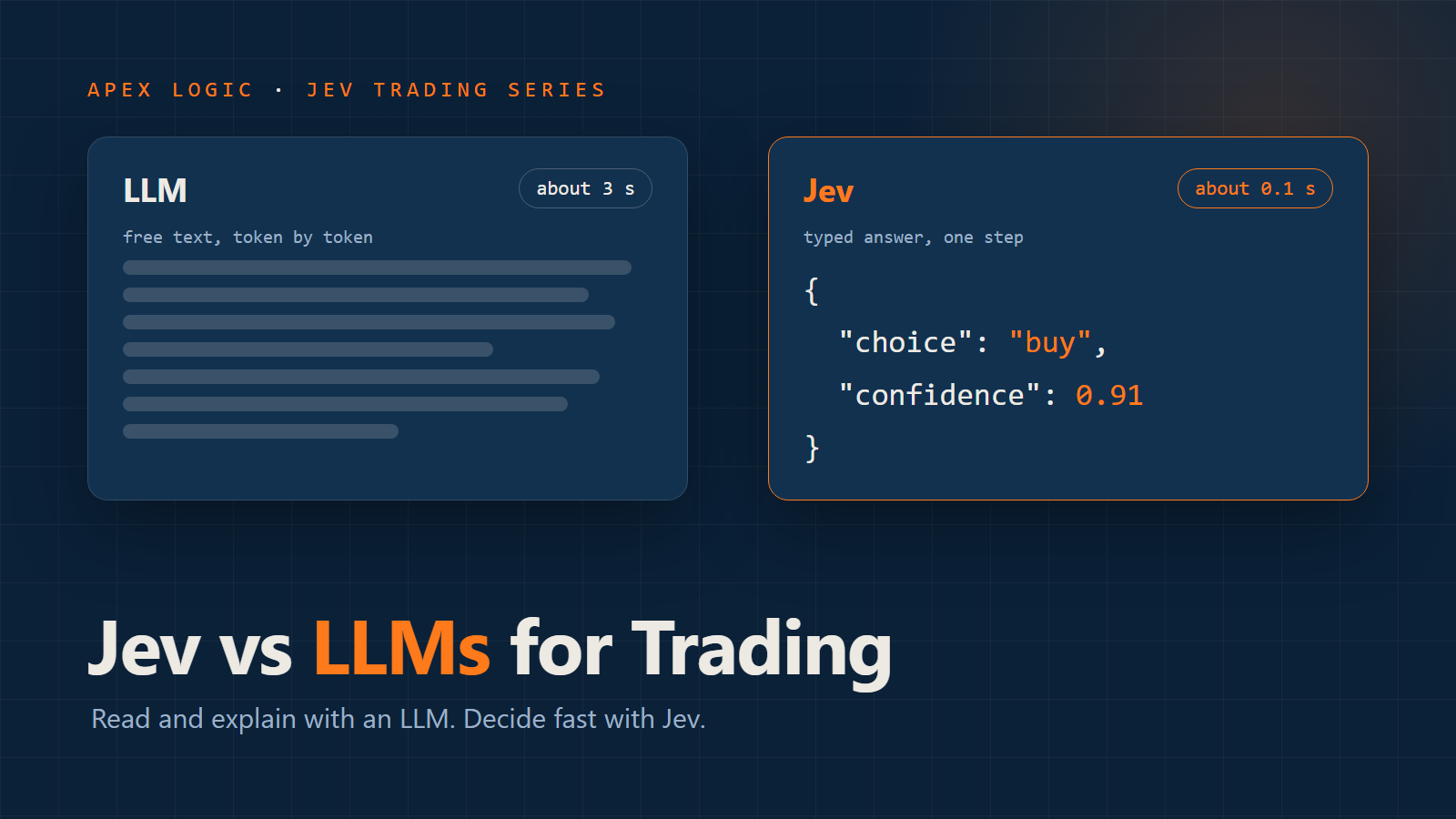
Since TypeSafe AI released Jev in September 2026, one question keeps coming up: should it replace ChatGPT, Claude or Gemini in a trading tool? Usually, no. Jev and large language models (LLMs) do different jobs. This comparison explains which does what, and how to use them together. For background, start with Jev AI for trading.
Jev vs LLMs: the short version
- LLMs such as ChatGPT, Claude and Gemini read, write, reason and explain. They are flexible, but slow and costly at high volume.
- Jev answers narrow, typed questions very quickly, with probabilities. It cannot write, and it cannot see images.
- Code does the maths, the risk management and the orders. Neither model should.
Jev vs ChatGPT side by side
| LLMs (ChatGPT, Claude, Gemini) | Jev | |
|---|---|---|
| Output | Text, or structured output the model can still get wrong | Typed values chosen from options you define, with probabilities |
| Speed | Usually seconds, longer for reasoning models | 70 to 500 ms, as quoted by TypeSafe |
| Price | You pay for input and output, and output usually costs several times more. TypeSafe's comparison used $0.20 to $10 per million input tokens | $0.042 per million input tokens; output is free |
| Inputs | Text, plus images for vision models | Text and JSON only |
| Knowledge | Broad general knowledge, up to a cut-off date | Assume none; put everything it needs in the state |
| Maths | Unreliable without tools | Not a calculator, by TypeSafe's own description |
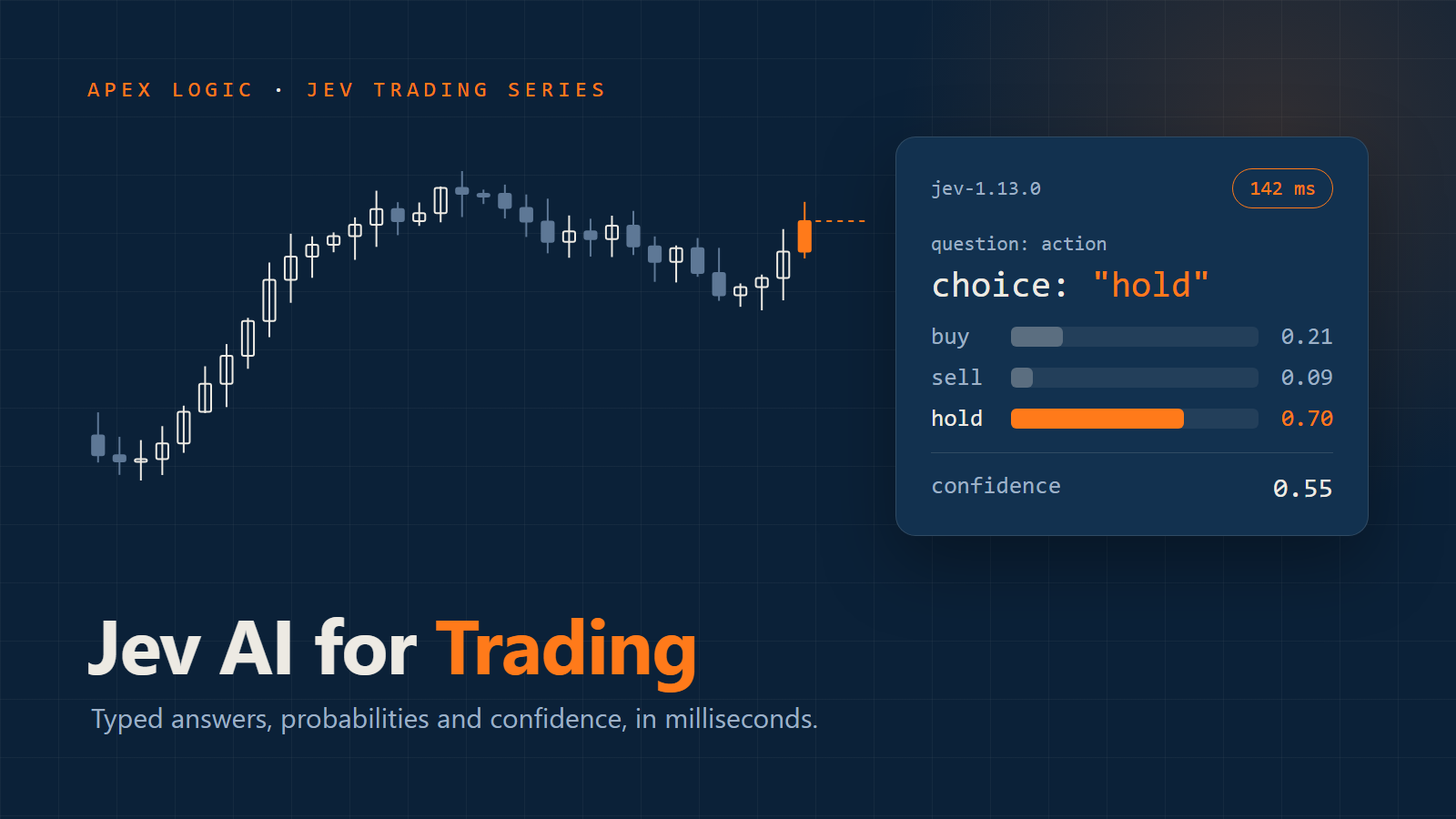
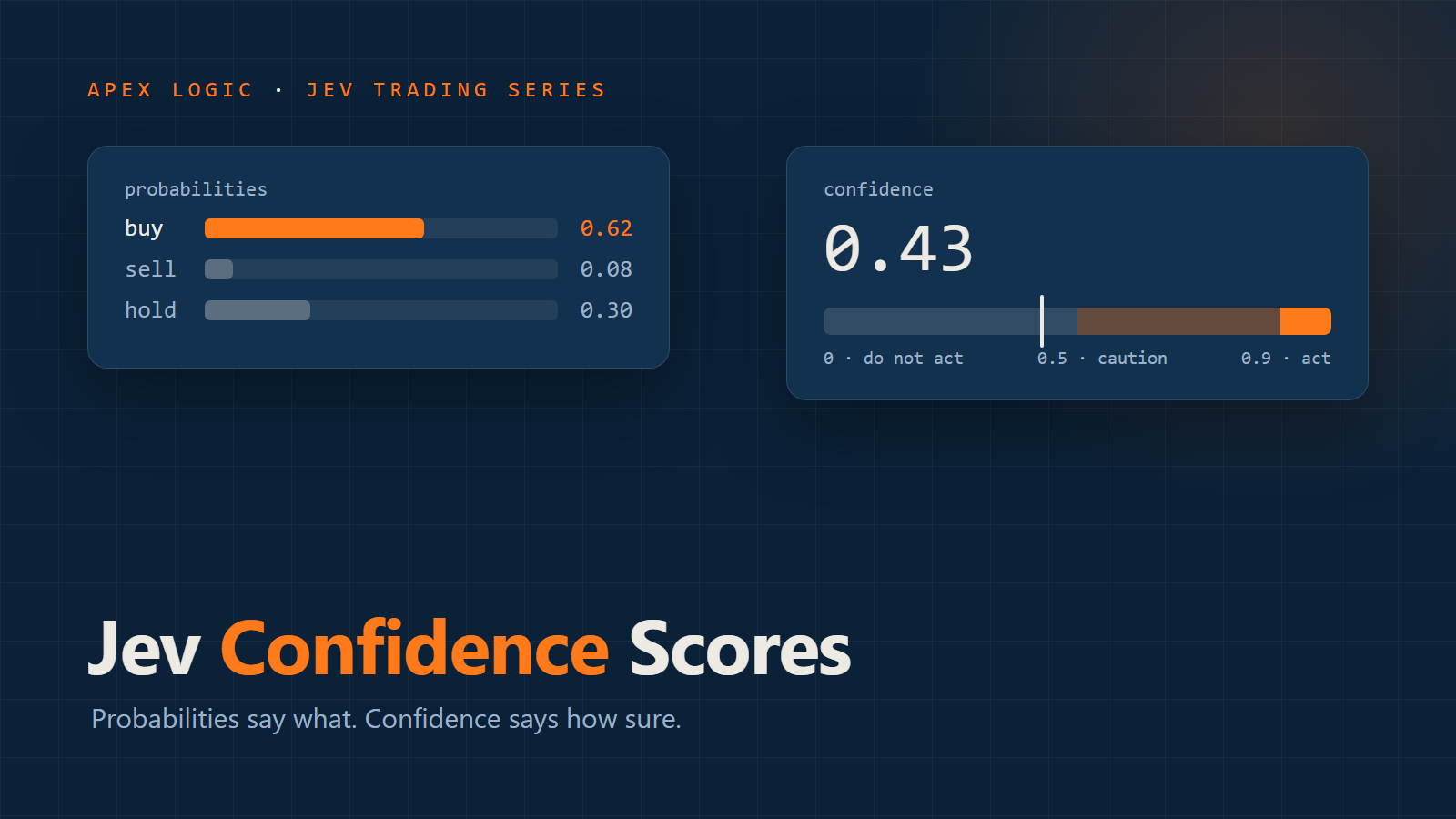
| Uncertainty | Not built in; self-reported confidence is often unreliable | Probabilities and confidence on every answer |
| Maturity | Years of production use | Early access since 15 September 2026 |
What early Jev users report
Independent evidence is still thin, but the first reports point the same way:
- Vercel told TechCrunch it uses Jev to classify commands for safety, and found it 5 to 18 times faster than the OpenAI model it had been using, with better accuracy.
- Bryo AI tested Jev on business email classification and found it 10 to 20 times cheaper than Gemini, with Gemini slightly more accurate.
- One developer's public test on BANKING77, a standard dataset of banking customer questions, scored Jev at 92.40 percent against 93.66 percent for a fine-tuned BERT model. The final test of 3,080 messages cost 44 cents. The author notes that the data is public, so Jev may have seen it in training, and that the test used labelled examples rather than starting cold.
The pattern: on narrow classification, Jev comes close to heavier models, for a fraction of the time and cost. None of these are trading results.
Jobs for Jev in a trading system
- Headline and filing triage. Is this headline about this company? Is it material? Positive, negative or neutral? At 300 tokens a headline, 10,000 headlines a day is 3 million tokens: about 13 cents at Jev's listed price.
- Market regime labels from indicators you compute in code.
- Pre-trade checks. Does this order fit the strategy's rules, the current exposure and the budget? QuantDinger, an open-source trading platform, added Jev for exactly this.
- Routing. Decide which items deserve a slower LLM analysis, and which need a person.
- Parsing trading commands. TypeSafe's function-calling example turns "biggest losers today" into
top_movers(window='1d', direction='losers')with 0.98 confidence, using only argument values the function accepts. - Auditing another model. Does an LLM's written thesis actually support the direction it chose?
Jobs for an LLM
- Reading long documents: earnings call transcripts, annual reports, central bank statements.
- Writing: research notes, trade journals, client updates.
- Looking at charts with a vision model. Jev cannot.
- Open-ended research: "What could explain this move?"
- Writing and reviewing the code for your strategy.
Jobs for neither
- Indicator maths, profit and loss, and position sizing.
- Placing, cancelling and tracking orders.
- Stop losses and hard risk limits.
- Anything that must keep working when an API is down.
Three ways to combine Jev and an LLM
1. The LLM decides, Jev audits
A developer on DEV Community runs a forex bot where Gemini reads charts every hour and calls the direction with a one-line reason. Jev then checks whether the reason actually supports the call, at what the author estimates is a fraction of a cent per decision. The plan is to measure whether inconsistent calls lose more, and to drop Jev if they do not.
2. Jev filters, the LLM goes deep
Jev screens every headline in real time. Only the few that are relevant and material go to an LLM for a proper summary and a note a person can read. You pay LLM prices only for the items that matter.
3. Jev in the loop, the LLM after hours
The live trading loop uses only code and Jev, for speed and predictability. After the close, an LLM reads the day's decision log and writes a plain-English report for a person to review.
Which should you start with?
- If the problem is reading or explaining, start with an LLM.
- If it is the same narrow judgement, thousands of times, try Jev.
- If it is a number, write code.
For the cost side of LLMs, see how to estimate and cut your LLM API bill and open-weight LLMs vs API models. To build the Jev side, read how to build a Jev AI trading bot. If you want a hybrid Jev and LLM tool built, talk to us.
Jev vs ChatGPT FAQ
Is Jev better than ChatGPT?
They are built for different jobs. Jev is faster and far cheaper for narrow, repeated decisions with fixed answers. ChatGPT is far more capable at reading, writing, reasoning and explaining. Many systems will use both.
Can Jev replace ChatGPT in a trading bot?
Only for the parts that are narrow, typed decisions, such as classifying headlines or labelling a market regime. Anything that needs long documents read, text written or charts examined still needs an LLM.
Is Jev cheaper than GPT, Claude or Gemini?
Per token, yes, by a wide margin. Jev lists input at $0.042 per million tokens with free output. The LLM input prices TypeSafe compared against ranged from $0.20 to $10 per million, before output costs.
Can Jev analyse chart images?
No. Jev accepts text and JSON only. Send it the numbers behind a chart, turned into labels, or use a vision-capable LLM for images.
Comments