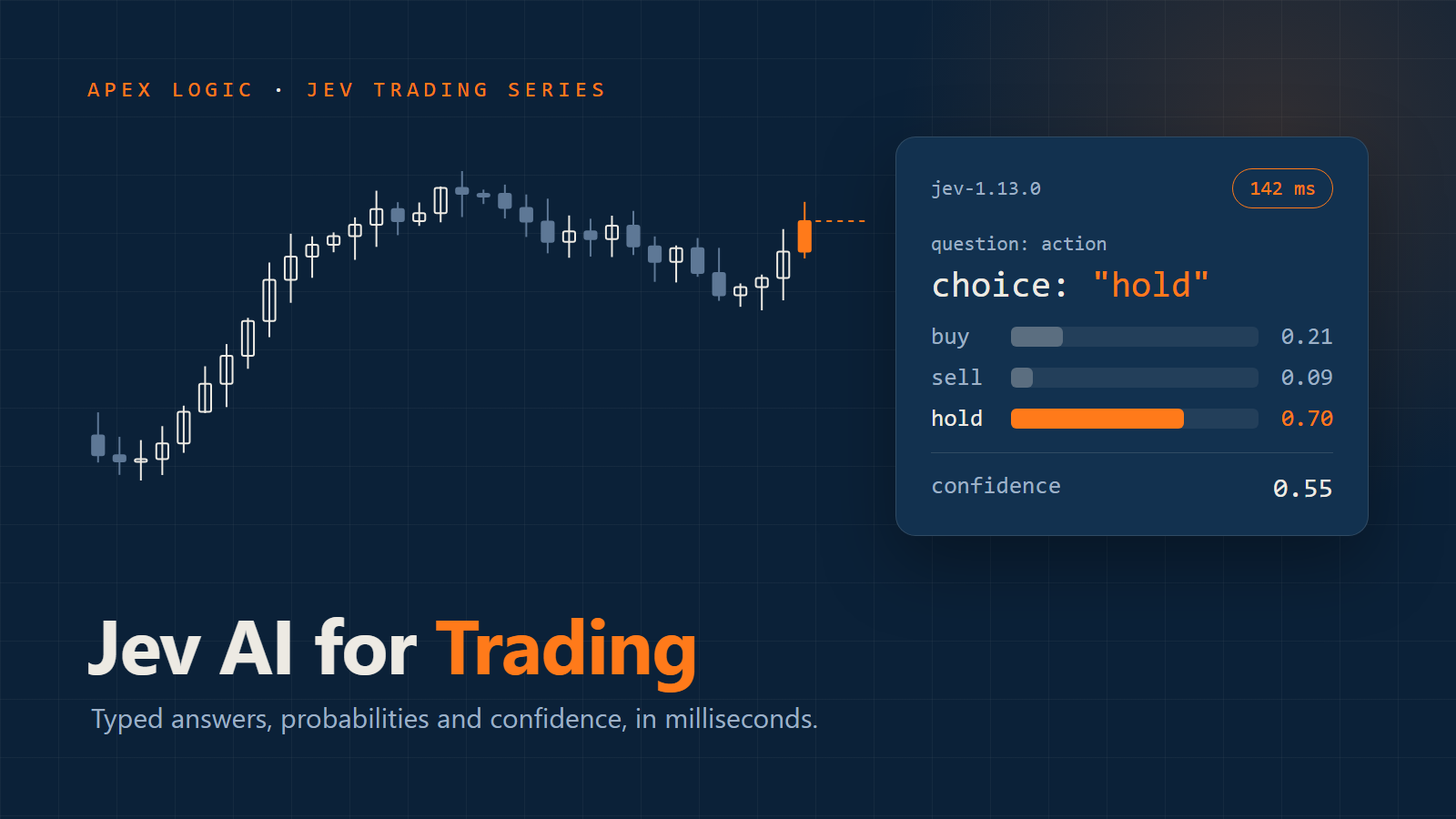
Related: Jev AI for Trading: What TypeSafe's New Model Can and Cannot Do
This article describes open-source software for information only. It is not financial advice and not an endorsement of any project. Read a bot's code before running it, and never give software a funded private key or exchange API key you have not reviewed.
TypeSafe AI released Jev on 15 September 2026. By 20 September, a public survey of GitHub counted more than 15 active finance and trading projects built on it. Here are five of the most instructive Jev trading bots, what each one does, and the lessons they share. The details come from each project's own README as of late September 2026. Open-source projects change quickly, so check the latest version.
New to Jev? Start with Jev AI for trading.
1. jarrodwatts/jev-trader: a market maker on Monad
- Market: MON-USDC on Kuru, an exchange on the Monad blockchain.
- What Jev decides: buy, sell or hold, once per block, roughly every 300 milliseconds.
- Orders: one post-only limit order per block, placed inside the best price, with resting orders cancelled and replaced each block. The aim is to earn the spread rather than pay it.
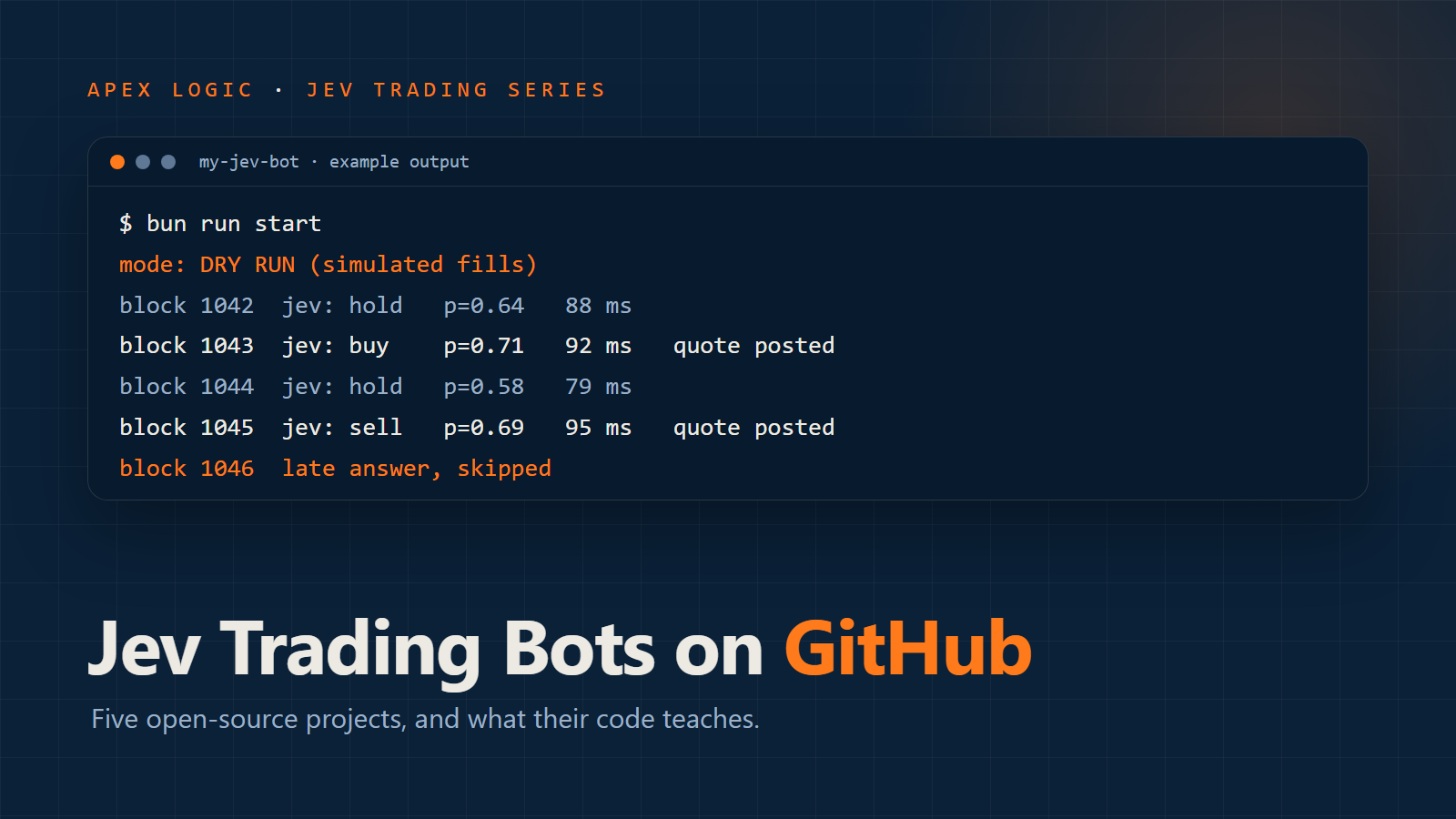
- Safety: it runs in dry-run mode unless you set a private key. It then reads the real order book and makes real decisions, but only simulates fills. It skips any decision that arrives after its block has closed.
- Stack: TypeScript on Bun, MIT licence.
The survey treats it as the reference design, and many later projects borrow its shape.
2. aowang-ai/jev-trade: five markets on Hyperliquid
- Markets: BTC, ETH, SOL, DOGE and BNB on Hyperliquid, each with its own isolated wallet.
- What Jev decides: first long or short, then open, close or hold. Hold is a valid answer.
- Cadence: every 2 seconds by default.
- Orders: entries as maker quotes one tick inside the best price. Exits cross the spread for an immediate fill, with slippage capped at 5 basis points.
- Safety: quote size defaults to $40, dry run is the default, and switching to real trading takes a deliberate setting.
3. buberlo/jev-trader: the most careful design
- Stack: Python.
- State: a feature engine in code compresses the market into a snapshot under 400 tokens.
- What Jev decides: six separate judgements: market regime, direction, toxic order flow, liquidity stress, quote environment and inventory pressure.
- Control: a policy engine applies thresholds, then hard risk rules with an absolute veto, plus a kill switch.
- Fallbacks: a ladder from normal trading, to smaller size, to holding, to a rules-only fallback, to closing everything if a limit is breached.
- Calibration: it logs every state, decision and outcome, and reports Brier score, log loss, expected calibration error and reliability curves.
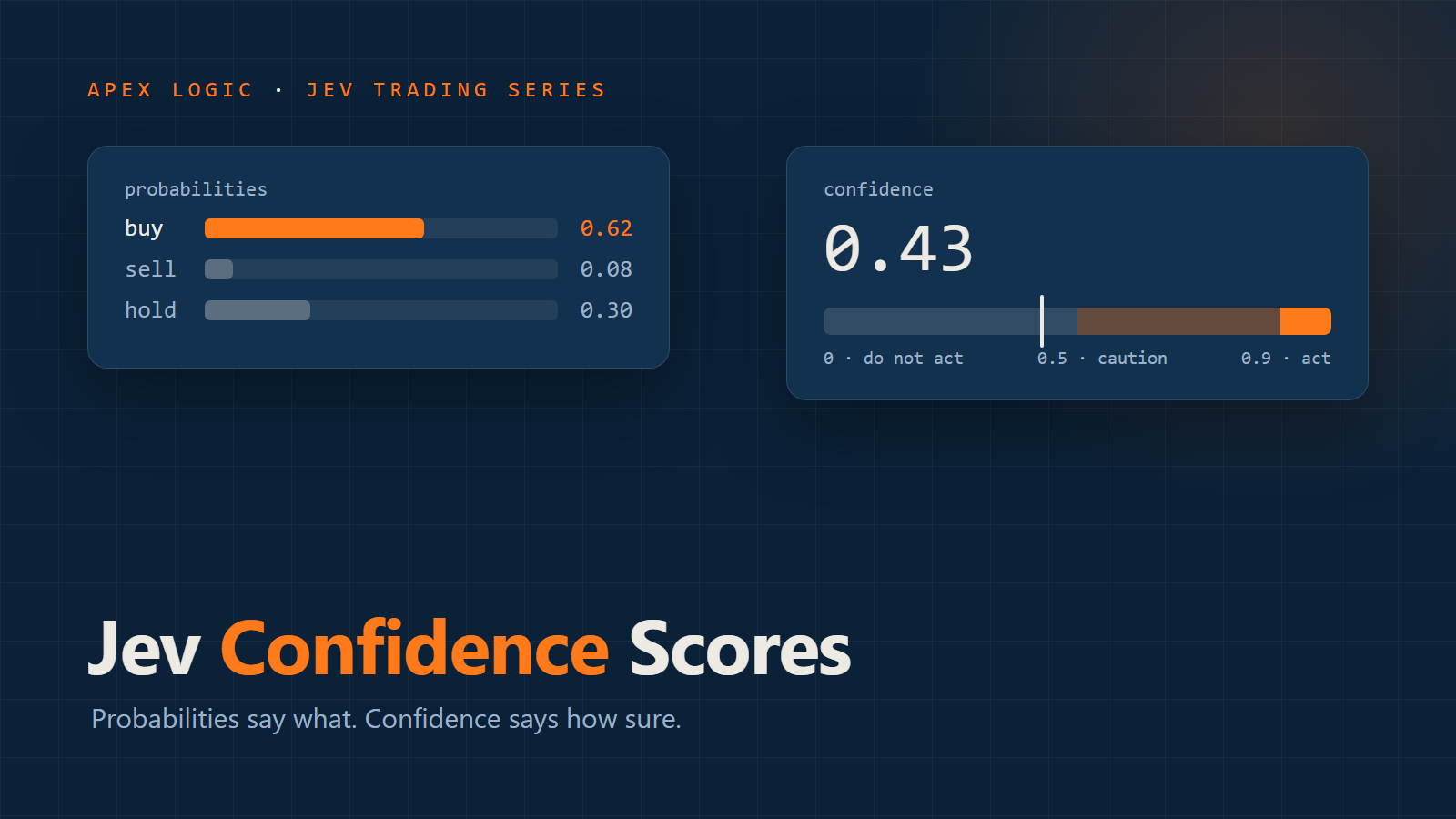
If you study one Jev trading bot, study this one. It treats the model as one noisy input among many, which is exactly right. Our guide to Jev confidence scores explains why the calibration logging matters.
4. OpenByteInc/QuantDinger: Jev as a pre-trade gate
- What it is: an open-source AI trading platform for crypto, stocks and forex, and the largest project in the survey by GitHub stars.
- What Jev decides: whether a live entry order should go ahead. Before an order reaches the exchange, QuantDinger sends Jev the order, strategy context, exposure, positions and budget, and gets back a typed choice with probabilities and confidence.
- Failure rules: if Jev times out or returns something invalid, the order goes ahead and the reason is logged. Exits, stop losses and take profits skip the AI check entirely, so a provider outage cannot trap a position.
This is Jev at its most practical: not a strategy, but a fast, cheap second check in front of one.
5. sosopop/jev_stock: stock forecasts with honest results
- Market: Hong Kong stocks, with the Hang Seng Index and the Hang Seng TECH Index as context. Data comes from AKShare.
- What Jev decides: up, flat or down for the next trading day, where "flat" means within 0.3 percent, and for a 30-day horizon, where "flat" means within 2 percent.
- Output: self-contained HTML reports with probability bars and indicators.
- Results: in the author's backtest, 54 of 120 next-day calls were right, or 45.0 percent, ranging from 30.0 to 56.7 percent across four stocks.
The author presents this as one historical window, not a promise, and says the forecasts need testing against simple baselines. That honesty is worth copying. Before trusting any forecast, compare it with a naive rule, such as always predicting the most common outcome.
Bonus: an LLM bot with a Jev auditor
Not on GitHub, but worth reading: a developer on DEV Community describes a forex bot where Gemini reads charts every hour and calls the direction, and Jev checks whether the stated reasoning supports the call. The results are logged for later analysis, and the author set the success bar in code before the first result. They are also candid that an earlier account hit its maximum drawdown limit. Trading with AI is hard, whichever model you use.
What the best Jev trading bots have in common
- Jev judges, code executes. No project lets Jev place orders directly.
- Paper trading by default. Real orders need keys you set on purpose.
- A small, labelled state. Features are computed in code and kept compact.
- Maker orders. Most quote limit orders rather than chasing the price.
- Honest disclaimers. None of these projects has shown lasting profits, and the careful ones say so.
The survey also noted gaps. As of 20 September, no projects covered prediction markets, arbitrage, dedicated forex trading or DeFi strategies.
Before you run any Jev bot
- Read the code, especially anything that touches keys or places orders.
- Start on a testnet or in dry-run mode.
- Use a separate wallet or sub-account holding only a small amount.
- Never paste your main wallet's private key into a bot.
- Be wary of hype. TypeSafe sells API access to a model. Treat any "Jev signals" group, Jev-branded token or paid Jev bot with suspicion unless you can verify it yourself.
To build your own, follow how to build a Jev AI trading bot. If you want one built properly, with tests, calibration logs and risk controls, talk to us.
Jev trading bots FAQ
Is there an official Jev trading bot?
Not one that TypeSafe has announced. TypeSafe provides the Jev model through an API. The trading bots on GitHub are independent projects by outside developers.
Are open-source Jev trading bots profitable?
None has shown lasting profits so far. Most run in paper mode by default, and the careful ones say plainly that they are research software. Treat any profit claim with caution.
Which exchanges do Jev trading bots use?
Early projects trade crypto on Kuru, Hyperliquid and Kraken, and at least one forecasts Hong Kong stocks. Jev itself works with any market, because it only sees the state your code sends it.
Do I need a Jev API key to try these bots?
For real Jev decisions, yes. Some bots include a mock model or a paper mode that runs without a key, so you can see how they work first.
Comments