Updated 16 October 2026. Microsoft announced Microsoft-Decision-1 on 9 October and TypeSafe released Jev 1.14 on 14 October; this comparison adds OpenAI's Decisions API beta.
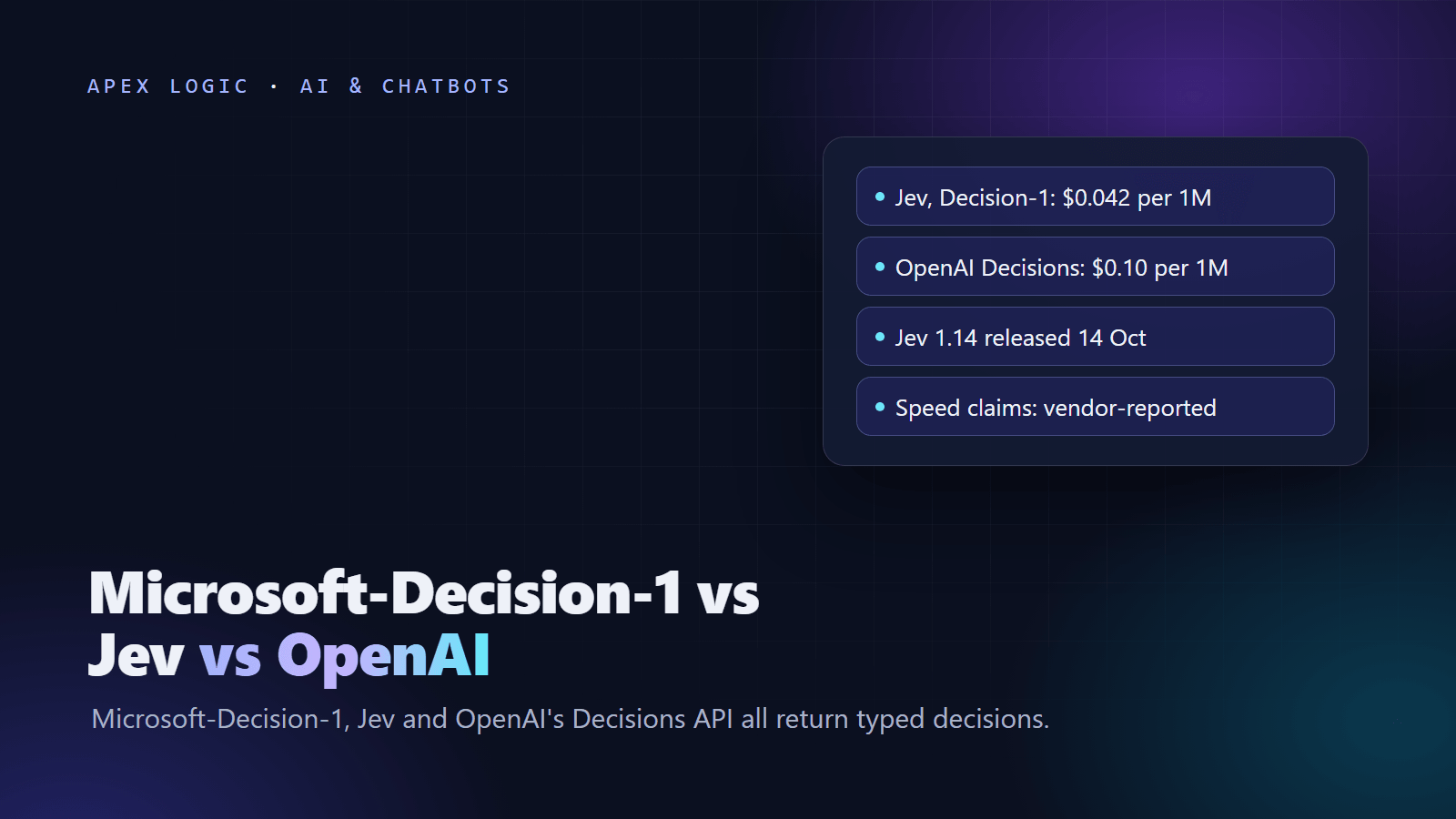
Microsoft-Decision-1, Jev and the OpenAI Decisions API do the same job: they answer typed questions about your data with probabilities and write no text. As of 16 October 2026, Microsoft-Decision-1 and Jev both list $0.042 per 1M input tokens with free output. OpenAI's Decisions API costs $0.10 per 1M input tokens, charges nothing for output, and is in public beta.
The short verdict: Microsoft-Decision-1 if you run on Azure, the OpenAI Decisions API if you build on OpenAI and need image input now, and Jev for a standalone API whose request format other models follow. Speed and accuracy figures are vendor-reported or come from one outside test, so decide on how each scores on your own labeled examples.
Comparison table
| Microsoft-Decision-1 | Jev | OpenAI Decisions API | |
|---|---|---|---|
| Maker | Microsoft | TypeSafe AI | OpenAI |
| Launched | 9 October 2026 | 15 September 2026; 1.14.0 on 14 October | Preview 29 September (InfoQ); beta 6 October 2026 |
| Status | In Foundry and on OpenRouter; preview or GA unclear | jev-latest is 1.13.0; 1.14.0 via jev-preview | Public beta; GA expected within weeks, no date |
| Input price per 1M tokens | $0.042 | $0.042 | $0.10 |
| Output | Free | Free | Not charged |
| Speed claim (vendor) | About 35x faster median latency than GPT-6 Sol | 70 to 500 ms end to end | About 10x faster than the Responses API |
| Context | Not on Microsoft's pages; third parties report 32,768 tokens | 64k per request, 32k per question; 262k opt-in | Not stated in the guide |
| Question types | noul, choice, score | noul, choice, score, experimental box | predicate, choice, score |
| Images | Not documented | Experimental, opt-in header | Yes, base64 data URLs only |
| Underlying model | Post-trained from Qwen3.5-9B | Not disclosed | gpt-6-luna |
| Access route | Foundry deployment, /providers/microsoft/v1/systemone | api.typesafe.ai/v1/systemone | /v1/decisions |
Prices and status are as of 16 October 2026, from each vendor's own pages unless marked otherwise.
What the three have in common
All three take the information to judge (the state for TypeSafe and Microsoft, the input for OpenAI) plus typed questions, and return probabilities, a chosen option or a score. That makes them fast and cheap enough for every ticket or agent step. Our Jev model guide explains the idea, and Jev vs ChatGPT covers when you still need a chat model.
The formats differ. Jev and Microsoft-Decision-1 take a state and named questions with a type, instructions and, where needed, criteria, a pattern Microsoft calls similar to a system-one API. OpenAI takes input and a questions array and calls its yes-or-no type predicate, not noul, so switching means rewriting the request code.
Microsoft-Decision-1: what Microsoft shipped
Microsoft announced it on 9 October 2026 in a post by Achint Srivastava, VP of Software Engineering in the Office of the CTO. It is a decision-scoring model that returns a calibrated probability for each option in a fixed set and writes no text. Stated uses: routing, classification, prioritization, verification, workflow control, and rubric grading of AI answers and agent actions.
- Base model: post-trained from Alibaba's Qwen3.5-9B; Microsoft plans to rebase later versions on Microsoft AI (MAI) and OpenAI models.
- Price and access: $0.042 per 1M input tokens with free output, as of 16 October 2026, in Microsoft Foundry and on OpenRouter.
- Endpoint: your Foundry resource endpoint plus
/providers/microsoft/v1/systemone. Themodelfield takes your deployment name. - Sign-in: Microsoft Entra ID (recommended) or an
api-keyheader. - Deployment: Foundry model catalog or Azure CLI, SKU
GlobalStandard;DataZoneStandardin selected regions keeps processing inside a data zone. You need an Azure subscription with a payment method and the Cognitive Services Contributor role.
Microsoft's own claims
Microsoft reports the highest accuracy in a 36-benchmark comparison of nearly 150,000 questions kept out of training, about 35x faster median latency than GPT-6 Sol, 2.5x faster than the runner-up H2O-Lightning-4B v1.1, and answer changes on 1.3% of input perturbations on average. It says Xbox Research sorted over 10,000 pieces of player feedback with quality competitive with GPT-6 Sol, over 14x faster and 200x cheaper.
All of this is self-reported. The charts compare against Jev 1.13.0, not 1.14.0. On calibration, the page states a goal (a 90% prediction right about 9 times in 10), not a measured result. Rivals in the appendix include GPT-6 Luna Decisions, Strands-Decider 2B and H2O-Lightning-4B, and the page was later updated with JevBench accuracy and calibration results.
What is still unconfirmed
- Preview or GA: a Foundry blog post is titled as a public preview, but we could not open it. One third-party post says GA came on 8 October. Microsoft's Learn page does not say, so we call it available in Foundry.
- Context window: third parties report 32,768 tokens; we found no figure on Microsoft's pages.
Microsoft's listed limits: possible bias from the base model, scores that change with wording and option order, calibration strongest on familiar tasks, no explanations, and missed subtle harmful content. It says not to use the model as the only decision-maker for credit, jobs, housing, health or legal matters.
Jev and what changed in Jev 1.14
TypeSafe AI launched Jev on 15 September 2026 as its first System One model: fast, typed decisions instead of text. It costs $42 per billion input tokens ($0.042 per 1M), with free output, at POST https://api.typesafe.ai/v1/systemone. Several questions can share a call, each evaluated in parallel against the same state. TypeSafe claims 70 to 500 ms end to end.
Jev 1.14.0, available since 14 October 2026, brings these changes:
- New
boxtype: returns a bounding box; experimental, 1.14.0 only. - Opt-in images: a "danger zone" feature behind the
TypeSafe-Danger-Zone-Images: trueheader. - Opt-in long context:
TypeSafe-Danger-Zone-Long-Context: truelifts the default 64k per request and 32k per question to 262k, with slower, less accurate results. - Not for production yet: TypeSafe does not yet trust the danger zone features for production use.
- Small quality changes: slightly better overall, with the biggest expected gain in multilingual use, and no figures published.
- Same price: $0.042 per 1M input tokens.
jev-preview points to 1.14.0, while jev-latest stays on 1.13.0 until about 21 October, one week after release. TypeSafe promises 60 days' notice before deprecating 1.13.0 (30 days for 1.14.0). If you tuned confidence thresholds, pin a versioned id, as TypeSafe's docs recommend, and retest before switching.
Outside reports: AlphaSignal says 1.14 image input takes PNG or JPEG, 16 MiB per image, 256 to 1,568 px per side and 32 MiB per request, figures we did not find on TypeSafe's models page. The Artificial Index reports that Workday uses Jev to power its Sana home experience. Red Hat notes that Jev's parameter count is undisclosed.
OpenAI Decisions API in brief
POST /v1/decisions runs on gpt-6-luna only. InfoQ reported a DevDay preview on 29 September; OpenAI's changelog lists the beta on 6 October and native GPT-Live support on 15 October. It costs $0.10 per 1M input tokens, nothing for output or caching, takes text plus base64 images, and offers Zero Data Retention and HIPAA for eligible customers. Our OpenAI Decisions API tutorial walks through a first request.
Speed and accuracy claims, side by side
| Claim | Source |
|---|---|
| Microsoft-Decision-1: about 35x faster median latency than GPT-6 Sol, 2.5x faster than H2O-Lightning-4B v1.1 | Microsoft |
| Jev: 70 to 500 ms end to end | TypeSafe |
| OpenAI Decisions: about 10x faster than the Responses API, no benchmark published | OpenAI |
| OpenAI Decisions: about 150 ms against 1.6 s for a normal Luna call, from a DevDay slide | Firecrawl, describing the slide |
| Jev median latency of 524.1 ms, against 209.3 ms for Cloudflare's open Clef model | Cloudflare |
| Jev at 86.35% and 348 ms on prompt injection, against 89.01% and 54 ms for a small DeBERTa classifier | Red Hat |
No shared test covers all of these, so they cannot be ranked. Red Hat's 2 October study is the best outside check so far: decision models did not reliably beat small pre-trained classifiers or LLM judges on prompt-injection and content-safety tasks. Jev came fourth on prompt injection but first on content safety, at 86.20%. For one narrow filter, a small trained classifier may be enough.
What the same workload would cost
A hypothetical workload at list prices as of 16 October 2026: 1 million decisions a month at 600 input tokens each, or 600M input tokens.
| Service | Input price per 1M tokens | Model cost per month |
|---|---|---|
| Microsoft-Decision-1 | $0.042 | $25.20 |
| Jev | $0.042 | $25.20 |
| OpenAI Decisions API | $0.10 | $60.00 |
Real bills differ: the same text may count as different numbers of tokens on each service, and OpenAI adds 10% for regional processing. At this volume, building and checking the workflow costs far more than the model, so accuracy matters more than the price gap. See our LLM API costs guide for a full estimate.
Verdict by use case
Your systems run on Azure
Choose Microsoft-Decision-1. It deploys in your Foundry resource, works with Entra ID, and offers DataZoneStandard in selected regions. Confirm its status and context limit first.
You already build on OpenAI
Choose the OpenAI Decisions API if you need image input today, use GPT-Live, or need Zero Data Retention, HIPAA support or US or European data residency. It is a beta and costs more per token.
You want a standalone, portable API
Choose Jev. It has been on the market longest, offers versioned ids with deprecation notice, and others follow its format: Microsoft calls its pattern similar to a system-one API, and Cloudflare says its open Clef model is fully compatible with the Jev API. Keep the danger zone features out of production.
Your data cannot leave your servers
None of the three runs on your hardware. See our guide to open-source Jev alternatives such as Clef, Strands Decider and pplx-decider.
Checks inside AI agents
Microsoft lists grading agent actions and OpenAI lists choosing an agent's next action, so match the API to your agent's stack; AI agents for business shows where such checks sit.
Decisions about people
For credit, jobs, housing, health or legal matters, let none of them decide alone. Microsoft says so about its own model, and the caution applies to all three.
How to test before you choose
- Label real examples from your own workflow.
- Write the same questions for each service, with clear option descriptions and an "other" fallback.
- Run every example from the region where your app runs, and record accuracy and latency.
- Set thresholds by weighing false positives against false negatives, and send low-confidence cases to a person.
- Pin versions and retest after each release, such as Jev 1.14. Our Jev confidence scores article shows how to check that probabilities are honest.
Want help running this test, or building the routing around the winner? Get in touch. Apex Logic works on fixed quotes, and you keep all the code.
Microsoft-Decision-1 vs Jev FAQ
What is Microsoft-Decision-1?
It is a decision-scoring model that Microsoft announced on 9 October 2026. It returns a calibrated probability for each option in a fixed set and writes no text. It is post-trained from Qwen3.5-9B, runs in Microsoft Foundry and on OpenRouter, answers noul, choice and score questions, and costs $0.042 per 1M input tokens as of 16 October 2026.
Is Microsoft-Decision-1 cheaper than Jev?
No. As of 16 October 2026, both list $0.042 per 1M input tokens with free output, while OpenAI's Decisions API costs $0.10. Your real bill also depends on how many tokens each service counts for the same text, so compare costs with your own requests rather than list prices alone.
What changed in Jev 1.14?
Jev 1.14.0, available since 14 October 2026, adds an experimental box type for bounding boxes and makes image input and long context opt-in danger zone features behind headers. Long context reaches 262k tokens but is slower and less accurate. TypeSafe says these features are not yet trusted for production. The price is unchanged.
Is Microsoft-Decision-1 better than Jev?
Microsoft says so on its own benchmarks, but those compare against Jev 1.13.0, not 1.14.0, and we have not found an independent test covering both. Its calibration statement is a goal, not a measured result. Treat the claims as a reason to test, and run both models on your own labeled examples.
Which decision API is fastest?
No shared test shows that. Microsoft reports about 35x faster median latency than GPT-6 Sol, TypeSafe claims 70 to 500 ms for Jev, and OpenAI says Decisions is about 10x faster than its Responses API, without a published benchmark. Network distance matters too, so measure from the region where your app runs.
Can I use Microsoft-Decision-1 outside Azure?
Microsoft lists it on OpenRouter as well as in Foundry. On Foundry you need an Azure subscription with a payment method and the Cognitive Services Contributor role, and you call your own resource's endpoint with your deployment name. Check OpenRouter's listing for its current terms, since our figures come from Microsoft's pages.
Sources
- Microsoft Command Line blog: Microsoft-Decision-1
- Microsoft Learn: Deploy and use Microsoft-Decision-1 in Microsoft Foundry
- TypeSafe: Introducing System One models and Jev
- TypeSafe blog: Jev 1.14
- TypeSafe docs: Jev models and pricing
- TypeSafe docs
- OpenAI API docs: Decisions guide
- OpenAI API changelog
- Cloudflare blog: Clef decision models
Loading comments...